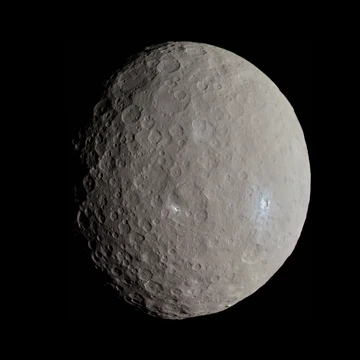
704 Interamnia
Fifth-largest asteroid, possibly a dwarf planet in equilibrium.

704 Interamnia is a large F-type asteroid orbiting in the main belt. With an average diameter of about 330 kilometers, it ranks as the fifth-largest asteroid known, trailing only Ceres, Vesta, Pallas, and Hygiea. Its mass likely falls between the fifth and tenth highest in the belt, accounting for roughly 1.2% of the total mass of all asteroids there. It orbits the Sun at an average distance of 3.067 AU.
Discovered on October 2, 1910, by Vincenzo Cerulli, the asteroid was named after the Latin name for Teramo, Italy, where Cerulli worked. Observations made with the Very Large Telescope’s SPHERE imager between 2017 and 2019, combined with occultation data, suggest that Interamnia’s shape may be consistent with hydrostatic equilibrium for a body of its density if it had a rotation period of 7.6 hours. However, its current rotation period is 8.7 hours. This mismatch implies that Interamnia may have originally formed as an equilibrium body, but later impacts altered its spin after it fully solidified.
Despite being the largest asteroid after the “big four,” Interamnia remains poorly studied. It is by far the biggest F-type asteroid, yet before the 2017–2019 VLT observations, little was known about its internal composition or shape, and no light curve analysis has determined the ecliptic coordinates of its poles or its axial tilt. The VLT data give an average diameter of about 332 kilometers and reveal an ellipsoidal shape similar to that of 4 Vesta. The resulting density estimate of 1.98 ± 0.68 g/cm³ is too imprecise to pin down its composition, but the presence of hydrated materials on its surface and its spectral resemblance to Ceres suggest it is likely an icy body. The lack of an associated asteroid family indicates that Interamnia has not experienced a major impact in the last 3 billion years, unlike Vesta and Hygiea.
Its very dark surface and relatively large distance from the Sun make Interamnia invisible through 10x50 binoculars. At most oppositions, its apparent magnitude is around +11.0, fainter than the minimum brightness of Vesta, Ceres, or Pallas. Even at a perihelic opposition, it only reaches magnitude +9.9—over four magnitudes dimmer than Vesta.
No deep basins are visible in the VLT images. Any large craters must have flat floors, consistent with an icy C/F-type composition.
Mass estimates for Interamnia have varied widely.
Quick Facts
- Minorplanet
- yes
- Discoverer
- Vincenzo Cerulli
- Discovered
- 2 October 1910
- Mpc Name
- (704) Interamnia
- Pronounced
- ɪ · n · t · ər · ˈ · æ · m · n · i · ə
- Adjective
- Interamnian ɪ · n · t · ər · ˈ · æ · m · n · i · ə · n
- Named After
- Teramo
- Mp Category
- Main belt
- Epoch
- July 01, 2021 / (JD 2459396.5, heliocentric)
- Aphelion
- 3.53 AU
- Perihelion
- 2.58 AU
- Semimajor
- 3.056 AU
Facts from the source article.
Lore & Background
704 Interamnia was discovered on 2 October 1910 by Vincenzo Cerulli, who named it after the Latin name for Teramo, Italy, where he worked. It is the largest F-type asteroid, but until 2017–2019 very few details of its internal composition or shape existed. Observations by the Very Large Telescope's SPHERE imager in 2017–2019, combined with occultation results, indicate that its shape may be consistent with hydrostatic equilibrium for a body of its density with a rotational period of 7.6 hours (its current period is 8.7 hours). This suggests that Interamnia may have formed as an equilibrium body, and that impacts changed its rotational period after it fully solidified. Its very dark surface and relatively large distance from the Sun mean it can never be seen with 10x50 binoculars; at most oppositions its magnitude is around +11.0.
Reader's Guide
704 Interamnia is notable as the largest asteroid after the 'big four' and the largest F-type asteroid, yet it remains little-studied. The Very Large Telescope studies gave an average diameter of about 332 km and found an ellipsoidal shape similar to 4 Vesta. The resulting density calculation (1.98 ± 0.68 g·cm−3) is not precise enough to definitely infer its composition, but the presence of hydrated materials at the surface and its overall spectral similarities to Ceres suggest it is likely an icy body. The absence of an affiliated asteroid family implies that Interamnia has not suffered a giant impact within the past 3 billion years, in contrast to 4 Vesta and 10 Hygiea. Its mass estimates vary widely: Michalak in 2001 estimated (7±2)×10^19 kg; Baer in 2011 calculated (3.9±0.2)×10^19 kg; Goffin's 2014 reanalysis gave (2.7±0.1)×10^19 kg; and Hanuš et al. in 2019 consolidated 21 prior estimates into a metastatistical result of (3.8±1.3)×10^19 kg. The possibility that Interamnia may have formed as an equilibrium body suggests it could be a transition object between a dwarf planet and a typical irregular-shaped minor body.
Did You Know?
- Interamnia is the fifth-largest asteroid, after Ceres, Vesta, Pallas and Hygiea.
- Its shape may be consistent with hydrostatic equilibrium, suggesting it formed as an equilibrium body.
- It has no affiliated asteroid family, implying no giant impact in the past 3 billion years.
- Its mass is estimated to be 1.2% of the mass of the entire asteroid belt.
More in Planets and Dwarf Planets 1-24
Spotted an error? Know more?
Reader corrections go straight into our review queue. Suggest an edit · How this site is sourced