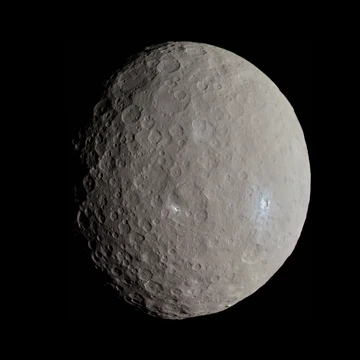
55565 Aya
A large, spheroidal Kuiper belt object and dwarf planet candidate.

55565 Aya (provisional designation 2002 AW197) is a large trans-Neptunian object in the classical Kuiper belt. It is notable as a dwarf planet candidate, with a diameter of 768+39−38 km, making it slightly smaller than the dwarf planet Ceres. Its brightness fluctuates very little as it rotates, indicating it is likely spheroidal.
Quick Facts
- Minorplanet
- yes
- Discovered
- 10 January 2002
- Discoverer
- Palomar Obs.The Minor Planet Center lists "Palomar" as the discoverer without listing specific people.
- Discovery Site
- Palomar Obs.
- Mpc Name
- (55565) Aya
- Pronounced
- ˈ · aɪ · ə
- Named After
- Aya
- Mp Category
- TNOclassical (hot)56 / distantScat-Ext
- Epoch
- 25 February 2023 (JD 2460000.5)
- Uncertainty
- 2
- Observation Arc
- 27.15 yr (9,915 d)
- Earliest Precovery Date
- 29 December 1997
Facts from the source article.
Lore & Background
Aya was discovered on 10 January 2002 by astronomers at Palomar Observatory in San Diego County, California, as part of the Caltech Wide Area Sky Survey using the 1.22-meter Samuel Oschin telescope. The discovery team included Michael Brown, Chad Trujillo, Eleanor Helin, Michael Hicks, Kenneth Lawrence, and Steven Pravdo. The object was found through manual vetting of potential moving objects identified by automatic image-searching software. At the time, it was the second-brightest Kuiper belt object known by absolute magnitude. The discovery was announced by the Minor Planet Center on 20 July 2002, and it received the permanent number 55565 on 16 February 2003. It was named Aya on 30 June 2025 after the Akkadian goddess of dawn.
Aya is a classical Kuiper belt object (cubewano) with a high orbital inclination of 24.4°, classifying it as a dynamically 'hot' member, likely scattered by Neptune's early migration. Its orbit has a semi-major axis of 47.2 AU, eccentricity 0.13, and a 324-year period, ranging from 41.1 AU at perihelion to 53.3 AU at aphelion. It last passed perihelion in July 1753 and will next do so in May 2078.
Physical characteristics include a diameter of 768+39−38 km from Herschel and Spitzer thermal measurements, a rotation period of about 8.8 hours (most likely 8.86±0.01 hours, though alias periods of 13.94, 6.49, and 15.82 hours are possible), and a dark, reddish surface with an albedo of about 11%. Its visible and near-infrared spectrum lacks obvious absorption features, suggesting tholins cover its surface. The object's brightness varies very little, indicating a spheroidal shape.
Reader's Guide
Aya is significant as one of the largest known trans-Neptunian objects, with a size comparable to the dwarf planet Ceres. Its likely spheroidal shape and size above 700 km make it a strong dwarf planet candidate, though the article notes that only 'some astronomers' consider it as such, reflecting ongoing debate. The object's high orbital inclination and classification as a dynamically 'hot' classical Kuiper belt object provide evidence for Neptune's early planetary migration, which scattered it to its current orbit. Its dark, reddish surface dominated by tholins is typical of many Kuiper belt objects, offering clues about surface chemistry in the outer Solar System. The discovery of Aya as part of the Caltech Wide Area Sky Survey, which also found Eris, Sedna, and Quaoar, highlights its role in the broader effort to map bright Kuiper belt objects. The naming after the Akkadian goddess of dawn connects it to ancient mythology, while its long observational arc of over 27 years (as of 2025) has allowed precise orbit determination.
Did You Know?
- Aya was the second-brightest Kuiper belt object known at the time of its discovery.
- Its diameter of 768+39−38 km makes it slightly smaller than the dwarf planet Ceres.
- The earliest pre-discovery observation of Aya is from an image taken on 29 December 1997.
- Aya's name comes from the Akkadian goddess of dawn, wife of the sun god Shamash.
More in Planets and Dwarf Planets 1-24
Spotted an error? Know more?
Reader corrections go straight into our review queue. Suggest an edit · How this site is sourced