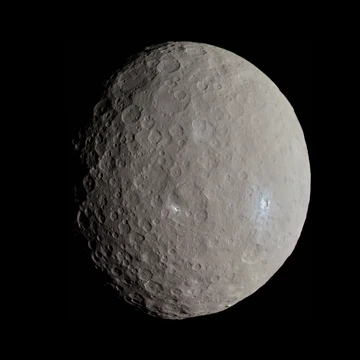
307261 Máni
A large Kuiper belt object with extreme topography.

307261 Máni, originally designated 2002 MS4, is a sizable icy body residing in the Kuiper belt, the ring of frozen debris beyond Neptune. Its diameter is roughly 800 km (500 mi), putting it in the range where it could qualify as a dwarf planet, but its irregular outline—similar to that of the asteroid Vesta—suggests it might not be one. The object is best known for its extreme surface features: a mountain-like peak rising 25 km (16 mi) high and a basin-like depression spanning 320 km (200 mi) across and plunging 45 km (28 mi) deep, placing them among the tallest and deepest landforms recorded on any Solar System body. Discovered on 18 June 2002 by Chad Trujillo and Michael Brown at Palomar Observatory, Máni was found during their survey for Pluto-sized objects in the Kuiper belt. The team used the observatory's 1.22-meter Samuel Oschin telescope, equipped with a wide-field CCD camera, in coordination with the Near Earth Asteroid Tracking program. This same survey later uncovered other large trans-Neptunian objects, including , , and . Máni was one of the fainter detections, with an apparent magnitude of 20.9, and was identified through manual checks of candidate moving objects flagged by automated software. Follow-up observations came on 8 August 2002 using Palomar's 1.52-meter telescope, and the Minor Planet Center announced the discovery on 21 November 2002. After its initial follow-up, Máni went unobserved for over nine months until Trujillo recovered it on 29 May 2003, with additional observations by Wolf Bickel in Germany the following month. These recoveries tightened the orbital uncertainty, enabling astronomers to locate precovery images. In 2007, Andrew Lowe identified seven such images from Digitized Sky Survey plates, the earliest dating to 8 April 1954 from Palomar. By 2025, Máni had been tracked for more than 68 years, roughly a quarter of its orbital period. The object received its permanent minor planet number, 307261, on 10 December 2011. On 9 June 2025, the International Astronomical Union's Working Group for Small Bodies Nomenclature officially named it Máni, after the Norse moon god described in the Prose Edda as the son of Mundilfari and brother of Sól, the sun. This name aligns with the group's convention of using mythological creation figures for classical Kuiper belt objects.
Quick Facts
- Minorplanet
- yes
- Discovered
- 18 June 2002
- Discoverer
- Chadwick A. Trujillo / Michael E. Brown
- Discovery Site
- Palomar Obs.
- Mpc Name
- (307261) Máni
- Pronounced
- ˈ · m · ɑː · n · i
- Named After
- Máni
- Epoch
- 25 February 2023 (JD 2460000.5)
- Uncertainty
- 1
- Observation Arc
- 68.24 yr (24,924 d)
- Earliest Precovery Date
- 8 April 1954
- Aphelion
- 47.801 AU
Facts from the source article.
Lore & Background
Máni was discovered on 18 June 2002 by astronomers Chad Trujillo and Michael Brown at Palomar Observatory as part of their Caltech Wide Area Sky Survey for Pluto-sized Kuiper belt objects. It was found through manual vetting of potential moving objects identified by automatic image-searching software, and was among the fainter objects detected, with an observed brightness of magnitude 20.9. The discovery was announced by the Minor Planet Center on 21 November 2002, and the object received its permanent minor planet catalog number 307261 on 10 December 2011. It was officially named 'Máni' on 9 June 2025 by the International Astronomical Union's Working Group for Small Bodies Nomenclature, after the personification of the Moon in German mythology. Máni is a classical Kuiper belt object with an orbital period of 269 years, a semi-major axis of 41.7 AU, and an orbital inclination of nearly 18°. Its surface is dark gray and composed of water and carbon dioxide ices. Stellar occultations observed from 2019 to 2022 revealed that Máni has a shape resembling an oblate spheroid, with an equatorial diameter of 824 ± 20 km and a polar diameter of up to 770 ± 34 km. The occultations also revealed massive topographic features, including a 25 km tall mountain-like peak and a 320 km wide, 45 km deep crater-like depression. Máni is suspected to have one large moon, although this has not been confirmed with direct observations.
Reader's Guide
Máni is significant as one of the largest known trans-Neptunian objects, ranking 10th (or 11th if counting Pluto's moon Charon) in size. Its large diameter of about 800 km places it on the boundary of dwarf planet status, though its irregular shape leaves this classification uncertain. The object's topographic features—a 25 km tall peak and a 320 km wide, 45 km deep depression—are among the tallest and deepest known for Solar System bodies, highlighting the extreme geology possible in the Kuiper belt. The extensive stellar occultation campaign on 8 August 2020, which involved 116 telescope locations across Europe, North Africa, and Western Asia, yielded 61 positive detections and provided the first clear global shape outline and topography of Máni. This campaign is the most extensive participation in a trans-Neptunian object occultation as of 2023. Máni's high orbital inclination suggests it was gravitationally scattered by Neptune's outward migration in the Solar System's early history, offering insights into the dynamical evolution of the Kuiper belt.
Did You Know?
- Máni has a mountain-like peak 25 km tall and a crater-like depression 320 km wide and 45 km deep.
- The 8 August 2020 occultation campaign involved 116 telescope locations, the most extensive for a TNO as of 2023.
More in Planets and Dwarf Planets 1-24
Spotted an error? Know more?
Reader corrections go straight into our review queue. Suggest an edit · How this site is sourced