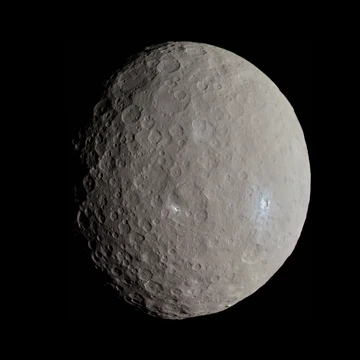
28978 Ixion
A large plutino in the Kuiper belt.

28978 Ixion (provisional designation 2001 KX76) is a large trans-Neptunian object located in the Kuiper belt, a region of icy objects orbiting beyond Neptune in the outer Solar System. It is classified as a plutino, a dynamical class of objects in a 2:3 orbital resonance with Neptune. With a measured diameter of 697 km (433 mi), Ixion is the fourth-largest known plutino and appears to be a transitional object between irregularly-shaped small Solar System bodies and spherical dwarf planets.
Quick Facts
- Minorplanet
- yes
- Symbol
- or (astrological)
- Discovered
- 22 May 2001
- Discoverer
- Deep Ecliptic Survey
- Discovery Site
- Cerro Tololo Obs.
- Mpc Name
- (28978) Ixion
- Pronounced
- ɪ · k · ˈ · s · aɪ · . · ə · n
- Adjectives
- Ixionian ɪ · k · s · i · ˈ · oʊ · n · i · ə · n
- Named After
- Ιξίων Ixīōn
- Mp Category
- TNOplutinodistant
- Epoch
- 21 November 2025 (JD 2461000.5)
- Uncertainty
- 0
Facts from the source article.
Lore & Background
Ixion was discovered on 22 May 2001 by astronomers James Elliot and Lawrence Wasserman of the Deep Ecliptic Survey, using the 4-meter Víctor M. Blanco Telescope at Cerro Tololo. It was first noted by Elliot while compiling two images taken two hours apart, revealing its slow motion relative to background stars. The discovery was formally announced on 1 July 2001, and the object was given the permanent minor planet number 28978 on 2 September 2001. The name Ixion, suggested by Elaine K. Elliot, follows the IAU convention of naming plutinos after mythological figures related to the underworld; in Greek mythology, Ixion was a king of the Lapiths sentenced to an eternity bound to a burning solar wheel.
Ixion orbits the Sun with a semi-major axis of 39.5 AU, taking 248 years to complete one orbit in a 2:3 resonance with Neptune. Its orbit has an eccentricity of 0.24 and an inclination of 19.6° to the ecliptic, closely resembling Pluto's orbit. Its distance from the Sun ranges from 29.9 AU at perihelion to 49.1 AU at aphelion, with its next perihelion on 24 September 2070. In visible light, Ixion appears dark and moderately red due to organic compounds covering its surface; water ice may exist in trace amounts hidden underneath. Its rotation period is uncertain, with measurements suggesting 15.9±0.5 hours (2010) or 12.4±0.3 hours (2016). Ixion is not known to have a natural satellite, so its mass and density are unknown.
Reader's Guide
Ixion is notable as one of the largest known plutinos and a key object in understanding the Kuiper belt's population. Its discovery in 2001 supported suggestions that there were undiscovered large trans-Neptunian objects comparable in size to Pluto, and it preceded the discoveries of dwarf planets such as Haumea, Eris, and Makemake. At the time of discovery, Ixion was thought to be among the largest trans-Neptunian objects due to its high intrinsic brightness, prompting follow-up observations that extended its observation arc by over 18 years. Its measured diameter of 697 km places it in the size range where trans-Neptunian objects typically have densities lower than that of water ice, though its mass remains unknown. Ixion's nearly spheroidal shape, revealed by stellar occultations from 2020 to 2023, and its lack of detected rings or moons make it a transitional object between irregular bodies and dwarf planets. Its orbit, similar to Pluto's, and its red surface color due to organic compounds provide insights into the composition and dynamics of the Kuiper belt.
Did You Know?
- Ixion is the fourth-largest known plutino, after Achlys, Orcus, and Pluto.
- Its rotation period is uncertain, with estimates ranging from 12.4 to 15.9 hours.
- The object is named after the Greek mythological figure Ixion, a king of the Lapiths.
More in Planets and Dwarf Planets 1-24
Spotted an error? Know more?
Reader corrections go straight into our review queue. Suggest an edit · How this site is sourced