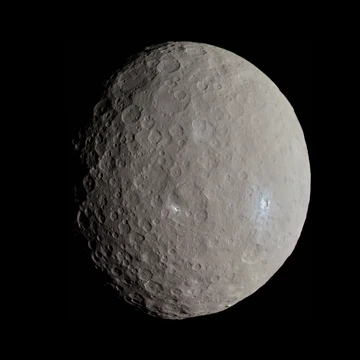
(278361) 2007 JJ43
A large, unnamed trans-Neptunian object and possible dwarf planet.

(278361) 2007 JJ43 is a large object in the outer Solar System, orbiting the Sun near the edge of the Kuiper belt. It is one of the twenty brightest unnamed trans-Neptunian objects, with an absolute magnitude of 4.5, and its estimated diameter of about 610 km makes it a candidate for dwarf planet status.
Discovered on 14 May 2007 using the Palomar Mountain telescope by Megan Schwamb, Michael E. Brown, and David L. Rabinowitz, it was later found in precovery images dating back to 10 May 2002. The Minor Planet Center assigned it the provisional designation 2007 JJ43 on 5 July 2007, and it later received the minor planet number 278361 from the IAU. As of 2026, it has no official name.
The object orbits the Sun at distances ranging from 40.4 to 56.3 AU, with an average orbital distance of 48.3 AU and a period of about 335.9 years. Its orbit has an eccentricity of 0.164 and an inclination of 12.04° relative to the ecliptic. As of 2026, it is about 40.5 AU from the Sun. Located in the classical Kuiper belt region (39–48 AU), it is classified as a cubewano. Its high inclination makes it a dynamically "hot" classical Kuiper belt object, unlike the "cold" population with inclinations under 5°. A 2015 study suggested it may be in a 2:1 orbital resonance with Neptune.
Assuming a typical albedo, its size is comparable to Ixion (530–620 km). A paper by András Pál and colleagues estimated its diameter at 610 +170 −140 km. This places it among "mid-sized" TNOs (400–1,000 km), which scientists propose represent a transition between small, porous, low-density objects and larger, denser dwarf planets. No moons have been detected, so its mass and density cannot be directly measured.
Spectroscopic observations from 2015 using the X-Shooter instrument at Paranal Observatory (300–2480 nm) show a mostly flat spectrum, classifying it as a blue-red object. No absorption bands from icy elements were found, and models indicate crystalline water ice is likely absent or present at no more than 6.5%. The surface composition is estimated at 50% complex organics. Observations covering about one-third of its surface show no variation, suggesting a homogeneous surface. A 2021 study measured its composition as 40%±30% water, 40%±20% silicates, and 20%±10% organics.
Its color indices include B-V = 1.020±0.028, V-R = 0.590±0.020, and R-I = 0.500±0.020.
Quick Facts
- Minorplanet
- yes
- Discoverer
- Palomar Obs.
- Discovered
- 14 May 2007
- Mp Category
- TNOScatNear
- Epoch
- 27 August 2011 (JD 2455800.5)
- Uncertainty
- 2
- Observation Arc
- 4813 days (13.18 yr)
- Earliest Precovery Date
- 10 May 2002 (NEAT)
- Time Periastron
- ≈ 2 April 2037 / ±6 days
- Eccentricity
- 0.1578
Facts from the source article.
Lore & Background
2007 JJ43 was discovered on 14 May 2007 using the Palomar Mountain telescope by Megan Schwamb, Michael E. Brown, and David L. Rabinowitz, with precovery images dating back to 10 May 2002. The Minor Planet Center officially assigned the provisional designation 2007 JJ43 on 5 July 2007, and it later received the minor planet number 278361. As of 2026, it has not been officially named by the International Astronomical Union.
The object orbits the Sun at a distance of 40.4–56.3 AU with an average orbital distance of 48.3 AU, completing one orbit every 335.9 years. Its orbit has a relatively high eccentricity of 0.164 and an inclination of 12.04° with respect to the ecliptic. It is classified as a classical Kuiper belt object (cubewano), but its high inclination makes it a dynamically 'hot' member. A 2015 study suggested it may be in a 2:1 resonance with Neptune.
Physically, 2007 JJ43 has a diameter estimated at 610+170−140 km, placing it in the 'mid-sized' TNO range (400–1,000 km). Its spectra are mostly flat, with no detected absorption bands of icy elements; models indicate crystalline water ice is likely not on the surface, with no more than 6.5% concentration. Surface composition is estimated at 40%±30% water, 40%±20% silicates, and 20%±10% organics. It rotates once every 12.1 hours and has no known moons.
Reader's Guide
2007 JJ43 is notable as one of the twenty brightest unnamed trans-Neptunian objects, with an absolute magnitude of 4.5. Its size of roughly 610 km makes it a possible dwarf planet, though it falls into the 'mid-sized' TNO category (400–1,000 km) that scientists propose represents a transition between small, low-density TNOs and large, high-density dwarf planets. The lack of known moons means its mass and density cannot be directly measured. Its surface appears mostly homogeneous, with a composition dominated by water, silicates, and organics, and no significant crystalline water ice. Its high orbital inclination suggests it is a dynamically 'hot' classical Kuiper belt object, possibly scattered by Neptune's gravitational influence early in Solar System history. As of 2026, it remains unnamed, highlighting the many large TNOs still awaiting official names.
Did You Know?
- 2007 JJ43 has an absolute magnitude of 4.5, making it one of the twenty brightest unnamed trans-Neptunian objects.
- Its diameter is estimated at 610+170−140 km, roughly the same size as Ixion.
- The object rotates once every 12.1 hours with a light curve amplitude of about 0.10, indicating an approximate spheroidal shape.
- No moons have been detected around 2007 JJ43, so its mass and density remain unknown.
More in Planets and Dwarf Planets 1-24
Spotted an error? Know more?
Reader corrections go straight into our review queue. Suggest an edit · How this site is sourced