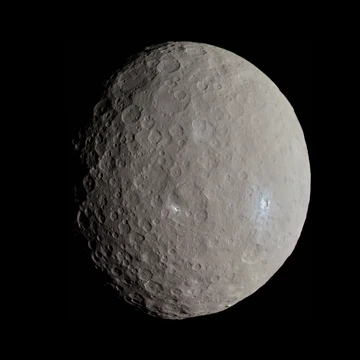
208996 Achlys
Third largest member of the plutinos, elongated by rapid rotation.

208996 Achlys (provisional designation ) is a large trans-Neptunian object orbiting the Sun in the Kuiper belt, a region of icy bodies beyond Neptune. This object is named after Achlys, the goddess of sorrow and grief in the ancient Greek epic poem Shield of Heracles.
Quick Facts
- Minorplanet
- yes
- Discovered
- 13 January 2003
- Discoverer
- Chad Trujillo · Michael E. Brown
- Discovery Site
- Palomar Obs.
- Mpc Name
- (208996) Achlys
- Pronounced
- ˈ · ae · k · l · ə · s
- Adjective
- Achlyan
- Named After
- Achlys (Ἀχλύς)
- Mp Category
- TNOplutinodistant
- Epoch
- 21 November 2025 (JD 2461000.5)
- Uncertainty
- 1
- Observation Arc
- 29+ yr
Facts from the source article.
Lore & Background
Achlys was discovered on 13 January 2003 by astronomers Chad Trujillo and Michael Brown at Palomar Observatory as part of their Caltech Wide Area Sky Survey. It was found through manual vetting of automated image-searching software, and its discovery was announced by the Minor Planet Center on 26 January 2003. Precovery observations date back to 19 March 1996. The object was officially named Achlys on 30 June 2025 by the IAU's Working Group for Small Body Nomenclature, after the goddess of sorrow and grief in the ancient Greek epic poem Shield of Heracles, following the theme of underworld figures required for plutinos. Achlys orbits the Sun at an average distance of 39.5 AU, completing one orbit every 247 years in a 2:3 resonance with Neptune. Its orbit is elliptical and inclined 13.6° to the ecliptic, ranging from 32.4 AU at perihelion to 46.5 AU at aphelion. It does not cross Neptune's orbit. Observations of stellar occultations in 2012 and 2014 revealed its elongated shape, approximated as a Jacobi ellipsoid with dimensions 940 km × 766 km × 490 km. Its surface is dark gray, dominated by water ice, with a chasm or depression 8–13 km deep. Achlys has one known moon about 80 km in diameter. Its mass and density have not been measured, though predictions based on its shape and rotation suggest that it has a density lower than that of water ice.
Reader's Guide
Achlys is significant as the third largest known plutino, after Pluto and Orcus, and as a likely dwarf planet due to its size and probable hydrostatic equilibrium. Its elongated shape, caused by rapid rotation, provides insights into the internal structure and evolution of Kuiper belt objects. The presence of crystalline water ice on its surface suggests past heating, possibly from an impact. The object's stable orbit over billions of years and its dark, ancient surface make it a valuable target for understanding the early Solar System. Its stellar occultations have revealed surface topography, including a chasm similar to those on Pluto and Charon, and have ruled out rings or additional moons. Achlys's low density implies a porous interior, consistent with other mid-sized TNOs that lack internal melting. Its discovery and naming continue the tradition of associating plutinos with underworld mythology.
Did You Know?
- Achlys is the third largest plutino, after Pluto and Orcus.
- Its equatorial diameter is roughly twice its polar diameter.
- The surface has a chasm or depression between 8 and 13 km deep.
More in Planets and Dwarf Planets 1-24
Spotted an error? Know more?
Reader corrections go straight into our review queue. Suggest an edit · How this site is sourced