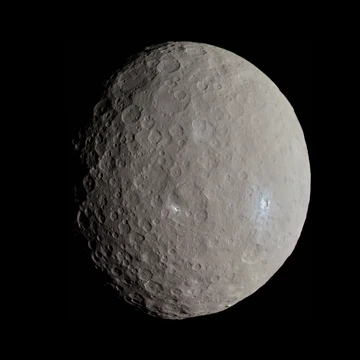
2012 VP113
A distant sednoid with the farthest perihelion known.

2012 VP113 is a trans-Neptunian object with a highly elongated orbit that keeps it extremely far from the Sun. It belongs to a group called sednoids because its closest approach to the Sun never dips below 80.5 AU—far enough that the gravitational pull of the giant planets has no noticeable effect on its path. As of 2025, no other known minor planet or Solar System body has a more distant perihelion, not even Sedna.
The object was discovered on November 5, 2012, using the 4-meter Víctor M. Blanco Telescope at Cerro Tololo Inter-American Observatory in Chile. American astronomers Scott Sheppard and Chad Trujillo led the discovery. They nicknamed it "Biden" after the "VP" in its provisional designation, referencing then–Vice President Joe Biden. The discovery was made public on March 26, 2014. Precovery images later showed it had been observed as early as September 2007.
Its size hasn’t been directly measured, but its brightness suggests a diameter around 450 km if it has a typical TNO albedo of 0.15. A wider range of possible albedos gives a diameter between 300 and 1,000 km. That would make it roughly half the size of Sedna and similar to Huya. Its surface is moderately red, a color that likely comes from radiation altering frozen water, methane, and carbon dioxide. This reddish tint matches objects thought to have formed near the gas-giant region, not the classical Kuiper belt, which tends to produce ultra-red surfaces.
The orbit of 2012 VP113 has the farthest perihelion of any known minor planet, but its aphelion is only about half that of Sedna. It’s the second sednoid discovered, with a semi-major axis beyond 150 AU and a perihelion above 50 AU. Its last perihelion occurred around September 1979. The object’s orbit shares similarities with other extreme TNOs, leading Sheppard and Trujillo to propose that an undiscovered planet—sometimes called Planet Nine—might be herding these distant bodies into similar paths. The lack of objects with perihelia between 50 and 75 AU is known as the Kuiper cliff and isn’t thought to be an observational error.
2012 VP113 may belong to a hypothesized Hills cloud. Its perihelion, argument of perihelion, and current sky position are all similar to Sedna’s.
Quick Facts
- Minorplanet
- yes
- Discoverer
- Scott S. Sheppard · Chadwick A. Trujillo
- Discovery Site
- Cerro Tololo Obs.
- Discovered
- 5 November 2012
- Mpc Name
- 2012 VP · 113
- Mp Category
- TNO · sednoid
- Epoch
- 5 May 2025 / (JD 2460800.5)
- Uncertainty
- 3
- Observation Arc
- 6187 d
- Earliest Precovery Date
- 19 September 2007
- Time Periastron
- ≈ September 1979
Facts from the source article.
Lore & Background
2012 VP113 was first observed on 5 November 2012 with NOAO's 4-meter Víctor M. Blanco Telescope at Cerro Tololo Inter-American Observatory. Carnegie's 6.5-meter Magellan telescope at Las Campanas Observatory in Chile was used to determine its orbit and surface properties. The discovery was announced on 26 March 2014. The object was nicknamed 'Biden' by the discovery team after Joe Biden, then Vice President of the United States, referencing the 'VP' in its designation. Precovery images have been found as early as September 2007.
Its size has not been directly measured, but its brightness suggests a diameter around 450 km, with a possible range of 300–1,000 km depending on albedo. Its surface is moderately red, similar to many other TNOs, resulting from radiation effects on frozen water, methane, and carbon dioxide. This optical color is consistent with formation in the gas-giant region rather than the classical Kuiper belt. 2012 VP113 has not yet been imaged by high-resolution telescopes and has no known moons; the Hubble Space Telescope is planned to image it in 2026 to determine if it has significantly sized moons.
The similarity of its orbit to other extreme trans-Neptunian objects led Sheppard and Trujillo to suggest an undiscovered Planet Nine shepherding these objects. Its perihelion, argument of perihelion, and current sky position are similar to those of Sedna. It is possibly a member of a hypothesized Hills cloud. The origin of its distant perihelion is unknown; explanations include a passing star, a trans-Neptunian planet, capture from another planetary system, or multiple interactions within the Sun's birth cluster.
Reader's Guide
2012 VP113 is significant as the second discovered sednoid, after Sedna, and as of 2025 holds the record for the farthest perihelion of any known minor planet or Solar System object. Its orbit, with a semi-major axis beyond 150 AU and perihelion greater than 50 AU, places it in a class of extreme trans-Neptunian objects whose orbital clustering has been used as evidence for the hypothetical Planet Nine. The object's reddish surface and estimated size of about 450 km suggest it may be large enough to be a dwarf planet, though its diameter and albedo remain unmeasured. Its discovery and study have deepened understanding of the outer Solar System's structure, including the Kuiper cliff—a paucity of bodies with perihelia at 50–75 AU—and the possible existence of a Hills cloud. The planned Hubble imaging in 2026 may reveal whether it hosts moons, further informing its formation history. The object's legacy lies in its role as a key data point in the search for undiscovered planets and in mapping the distant reaches of the Solar System.
Did You Know?
- 2012 VP113 has the farthest perihelion of all known minor planets and Solar System objects as of 2025.
- It was nicknamed 'Biden' by its discoverers after then-Vice President Joe Biden.
- Its estimated diameter is around 450 km, about half the size of Sedna.
- The Hubble Space Telescope is planned to image 2012 VP113 in 2026 to search for moons.
More in Planets and Dwarf Planets 1-24
Spotted an error? Know more?
Reader corrections go straight into our review queue. Suggest an edit · How this site is sourced