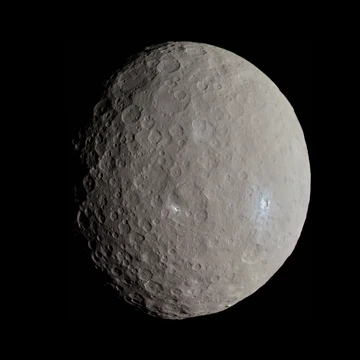
20000 Varuna
A large, rapidly rotating Kuiper belt object.

20000 Varuna (provisional designation 2000 WR106) is a large trans-Neptunian object in the Kuiper belt, discovered in November 2000 by American astronomer Robert McMillan during a Spacewatch survey at the Kitt Peak National Observatory. It is notable as one of the largest classical Kuiper belt objects known at the time of its discovery, and its rapid rotation suggests an elongated shape. The object is named after the Hindu deity Varuna, one of the oldest deities mentioned in the Vedic texts.
Quick Facts
- Minorplanet
- yes
- Symbol
- (astrological)
- Discoverer
- Spacewatch / (Robert McMillan)
- Discovered
- 28 November 2000
- Earliest Precovery Date
- 24 November 1954
- Mpc Name
- (20000) Varuna
- Pronounced
- ˈ · v · ær · ən · ə VARR · ə-nə / Sanskrit वरुण sa · ˈʋɐɾuɳɐ
- Adjectives
- Varunian v · ə · ' · r · uː · n · i · ə · n
- Named After
- Varuna
- Mp Category
- TNOclassical (hot) / Scat-Ext
- Epoch
- 2025-05-05 (JD 2460800.5)
- Uncertainty
- 0
Facts from the source article.
Lore & Background
Varuna was discovered by Robert McMillan using the Spacewatch 0.9-meter telescope on 28 November 2000. McMillan identified the object by manually comparing multiple scans using the blinking technique, as his real-time computer software did not detect it. Follow-up observations by astronomer Jeffrey Larsen confirmed the object, and the discovery was announced on 1 December 2000. Precovery images from 1954 and 1955 were later found, helping refine its orbit. In January 2001, Varuna was assigned the minor planet number 20000, chosen to commemorate its large size and the 200th anniversary of the discovery of Ceres.
Varuna's surface is moderately red due to complex organic compounds, and water ice is also present, likely exposed by past collisions that may have caused its rapid rotation. Its light curve is compatible with a Jacobi ellipsoid shape, suggesting elongation. No natural satellites have been directly imaged, but analysis of light curve variations in 2019 suggests a possible satellite orbiting closely. Assumptions of hydrostatic equilibrium (dwarf planet status) lead to a calculated density so low that it is likely not a dwarf planet.
Varuna orbits the Sun at an average distance of 42.7 AU with a nearly circular orbit (eccentricity 0.056) and an inclination of 17 degrees. It is classified as a classical Kuiper belt object (cubewano) and is a member of the dynamically hot class. Its rotation period is 6.34 hours (double-peaked solution), with an estimated a/b aspect ratio of 1.5–1.6.
Reader's Guide
Varuna's significance lies in its status as one of the largest classical Kuiper belt objects known at its discovery, comparable in size to Ceres. Its rapid rotation and elongated shape, inferred from light curve analysis, provide insights into the physical properties of trans-Neptunian objects. The presence of water ice and complex organic compounds on its surface, along with evidence of past collisions, suggests a dynamic history. The possibility of a satellite, indicated by 2019 light curve variations, remains unconfirmed. The object's low calculated density under hydrostatic equilibrium assumptions challenges its classification as a dwarf planet, highlighting the uncertainties in determining the nature of such distant bodies. The naming after the Hindu deity Varuna follows IAU conventions for non-resonant Kuiper belt objects.
Did You Know?
- Varuna was discovered by Robert McMillan using the blinking technique after his real-time software failed to detect it.
- The minor planet number 20000 was chosen to commemorate Varuna's large size and the 200th anniversary of Ceres' discovery.
- Varuna's light curve suggests it is a Jacobi ellipsoid with an elongated shape due to rapid rotation.
More in Planets and Dwarf Planets 1-24
Spotted an error? Know more?
Reader corrections go straight into our review queue. Suggest an edit · How this site is sourced