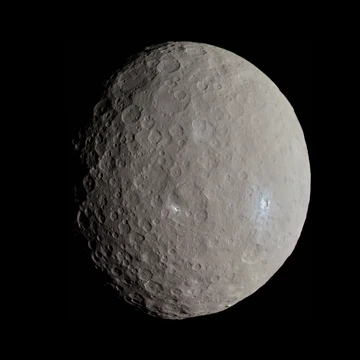
120347 Salacia
A possible dwarf planet in the Kuiper belt with a dark, icy surface.

120347 Salacia is a large trans-Neptunian object in the Kuiper belt, discovered on 22 September 2004 by American astronomers Henry G. Roe, Michael E. Brown, and Kristina Barkume using the Hale Reflector at the Palomar Observatory. It is a possible dwarf planet with an estimated diameter of 838±44 km and a nearly spherical shape, notable for its exceptionally low albedo and dark gray surface. Salacia has one known moon, Actaea, and the two bodies form a fully tidally locked system with a synchronous rotation period of 5.49 days, similar to the Pluto–Charon system.
Quick Facts
- Minorplanet
- yes
- Symbol
- or (rare)
- Discoverer
- H. G. Roe / M. E. Brown / K. M. Barkume
- Discovery Site
- Palomar Obs.
- Discovered
- 22 September 2004
- Earliest Precovery Date
- 25 July 1982
- Mpc Name
- (120347) Salacia
- Pronounced
- s · ə · ˈ · l · eɪ · ʃ · ə (sə · LAY · shə)
- Adjective
- Salacian
- Named After
- Salacia (Roman mythology)
- Mp Category
- TNOclassical (hot) / extended
- Epoch
- 31 May 2020 (JD 2459000.5)
Facts from the source article.
Lore & Background
Salacia was discovered on 22 September 2004 at the Palomar Observatory, with its discovery officially announced in May 2005. It was named after the Roman sea goddess Salacia, and its moon Actaea is named after one of the Nereid sea-nymphs, continuing the marine naming theme. The object's observation arc begins with a precovery image from 25 July 1982 at Siding Spring Observatory, and as of May 2026, 490 observations have been recorded over 37.16 years.
Salacia orbits the Sun at an average distance slightly greater than Pluto's, with a semi-major axis of 42.2 AU and an orbital period of 274.0 years. It has a moderate eccentricity of about 0.11 and a large inclination of 23.9°. Its classification is debated: the Deep Ecliptic Survey groups it as a scattered–extended object, while Brett Gladman and his team classify it as a hot classical Kuiper belt object based on orbital stability simulations. It is not related to the Haumea collisional family despite its water-ice rich surface.
Observations by the James Webb Space Telescope show that water ice makes up less than 5% of its surface, detecting both amorphous and crystalline water ice alongside carbon dioxide ice, but lacking volatile super-ices like methane. This places Salacia in the 'prominent water' TNO group. The system's combined mass is 4.861+0.076−0.074×10²⁰ kg, and the two bodies will pass directly in front of each other during a rare mutual occultation season starting in 2067.
Reader's Guide
Salacia's significance lies in its status as a possible dwarf planet and its role in understanding the composition and dynamics of the Kuiper belt. Its exceptionally low albedo of 0.041±0.004 indicates a lack of geological activity, while its nearly spherical shape and low light curve amplitude suggest a relaxed interior. The detection of water ice and carbon dioxide ice by JWST, but absence of methane, helps classify it within the 'prominent water' group of trans-Neptunian objects. The fully tidally locked system with its moon Actaea, similar to Pluto–Charon, provides a natural laboratory for studying binary formation and evolution. Stellar occultations have progressively refined its orbit and size, with a rare double occultation in August 2024 measuring both bodies. The ongoing debate over its classification—hot cubewano versus scattered–extended object—highlights the complexities of sorting outer Solar System bodies. Its legacy includes improving observational techniques for distant objects and informing models of Neptune's early migration.
Did You Know?
- Salacia's discovery was officially announced in May 2005 alongside seven other trans-Neptunian objects.
- It has a very low light curve amplitude of about 3%, implying a nearly spherical shape or a pole pointing almost directly at Earth.
- A rare double stellar occultation on 17 August 2024 saw both Salacia and its moon Actaea block the same star within 5 minutes.
- The two bodies will experience a mutual occultation season starting in 2067.
More in Planets and Dwarf Planets 1-24
Spotted an error? Know more?
Reader corrections go straight into our review queue. Suggest an edit · How this site is sourced