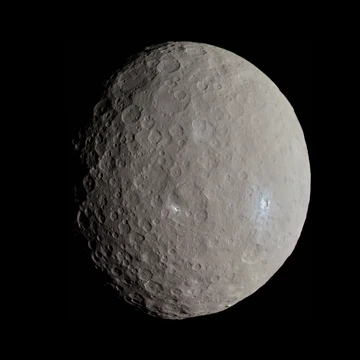
10 Hygiea
A large, nearly spherical asteroid possibly qualifying as a dwarf planet.

10 Hygiea is a sizable asteroid located in the outer part of the main asteroid belt, situated between Mars and Jupiter. It ranks as the fourth-largest asteroid in the belt when measured by both volume and mass, with an average diameter of 433 kilometers, and it accounts for about 3% of the total mass of the main belt. Its shape is nearly spherical, and it has two known craters, roughly 100 and 180 kilometers across. Due to its roundness and size, some scientists suggest it could be classified as a dwarf planet.
The asteroid’s surface is dark and carbon-rich, made up of hydrated and ammoniated silicate minerals, along with carbonates and water ice. Its interior likely contains a significant amount of water ice as well. These features make Hygiea very similar to Ceres, the dwarf planet in the main belt, implying that both objects may have formed and evolved in comparable ways.
Hygiea is the largest member of the Hygiea family, a group of over 7,000 asteroids that share similar orbits and compositions. This family is thought to have originated from a massive impact on Hygiea around 2 to 3 billion years ago. That collision likely shattered the asteroid, after which it reassembled into its current nearly round shape.
**History**
**Discovery** Italian astronomer Annibale de Gasparis discovered Hygiea on the evening of 12 April 1849 at the Astronomical Observatory of Capodimonte in Naples, Italy. That night, he was using the observatory’s Reichenbach equatorial telescope to scan a region of the sky in the 12th hour of right ascension, as part of a larger effort to map stars along the ecliptic down to the 14th apparent magnitude. While comparing his observations with the Berlin Academy’s star chart, he spotted a star-like object between magnitudes 9 and 10 that was not listed. Bad weather delayed further observations for a few days, but de Gasparis saw the object again on 14 and 17 April, confirming it had shifted position between those dates.
Based on how much it had moved, de Gasparis concluded it was another new planet located between Mars and Jupiter. He reported his finding to Erasmo Fabri Scarpellini, secretary of the *Correspondenza Scientifica* bulletin in Rome, who then passed the news to Heinrich Christian Schumacher. Schumacher published the discovery in the journal *Astronomische Nachrichten* on 11 May 1849.
Quick Facts
- Minorplanet
- yes
- Symbol
- (historical astronomical) / (modern astrological)
- Discoverer
- Annibale de Gasparis
- Discovery Site
- Astronomical Observatory of Capodimonte
- Discovered
- 12 April 1849
- Pronounced
- h · aɪ · ˈ · dʒ · iː · ə
- Adjectives
- Hygiean h · aɪ · ˈ · dʒ · iː · ə · n
- Mpc Name
- (10) Hygiea
- Named After
- Hygieia
- Mp Category
- Main belt (outer)Hygiea family
- Epoch
- 5 May 2025 (JD 2460800.5)
- Uncertainty
- 0
Facts from the source article.
Lore & Background
Hygiea was discovered on the evening of 12 April 1849 by Italian astronomer Annibale de Gasparis at the Astronomical Observatory of Capodimonte in Naples, Italy. While observing a section of the sky in the 12th hour of right ascension as part of a project cataloguing stars along the ecliptic, de Gasparis noticed a starlike object between magnitude 9 and 10 not recorded before. After reobserving it on 14 and 17 April, he confirmed it had moved and concluded it must be another new planet between Mars and Jupiter. It was the tenth asteroid discovered in history.
The asteroid was named after Hygieia, the Greek goddess of health. De Gasparis invited his friend and observatory director Ernesto Capocci Belmonte to assign a name; Capocci suggested Igea, the Italian spelling of Hygieia. De Gasparis added the adjective Borbonica to honor King Ferdinand II of the Bourbons, proposing the name Igea Borbonica. The name was later simplified to Hygiea, with the adjective dropped by 1852. An astronomical symbol was proposed by de Gasparis—a serpent crowned with a star—but it was not widely used, and by 1851 a numbered designation system was adopted, giving Hygiea the number 10.
Hygiea has a dark, carbonaceous surface consisting of hydrated and ammoniated silicate minerals, with carbonates and water ice. Its subsurface likely contains a large fraction of water ice. These characteristics make Hygiea very similar to the main-belt dwarf planet Ceres, suggesting similar origins and evolutionary histories. Hygiea is the parent body of the Hygiea family, an asteroid family comprising over 7,000 known asteroids believed to have formed by a giant impact on Hygiea about 2 to 3 billion years ago. That impact is thought to have shattered Hygiea, leading to its reaccumulation as a nearly spherical body.
Reader's Guide
10 Hygiea holds significance as the fourth-largest main-belt asteroid and a possible dwarf planet due to its nearly spherical shape. Its discovery in 1849 by Annibale de Gasparis marked the tenth asteroid found, contributing to the evolving classification of such bodies—initially called planets, then increasingly referred to as minor planets or asteroids. Hygiea's naming history reflects 19th-century scientific and political contexts, including a tribute to the Bourbon monarchy and a competing suggestion of Parthenope from John Herschel. The asteroid's dark, carbonaceous composition and subsurface water ice closely resemble those of Ceres, suggesting a shared origin and evolutionary path. As the parent body of the Hygiea family—over 7,000 asteroids—it provides evidence of a major impact event 2 to 3 billion years ago that shattered and reaccumulated the body into its current spherical form. This impact history and its potential dwarf planet status make Hygiea an important object for understanding the formation and evolution of small bodies in the solar system. Its legacy also includes the early adoption of numbered designations for asteroids, as Hygiea was among the first to be assigned a number (10) instead of a unique symbol, a system that persists today.
Did You Know?
- It is the fourth-largest main-belt asteroid by both volume and mass, with a mean diameter of 433 km.
- Hygiea has a nearly spherical shape with two known craters about 100 and 180 km in diameter.
More in Planets and Dwarf Planets 1-24
Spotted an error? Know more?
Reader corrections go straight into our review queue. Suggest an edit · How this site is sourced