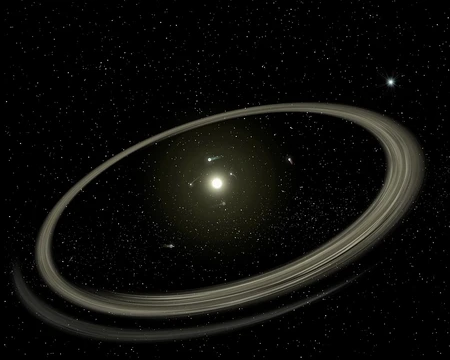
HAT-P-13
Last updated
HAT-P-13, also called GSC 03416-00543, is a G-type subgiant star about 800 light-years away in Ursa Major. Two massive planets orbit it, with the inner one transiting the star. Discovered in 2009, this was the first system known to have both a transiting exoplanet and another planet. A 2015 spectroscopic study found very strong starspot activity on HAT-P-13.
Quick Facts
- Distance
- approximately 800 light-years
- Constellation
- Ursa Major
- Stellar type
- G-type subgiant
- Inner planet designation
- HAT-P-13b
- Inner planet mass
- around 90% that of Jupiter
- Outer planet designation
- HAT-P-13c
- Outer planet mass
- over 15 Jupiters
- Outer planet orbital period
- 446 days
Facts from the source article.
Planetary system
Two confirmed planets orbit HAT-P-13. The inner planet, HAT-P-13b, was detected via the transit method and has a mass about 90% that of Jupiter, completing an orbit every 2.91624039 days. Its high temperature classifies it as a hot Jupiter. The outer companion, HAT-P-13c, was found through radial velocity measurements and has a mass exceeding 15 Jupiter masses, placing it at the boundary between a massive planet and a low-mass brown dwarf.
It follows an eccentric orbit with a period of 446 days. A search for transits by HAT-P-13c was negative, but only 72% of possible transit configurations could be ruled out. Radial velocity data also hint at a third, more distant companion, which could be a planet, brown dwarf, or small star.
More in Planetary Systems with Two Confirmed Planets
Sources
Compiled from Wikipedia and the sources listed below. Text from Wikipedia is available under CC BY-SA 4.0; this entry is adapted from it.
- Wikipedia: HAT-P-13 (CC BY-SA 4.0).
Spotted an error? Know more?
Reader corrections go straight into our review queue. Suggest an edit · How this site is sourced