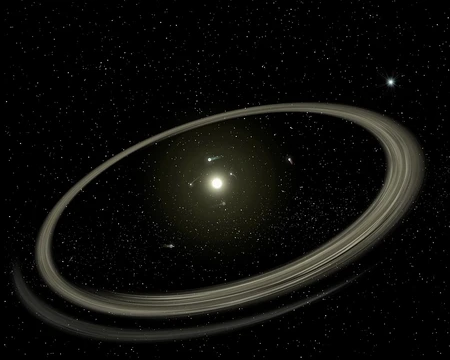
HD 15337
Last updated
HD 15337 (TOI-402) is a binary star system in the southern constellation Fornax, located 146 light-years away. It is too faint to be seen with the naked eye but is visible through a small telescope. The system is notable for hosting two exoplanets discovered in 2019 by the TESS space telescope.
Quick Facts
- Apparent magnitude
- 9.09
- Distance
- 146 ly
- Radial velocity
- −3.9 km/s
- Spectral type (primary)
- K1V
- Effective temperature (primary)
- 5131 K
- Number of confirmed planets
- 2
Facts from the source article.
Characteristics
The two stars orbit each other once every 760 years or so, separated by an average of 88 AU on a very stretched-out path. The larger star is a K1V orange dwarf, 15% smaller than the Sun in both mass and radius, and shines with less than half the Sun’s light. Its surface temperature is 5131 K. Billions of years old, it has a metal content and activity level similar to the Sun’s. The smaller companion weighs in at just 26% of the Sun’s mass.
Planetary system
In May 2019, two exoplanets were discovered transiting the primary star: HD 15337 b and c. Both orbit much closer to their star than Mercury is to the Sun, with equilibrium temperatures of 1001 K and 642 K, respectively—hot enough to melt lead. The inner planet, HD 15337 b, has a radius of 1.770 Earth radii and a mass of 6.519 Earth masses, giving it a density higher than Earth's, indicating a rocky super-Earth.
The outer planet, c, has a mass of 6.792 Earth masses but a radius over 40% larger, resulting in a much lower density suggestive of a mini-Neptune with a thick hydrogen-helium envelope. This difference places the two planets on opposite sides of the small planet radius gap. In 2024, CHEOPS and HARPS observations refined the parameters: HD 15337 b's mass and radius uncertainties were reduced to under 2% and 7%, and HD 15337 c's radius was constrained to within 3%.
More in Planetary Systems with Two Confirmed Planets
Sources
Compiled from Wikipedia and the sources listed below. Text from Wikipedia is available under CC BY-SA 4.0; this entry is adapted from it.
- Wikipedia: HD 15337 (CC BY-SA 4.0).
Spotted an error? Know more?
Reader corrections go straight into our review queue. Suggest an edit · How this site is sourced