HD 12661
Last updated
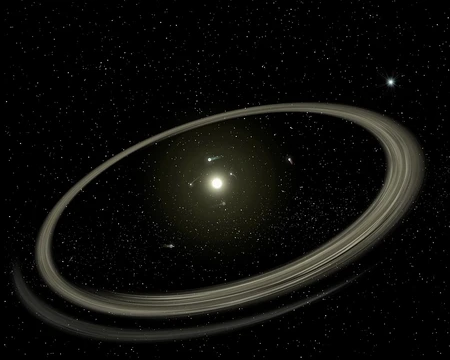
HD 12661 is a G-type main sequence star in the northern constellation of Aries, slightly larger and more massive than the Sun at an estimated age of seven billion years. It hosts two known extrasolar planets, both more massive than Jupiter.
Quick Facts
- Apparent visual magnitude
- 7.42
- Distance from earth
- about 123.3 ly
- Stellar classification
- G6 V
- Effective temperature
- 5,754 K
- Radius (relative to sun)
- 107% to 112%
- Mass (relative to sun)
- 107% to 110%
- Estimated age
- roughly seven billion years
Facts from the source article.
Properties
The star has an apparent visual magnitude of 7.42, too faint for naked-eye viewing but observable with a small telescope of 6 cm aperture or more. Parallax measurements place HD 12661 at a distance of about 123.3 light-years from Earth. Its stellar classification is G6 V, a main sequence star fusing hydrogen at its core. The effective temperature of the outer envelope is about 5,754 K, giving it a yellow hue typical of G-type stars.
Stellar models estimate its radius between 107% and 112% of the Sun's radius and its mass between 107% and 110% of the Sun's mass. Chromospheric emission indicates the star is older than the Sun, with an estimated age of roughly seven billion years, though the technique becomes less accurate beyond about 5.6 billion years. The star has a low projected rotational velocity of 1.20 km/s, consistent with older age. Lithium abundance provides a separate age estimate of 4.4 billion years, though this method is less accurate.
The metallicity—abundance of elements heavier than hydrogen and helium—is unusually high compared to the Sun. High metallicity correlates statistically with multi-planet systems; one planet may have been scattered and accreted by the star, possibly explaining the high surface metallicity.
Planetary system
Astronomers first detected a planet around HD 12661 in 2001 by measuring tiny shifts in the star's light at Lick and Keck observatories. The same team found a second planet two years later.
Both worlds are heavier than Jupiter. In 2025, astrometry revealed the true mass and orbital tilt of the outer planet. The system is dynamically unstable, suggesting either we are seeing it in an unusual phase or unseen planets are influencing its motion.
More in Planetary Systems with Two Confirmed Planets
Sources
Compiled from Wikipedia and the sources listed below. Text from Wikipedia is available under CC BY-SA 4.0; this entry is adapted from it.
- Wikipedia: HD 12661 (CC BY-SA 4.0).
Spotted an error? Know more?
Reader corrections go straight into our review queue. Suggest an edit · How this site is sourced