AU Microscopii
Last updated

via Wikipedia: AU Microscopii · see source
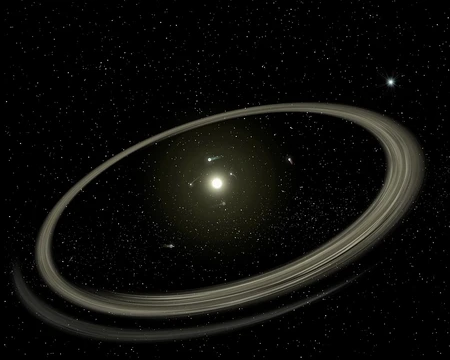
AU Microscopii is a young red dwarf star located 31.7 ly away in the southern constellation Microscopium. With an apparent visual magnitude of 8.73, it is too dim to be seen with the naked eye. It hosts a circumstellar disk of dust known as a debris disk and at least three exoplanets, with the presence of an additional planet being likely.
Quick Facts
- Distance
- 31.7 ly
- Apparent visual magnitude
- 8.73
- Stellar classification
- M1 Ve
- Radius
- 75% of the Sun
- Mass
- 50% of the Sun
- Luminosity
- 9% of the Sun
- Effective temperature
- 3,700 K
Facts from the source article.
Stellar properties
AU Mic is a red dwarf star with a classification of M1 Ve, only 22 million years old. Its physical radius is 75% that of the Sun, and its mass is half the Sun's, yet it radiates just 9% of the Sun's luminosity. The effective temperature of its outer atmosphere is 3,700 K, giving it a cool orange-red hue.
It belongs to the β Pictoris moving group and may be gravitationally bound to the binary star system AT Microscopii. The star exhibits flaring activity across the electromagnetic spectrum, first identified in 1973. A nearly sinusoidal brightness variation with a period of 4.865 days underlies these flares, with the amplitude changing slowly over time.
Planetary system
The debris disk around AU Microscopii has an asymmetric structure and an inner gap, prompting searches for planets. In 2020, a Neptune-sized planet was discovered via transit observations by TESS, with its rotation axis aligned to the star's axis within 5°. A second planet, AU Mic c, suspected since 2018, was confirmed in December 2020 after additional TESS transit events. A 2024 study of the Rossiter–McLaughlin effect for planet c found a possibly misaligned orbit, with a poorly constrained projected obliquity.
A third planet, suspected since 2022 from transit-timing variations, was validated in 2023, though several possible orbital periods remain. Radial velocity observations suggested a fourth outer planet as of 2023. Observations with CHEOPS detected strong TTVs of AU Mic c, explainable by planet d on a 12.6-day orbit, with a mass about 20% of Earth's.
Methods of observation
AU Mic's disk has been observed at optical wavelengths using coronagraphs to block starlight, providing high-resolution images of scattered light from dust. Comparing visible and near-infrared images yields information about dust grain sizes.
Optical observations have been conducted with the Hubble Space Telescope and Keck Telescopes. At infrared and sub-millimeter wavelengths, the disk emits its own thermal radiation, observed with the James Clerk Maxwell Telescope, Spitzer Space Telescope, and James Webb Space Telescope. These longer-wavelength observations cannot resolve the disk but measure total system light, revealing information about larger dust particles at greater distances from the star.
Did You Know?
- AU Microscopii is only 22 million years old, less than 1% of the age of the Sun.
- The debris disk around AU Mic was first resolved at optical wavelengths in 2003 by Paul Kalas and collaborators.
- Fast-moving features in the disk have been clocked at speeds up to 10 kilometers per second (22,000 miles per hour).
- Planet d has a mass only about 20% of Earth's mass, equivalent to two Mars masses.
More in Planetary Systems with Two Confirmed Planets
Sources
Compiled from Wikipedia and the sources listed below. Text from Wikipedia is available under CC BY-SA 4.0; this entry is adapted from it.
- Wikipedia: AU Microscopii (CC BY-SA 4.0).
Spotted an error? Know more?
Reader corrections go straight into our review queue. Suggest an edit · How this site is sourced