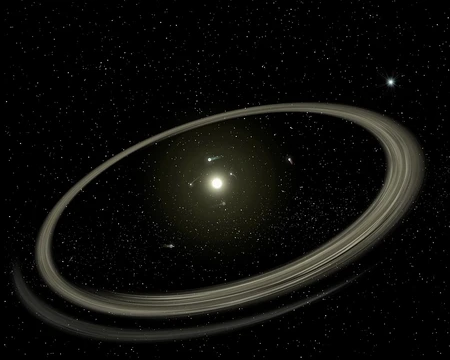
HD 21693
Last updated
HD 21693 is a G-type star in the constellation Reticulum, located 108.6 light-years from Earth. It hosts two Neptune-mass exoplanets discovered in 2011 via radial velocity measurements. The star is not visible to the naked eye, with an apparent visual magnitude of 7.94.
Quick Facts
- Spectral type
- G9IV-V
- Apparent visual magnitude
- 7.94
- Distance
- 108.6 light-years (33.3 parsecs)
- Effective temperature
- 5,430 K
- Metallicity
- approximately equal to that of the Sun
- Number of planets
- 2
Facts from the source article.
Star
HD 21693 has a spectral type of G9IV-V, indicating it is slightly evolved and lies between the main sequence and subgiant branch. Stellar evolution models place it at the end of the main sequence, with a mass and an age of roughly 7 billion years, though the age uncertainty is ±4 billion years. Its radius and luminosity are calculated from its Gaia-measured distance and brightness. The star's effective temperature is 5,430 K, and its metallicity is approximately equal to that of the Sun.
HD 21693 exhibits a stellar activity cycle with a period of 10 years, similar to the solar cycle, as shown by long-term variations in spectral activity indicators. Its log R′HK chromospheric activity index varies between −5.02 and −4.83, an amplitude comparable to the Sun's magnetic cycle. A weaker variation with a period of 33.5 days may correspond to the star's rotation period. The activity cycle affects the star's radial velocity and was accounted for in the planetary orbital solution.
No companion stars have been detected; observations with the NACO instrument at the Very Large Telescope set a detection limit at 0.5 arcseconds (16.7 AU).
Planetary system
Two exoplanets orbiting HD 21693 were announced in 2011, detected by the radial velocity method using the HARPS spectrograph at La Silla Observatory, with detailed analysis published in 2019. The HARPS instrument made 210 radial velocity measurements between 2003 and 2015, revealing two planetary signals and a 10-year signal from the star's activity cycle. The planetary signals have no counterpart in spectral activity indicators, confirming their planetary nature.
Residual radial velocity variability after removing all periodic signals may be due to strong granulation on the star's surface. The inner planet, HD 21693 b, has a minimum mass in the transition regime between super-Earths and Neptune-mass planets; its true mass is unknown because the orbital inclination cannot be determined. It orbits at 0.15 AU with a period of 22.7 days. The outer planet, HD 21693 c, has a minimum mass similar to Neptune's and orbits at 0.26 AU with a period of 53.7 days.
The planets have a period ratio of 2.37, close to a 5:2 commensurability. One formation scenario suggests convergent migration trapped them in a 5:2 resonance, which was lost after the protoplanetary disk dissipated.
More in Planetary Systems with Two Confirmed Planets
Sources
Compiled from Wikipedia and the sources listed below. Text from Wikipedia is available under CC BY-SA 4.0; this entry is adapted from it.
- Wikipedia: HD 21693 (CC BY-SA 4.0).
Spotted an error? Know more?
Reader corrections go straight into our review queue. Suggest an edit · How this site is sourced