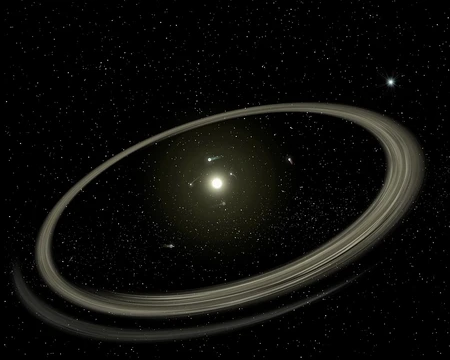
HD 21749
Last updated
HD 21749 is a K-type main-sequence star in the constellation Reticulum, located 53 light-years from Earth. It hosts two exoplanets discovered by the TESS spacecraft in 2019: a mini-Neptune-sized planet and an Earth-sized planet, the latter being the first Earth-sized exoplanet found by TESS. The star is too dim to be seen without a telescope, with an apparent visual magnitude of 8.143.
Quick Facts
- Constellation
- Reticulum
- Apparent visual magnitude
- 8.143
- Distance from earth
- 53 ly
- Spectral type
- K4.5V
- Effective temperature
- 4,640 K
- Number of confirmed exoplanets
- 2
Facts from the source article.
Stellar characteristics
HD 21749 is a K-type main-sequence star of spectral type K4.5V, making it smaller and cooler than the Sun. Its effective temperature is 4,640 K, giving it an orange color typical of K-type stars. The star's metallicity is approximately equal to the Sun's.
It is moderately active, with spectral and photometric indicators showing a rotation period most likely around 34 days, within a range of 30 to 40 days. This stellar activity causes radial velocity variations that complicate mass measurements of its planets. A 9th-magnitude star is listed as a companion in double star catalogues, separated by an unspecified distance in 2015, but the two are unrelated and only appear close due to the primary's high proper motion.
Planetary system
The outer planet, HD 21749 b, orbits at 0.21 AU with a period of 35.6 days. It has a mass and radius similar to Neptune but is much denser, with a density of 4.7 g/cm³, suggesting a substantial rocky core and a relatively thick gaseous layer. The inner planet, HD 21749 c, orbits at 0.08 AU with a period of 7.8 days. It is a terrestrial planet with an Earth-sized radius, making it the first Earth-sized planet found by TESS.
Its mass is too low to be calculated from current radial velocity data, with only an upper limit available; a probabilistic model estimates it most likely between 1 and an unspecified upper value. The discovery of HD 21749 b was initially based on a single transit from TESS data, with its orbital period and mass determined using archival HARPS radial velocity data. Two additional months of TESS data confirmed the period and revealed the second planet.
More in Planetary Systems with Two Confirmed Planets
Sources
Compiled from Wikipedia and the sources listed below. Text from Wikipedia is available under CC BY-SA 4.0; this entry is adapted from it.
- Wikipedia: HD 21749 (CC BY-SA 4.0).
Spotted an error? Know more?
Reader corrections go straight into our review queue. Suggest an edit · How this site is sourced