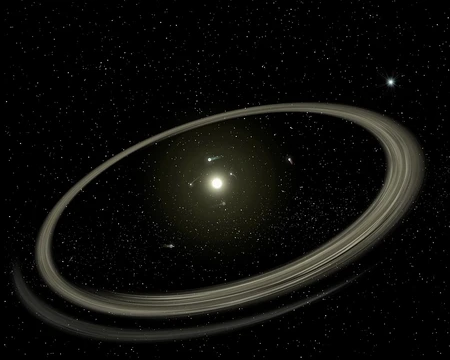
HD 4732
Last updated
HD 4732 is a 5.9-magnitude red giant star in Cetus, 180 light-years away. It hosts two giant planets discovered in 2012 via radial velocity measurements, each with a minimum mass of 2.4 Jupiter masses.
Quick Facts
- Constellation
- Cetus
- Apparent magnitude
- 5.9
- Distance
- 180 light-years
- Spectral type
- K-type giant (some sources classify it as a subgiant)
- Absolute magnitude
- 2.09
- Radial velocity
- Moving away from the Solar System
- Companion star
- About half the mass of the Sun at 8.77 arcseconds (481 AU)
Facts from the source article.
Observation
HD 4732 lies in the celestial Southern Hemisphere but is visible from most of Earth. Near Antarctica it is circumpolar, while near the Arctic it never rises. Its magnitude of 5.9 makes it a naked-eye target only under a clear, moonless sky. The best evening viewing occurs between September and February, with similar visibility from both hemispheres due to its proximity to the celestial equator.
Planetary system
In November 2012, radial velocity observations at Okayama Astrophysical Observatory and the Australian Astronomical Observatory revealed two giant planets. Both have identical minimum masses of 2.4 Jupiter masses, with orbital periods of 360 days and 2732 days. If coplanar and prograde, dynamical stability analysis limits their true masses to no more than 28 Jupiter masses. The planetary parameters were updated in 2023, and a 2019 study found the system stable.
More in Planetary Systems with Two Confirmed Planets
Sources
Compiled from Wikipedia and the sources listed below. Text from Wikipedia is available under CC BY-SA 4.0; this entry is adapted from it.
- Wikipedia: HD 4732 (CC BY-SA 4.0).
Spotted an error? Know more?
Reader corrections go straight into our review queue. Suggest an edit · How this site is sourced