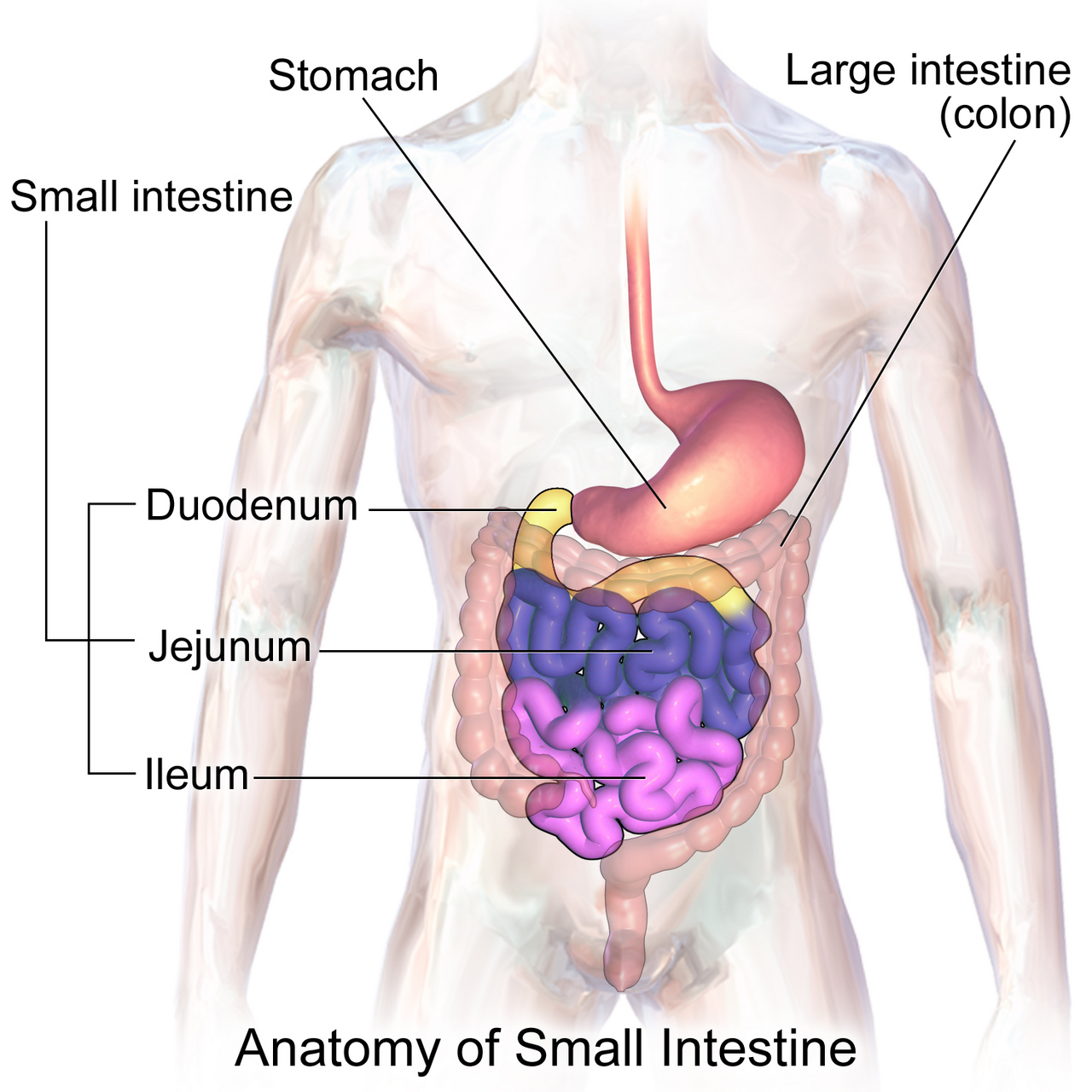
Small intestine

BruceBlaus . When using this image in external sources it can be cited as: Blaus · CC BY 3.0
The small intestine is the organ where most nutrient absorption from food occurs, lying between the stomach and large intestine.[1] Bile and pancreatic juice enter the small intestine via the pancreatic duct, contributing to digestive processes.[1]
Quick Facts
- Latin
- intestinum tenue
- Part of
- Gastrointestinal tract
- System
- Digestive system
- Artery
- Superior mesenteric artery
- jejunal arteries
- ileal arteries
- Vein
- Hepatic portal vein, superior mesenteric vein
- Nerve
- Celiac ganglia, vagus
- Lymph
- Intestinal lymph trunk
Facts from the source article.
Key facts and history
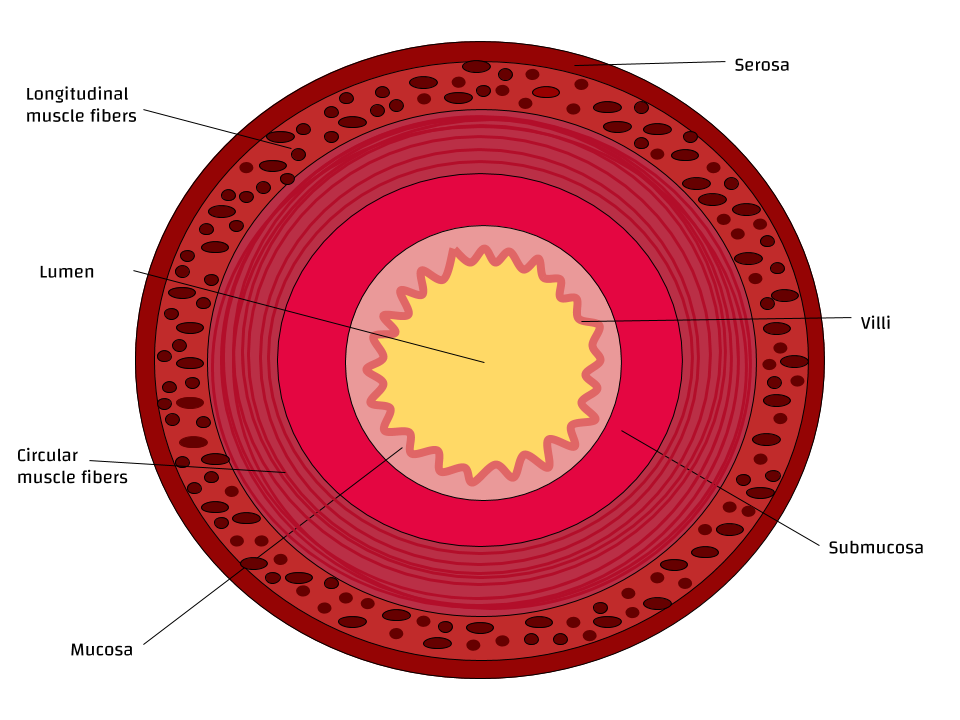
Its diameter in adults is 2.5–3 cm.[2] This loop protrudes through the umbilicus and retracts back into the abdomen by week 10.[3] The small intestine is found in all tetrapods and in teleosts, though its form and length vary between species.[4] Among the three regions, the duodenum is the smallest in length, and it is within this section that finger-like projections called intestinal villi initiate the preparatory phase for nutrient absorption.[5]
Enterocytes lining the jejunum are adapted to absorb tiny digested nutrient particles.[5] In a living individual, the small intestine usually measures between 3 and 5 meters in length.[6] The primitive gut tube's midgut gives rise to the small intestine during development.[3] A U-shaped primary intestinal loop forms from the rapidly elongating ileum by the fifth week of embryonic development.[3]
From the sixth to the tenth week of development, the small intestine undergoes an anticlockwise rotation; after re-entering the abdomen, it rotates an additional 180 degrees.[3]
What the research sources say
The radiologymasterclass.co.uk account states that on abdominal X-rays, dilated small bowel greater than 3 cm is considered abnormal.[7] The same source notes that the most common causes of obstruction are adhesions, hernias, tumours, and Crohn's disease.[7] The Human Protein Atlas reports that 75% of all human proteins are expressed in the intestine, with 947 genes showing elevated expression compared to other tissues.[8] The Protein Atlas describes that several genes with elevated expression in the intestine encode proteins related to microvilli organization, such as VIL1.[8]
The Human Protein Atlas states that the intestine shares most group enriched gene expression with lymphoid tissue.[8]
Gallery
References
- Wikipedia, "Small intestine" (CC BY-SA 4.0), which cites: Fish, "Physiology, Small Bowel", StatPearls, 2025 (original not read by us) en.wikipedia.org
- Wikipedia, "Small intestine" (CC BY-SA 4.0), which cites: Debora Duro, Daniel Kamin, "Overview of short bowel syndrome and intestinal transplantation", Colombia Médica, 2007 (original not read by us) en.wikipedia.org
- Wikipedia, "Small intestine" (CC BY-SA 4.0), which cites: Schoenwolf, "Larsen's human embryology", Churchill Livingstone/Elsevier, 2009, p. 237 (we also read that source) en.wikipedia.org
- Wikipedia, "Small intestine" (CC BY-SA 4.0), which cites: Romer, Alfred Sherwood, "The Vertebrate Body", Holt-Saunders International, 1977, p. 349–353 (we also read that source) en.wikipedia.org
- Wikipedia, "Small intestine" (CC BY-SA 4.0), which cites: "Human body Organs, Systems, Structure, Diagram, & Facts Britannica", www.britannica.com, 2025-09-24 (original not read by us) en.wikipedia.org
- Wikipedia, "Small intestine" (CC BY-SA 4.0), which cites: DiBaise, "Short Bowel Syndrome: Practical Approach to Management", CRC Press, 2016, p. 31; Tortora, "Principles of Anatomy & Physiology", Wiley, 2014, p. 913; Standring, "Gray's Anatomy", Elsevier, 2016, p. 1124; DiBaise, "Short Bowel Syndrome: Practical Approach to Management", CRC Press, 2016, p. 31; DiBaise, "Short Bowel Syndrome: Practical Approach to Management", CRC Press, 2016, p. 31 (original not read by us) en.wikipedia.org
- "Abdominal X-ray - Abnormal bowel gas pattern", radiologymasterclass.co.uk. facts only, no text reused. radiologymasterclass.co.uk
- "The human proteome in small intestine - The Human Protein Atlas", www.proteinatlas.org. facts only, no text reused. proteinatlas.org
Each numbered sentence above was checked against the source it cites before publication. Sentences citing Wikipedia adapt text from the English Wikipedia article Small intestine (contributors), used under CC BY-SA 4.0; this entry is available under the same licence. Other sources were used for facts only; no text or images are copied from them.
More in Physiology & Medicine
Spotted an error? Know more?
Reader corrections go straight into our review queue. Suggest an edit · How this site is sourced