Thermoregulation

OpenStax College · CC BY 3.0
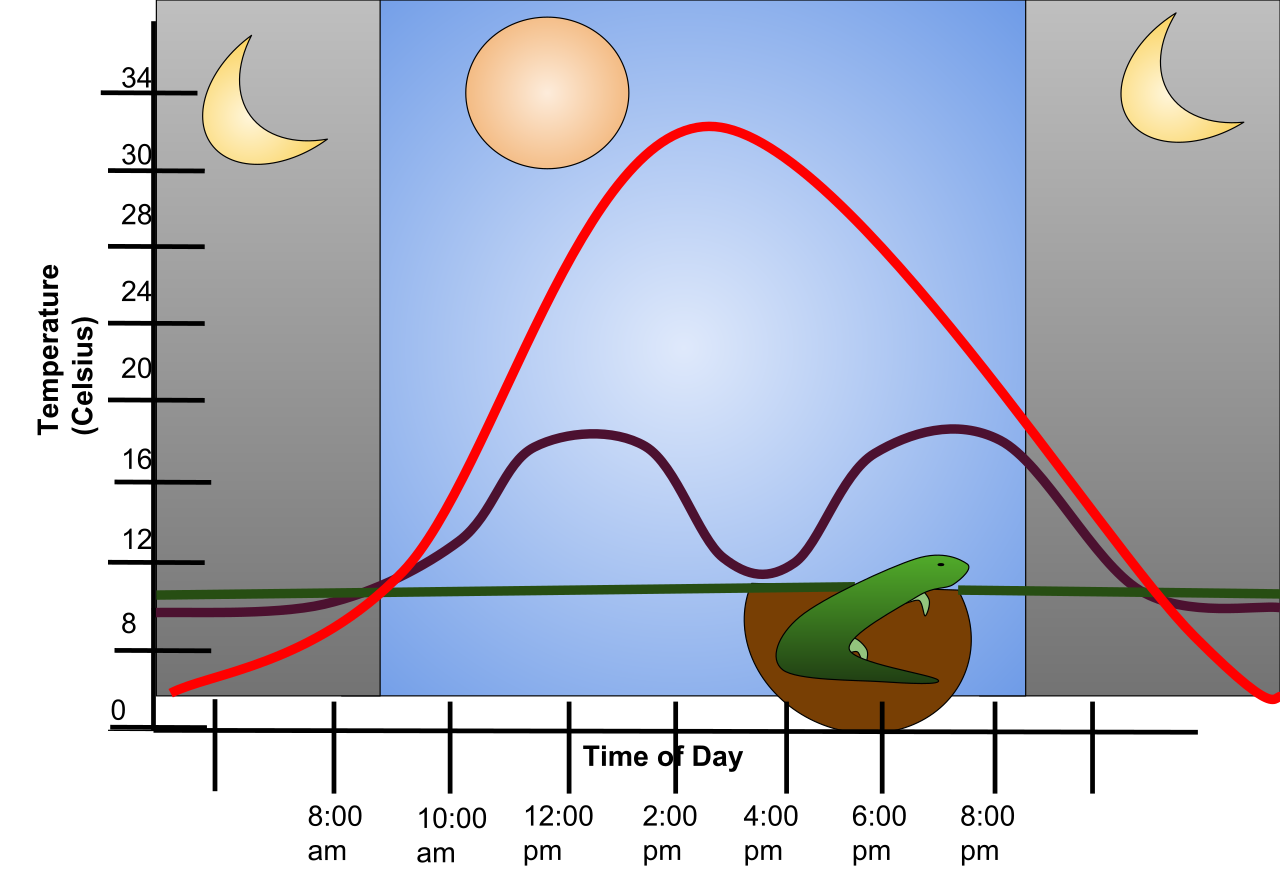
The range of thermoregulatory strategies extends from endothermy, where metabolic processes generate most heat, to ectothermy, where environmental heat sources are primary.[1][2] When thermoregulation fails, hyperthermia (body temperature rising significantly above normal) or hypothermia (body temperature dropping below normal) can occur.[3][4]
Last updated 2026-10-07 from the source article.
Quick Facts
- Field
- Physiological ecology
Facts from the source article.
Key facts and history
The preoptic area of the anterior hypothalamus primarily controls thermoregulation in both ectotherms and endotherms.[5] In rats, EP3-expressing neurons in the preoptic area provide tonic GABAergic inhibition to control sympathetic output.[5] In a cold environment, the tonic inhibition is attenuated, increasing heat production and constricting skin blood vessels.[6] Hypothermia sets in when core body temperature drops below 35 °C, usually from prolonged cold exposure.[4][7]
Through many observations on humans and other animals, John Hunter determined that the key distinction between warm-blooded and cold-blooded animals is that the former have a constant temperature while the latter have a variable one.[8] Homeothermy, a high and nearly constant body temperature independent of the environment, is characteristic of almost all birds and mammals.[8] Poikilothermy, where body temperature varies with the surroundings, is displayed by almost all other animals.[8] The concept that tonic inhibitory control governs body temperature was initially suggested as a fever mechanism in 2002, and in 2022 it was proven to be the fundamental principle behind mammalian body temperature homeostasis.[6]
A sustained wet-bulb temperature above 35 °C for six hours can cause lethal hyperthermia in humans.[3]
What the research sources say
The 2022 study by Nakamura and colleagues demonstrated that EP3-expressing preoptic neurons bidirectionally control body temperature via tonic GABAergic signaling.[5][6] Antifreeze proteins, which occur in some fish and plants, were characterized in a 2002 Food and Chemical Toxicology paper by Crevel et al.[9][10]
Gallery
References
- Wikipedia, "Thermoregulation" (CC BY-SA 4.0), which cites: "Khan Academy", Khan Academy; Boundless, "Homeostasis: Thermoregulation", Boundless, 2016-09-20 (original not read by us) en.wikipedia.org
- Wikipedia, "Thermoregulation" (CC BY-SA 4.0), which cites: Boundless, "Homeostasis: Thermoregulation", Boundless, 2016-09-20; "Khan Academy", Khan Academy (original not read by us) en.wikipedia.org
- Wikipedia, "Thermoregulation" (CC BY-SA 4.0), which cites: "Global Warming: Future Temperatures Could Exceed Livable Limits, Researchers Find" (we also read that source) en.wikipedia.org
- Wikipedia, "Thermoregulation" (CC BY-SA 4.0), which cites: "Hypothermia", Mayo Clinic; "Hypothermia: Causes, Symptoms, and Treatment", WebMD (we also read that source) en.wikipedia.org
- Wikipedia, "Thermoregulation" (CC BY-SA 4.0), which cites: Nakamura, "Central circuitries for body temperature regulation and fever", American Journal of Physiology. Regulatory, Integrative and Comparative Physiology, November 2011, p. R1207–R1228; Romanovsky, "Functional architecture of the thermoregulatory system", Am J Physiol Regul Integr Comp Physiol, 2007, p. R37–46; Morrison, "Central Mechanisms for Thermoregulation", Annual Review of Physiology, 2019-02-10, p. 285–308; Nakamura, "Prostaglandin EP3 receptor–expressing preoptic neurons bidirectionally control body temperature via tonic G en.wikipedia.org
- Wikipedia, "Thermoregulation" (CC BY-SA 4.0), which cites: Nakamura, "Prostaglandin EP3 receptor–expressing preoptic neurons bidirectionally control body temperature via tonic GABAergic signaling", Science Advances, 2022-12-23; Nakamura, "A hypothalamomedullary network for physiological responses to environmental stresses", Nature Reviews Neuroscience, January 2022, p. 35–52; Nakamura, "Prostaglandin EP3 receptor–expressing preoptic neurons bidirectionally control body temperature via tonic GABAergic signaling", Science Advances, 2022-12-23; Nakamura, "The Rostral Raphe Pallidus Nucleus Mediat en.wikipedia.org
- "Hypothermia: Causes, Symptoms, and Treatment", WebMD. facts only, no text reused. webmd.com
- Wikipedia, "Thermoregulation" (CC BY-SA 4.0), which cites: Chisholm 1911, p. 48 (original not read by us) en.wikipedia.org
- R.W.R. Crevel, "Antifreeze proteins: characteristics, occurrence and human exposure", Food and Chemical Toxicology (2002), doi:10.1016/s0278-6915(02)00042-x. OpenAlex metadata CC0; paper not read. doi.org
- Wikipedia, "Thermoregulation" (CC BY-SA 4.0), which cites: Crevel, "Antifreeze proteins: characteristics, occurrence and human exposure", Food and Chemical Toxicology, July 2002, p. 899–903 (we also read that source) en.wikipedia.org
Each numbered sentence above was checked against the source it cites before publication. Sentences citing Wikipedia adapt text from the English Wikipedia article Thermoregulation (contributors), used under CC BY-SA 4.0; this entry is available under the same licence. Other sources were used for facts only; no text or images are copied from them.
More in Physiology & Medicine
Spotted an error? Know more?
Reader corrections go straight into our review queue. Suggest an edit · How this site is sourced