Thyroid
Butterfly-shaped gland regulating metabolism and calcium balance.

Mikael Häggström , M.D. Author info - Reusing images - Conflicts of interest: No · CC0
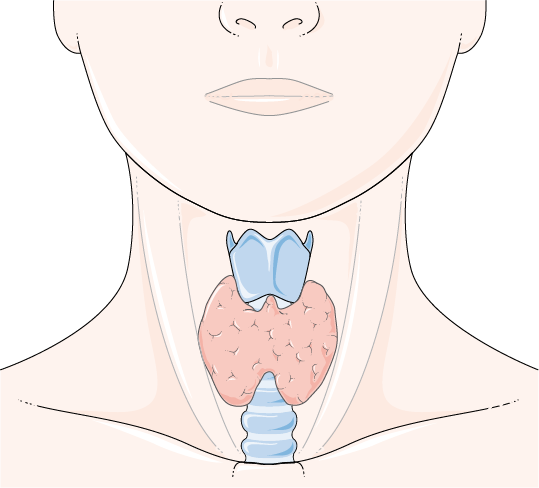
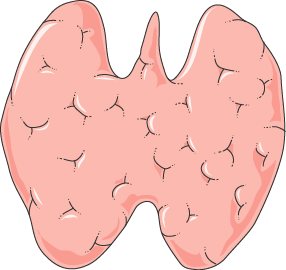
The thyroid is an endocrine gland found in vertebrates. In humans, it sits in the neck, just below the Adam's apple, and is shaped like a butterfly or the letter H. The gland has two connected lobes. A thin strip of tissue called the isthmus links the lower two-thirds of these lobes. Under a microscope, the thyroid's basic working unit is the spherical thyroid follicle. This follicle is lined with follicular cells, also called thyrocytes, and a few parafollicular cells. These cells surround a central space filled with a substance called colloid.
The thyroid makes three hormones: two thyroid hormones—triiodothyronine (T3) and thyroxine (T4)—plus a peptide hormone, calcitonin. T3 and T4 control the body's metabolic rate, help regulate protein synthesis, and are crucial for growth and development in children. Calcitonin helps manage calcium levels in the body. The release of T3 and T4 is controlled by thyroid-stimulating hormone (TSH), which comes from the anterior pituitary gland. TSH itself is regulated by thyrotropin-releasing hormone (TRH), produced by the hypothalamus.
Several disorders can affect the thyroid. Hyperthyroidism means too much thyroid hormone is released; the autoimmune condition Graves' disease is its most common cause. Hypothyroidism means too little thyroid hormone is released; iodine deficiency is the most common cause worldwide. In areas where iodine is scarce, this deficiency-driven hypothyroidism is the leading preventable cause of intellectual disability in children. Where iodine is plentiful, the autoimmune disorder Hashimoto's thyroiditis is the most common cause of hypothyroidism. Other thyroid problems include inflammation (thyroiditis), enlargement (goitre), nodules, and cancer.
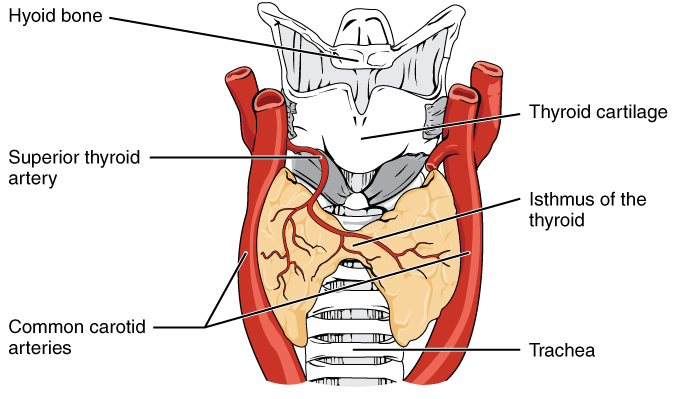
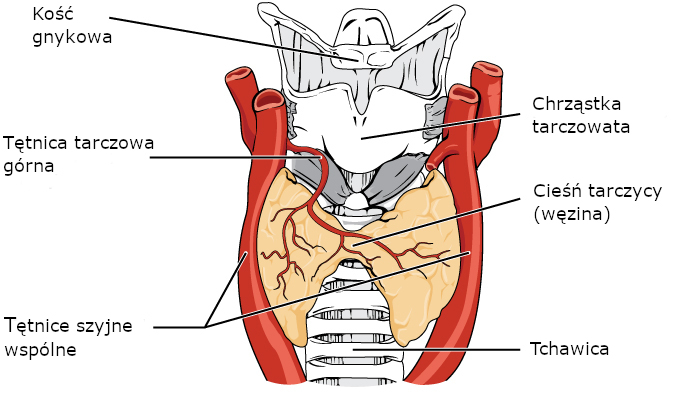
The thyroid's two lobes are each about 5 cm long, 3 cm wide, and 2 cm thick, with the isthmus roughly 1.25 cm in both height and width. The whole gland weighs about 25 grams in adults. It is usually larger in women than in men and grows during pregnancy. The gland sits near the front of the neck, against and around the front of the larynx and trachea. The thyroid cartilage and cricoid cartilage are just above it, below the Adam's apple. The isthmus spans from the second to third rings of the trachea, while the upper part of the lobes reaches the thyroid cartilage and the lower part extends to the fourth through sixth tracheal rings. The infrahyoid muscles lie in front of the gland, and the sternocleidomastoid muscle sits to the side. Behind the outer wings of the thyroid are the two carotid arteries. The trachea, larynx, lower pharynx, and esophagus all lie behind the gland. In this area, the recurrent laryngeal nerve and the inferior thyroid artery run next to or within a ligament. Typically, four parathyroid glands—two on each side—sit between the two layers of the thyroid capsule, at the back of the lobes.
A thin fibrous capsule covers the thyroid. Its inner layer pushes into the gland, forming septa that divide the tissue into microscopic lobules. The outer layer connects to the pretracheal fascia, attaching the gland to the cricoid and thyroid cartilages through a thickened part of the fascia called the posterior suspensory ligament of the thyroid gland, or Berry's ligament. This attachment makes the thyroid move up and down when a person swallows.
Blood reaches the thyroid through the superior thyroid artery (a branch of the external carotid artery) and the inferior thyroid artery (a branch of the thyrocervical trunk). Sometimes an anatomical variant called the thyroid ima artery also supplies it. The superior artery splits into anterior and posterior branches, and the inferior artery splits into superior and inferior branches; these join behind the outer part of the lobes. Venous blood drains through the superior and middle thyroid veins into the internal jugular vein, and through the inferior thyroid veins into the left and right brachiocephalic veins. Both arteries and veins form a network between the two layers of the thyroid capsule. Lymphatic drainage usually passes through the prelaryngeal lymph nodes (just above the isthmus) and the pretracheal and paratracheal nodes. The gland gets sympathetic nerve supply from the superior, middle, and inferior cervical ganglia of the sympathetic trunk, and parasympathetic supply from the superior laryngeal nerve and the recurrent laryngeal nerve.
The thyroid's size and shape vary, as does the position of the embedded parathyroid glands. A third lobe, called the pyramidal lobe or Lalouette's pyramid, is present in 18.3% to 44.6% of people. When it exists, it often stretches from the isthmus up to the hyoid bone and may consist of one or several divided sections. It usually arises from the left side and is sometimes separate. This lobe is a remnant of the thyroglossal duct, which normally disappears as the thyroid descends during development. Small accessory thyroid glands can appear anywhere along that duct, from the foramen cecum of the tongue to the adult position of the thyroid. A small horn at the back of the lobes, often near the recurrent laryngeal nerve and the inferior thyroid artery, is called Zuckerkandl's tubercle. Other variations include a levator muscle of the thyroid gland.
Quick Facts
- Latin
- glandula thyreoidea
- Precursor
- Thyroid diverticulum (an extension of endoderm into 2nd pharyngeal arch)
- System
- Endocrine system
- Artery
- Superior, inferior thyroid arteries
- Vein
- Superior
- middle
- inferior thyroid veins
Facts from the source article.
Lore & Background
Thyroid disorders include hyperthyroidism (often from Graves' disease), hypothyroidism (often from iodine deficiency or Hashimoto's thyroiditis), thyroiditis, goitre, nodules, and cancer. In iodine-deficient regions, hypothyroidism is the leading cause of preventable intellectual disability in children. Anatomical variants include a pyramidal lobe (Lalouette's pyramid) and Zuckerkandl's tubercle.
Gallery
Frequently Asked Questions
Who is Thyroid?
Thyroid is a butterfly-shaped endocrine gland positioned in the neck just beneath the Adam's apple, weighing about 25 grams in a healthy adult. It is one of the body's principal hormone-producing organs.
What is Thyroid known for?
Thyroid releases three hormones—T3, T4, and calcitonin—that control metabolic rate, protein synthesis, growth, development, and calcium homeostasis. Its basic working unit is the thyroid follicle, a small spherical cluster that stores and dispatches those hormones.
What is Thyroid's functional unit?
The thyroid follicle serves as Thyroid's functional unit, a round, single-layered cell cluster that synthesizes, stores, and secretes T3, T4, and calcitonin into the bloodstream. Each follicle acts as a miniature production line for the gland's three key hormones.
More in Physiology & Medicine
Spotted an error? Know more?
Reader corrections go straight into our review queue. Suggest an edit · How this site is sourced