
Tongue
Muscular organ for taste, chewing, swallowing, and speech.

Stephanie cheks · CC BY-SA 4.0
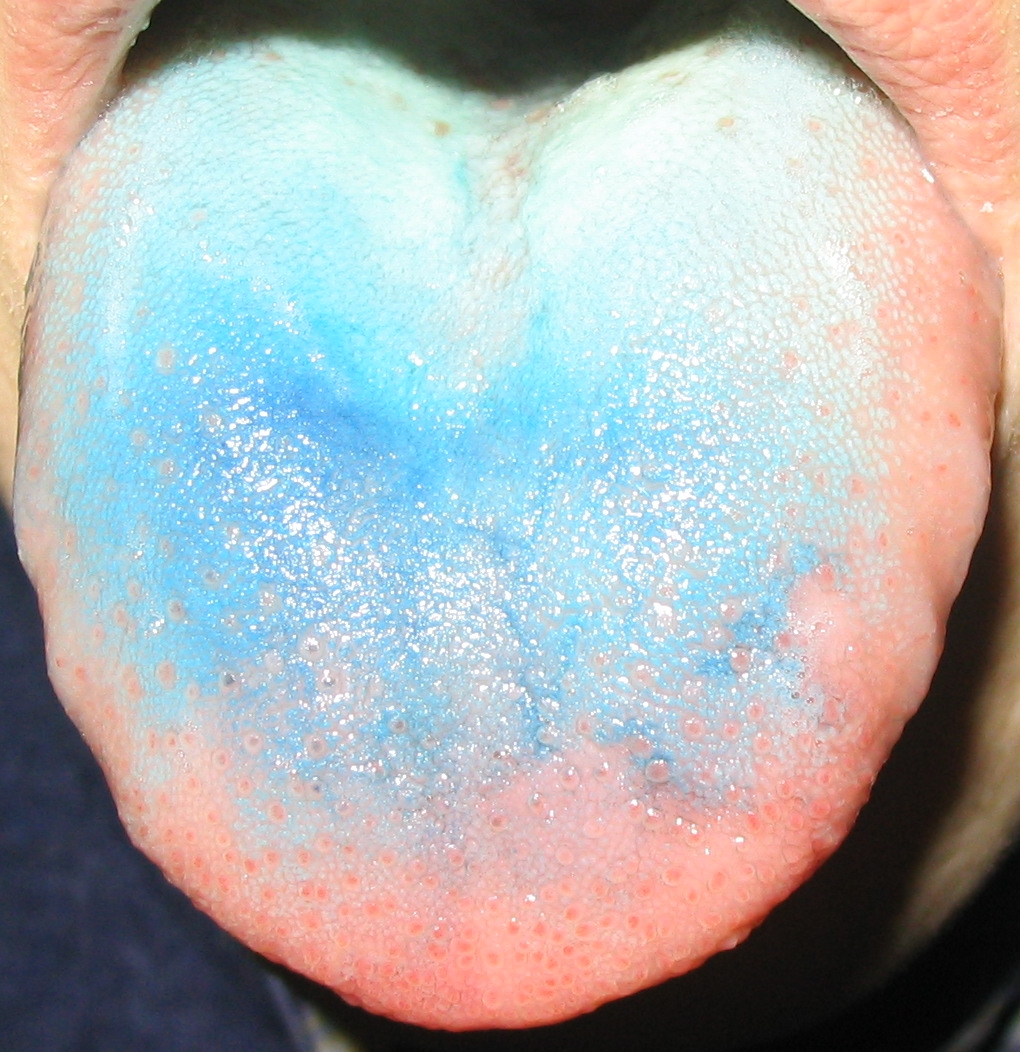
The tongue is a muscular organ found in the mouth of most tetrapods. Its main jobs in digestion are to move food around for chewing and to help with swallowing. It is also the body's main organ for taste. The top surface of the tongue, called the dorsum, is covered with taste buds that sit inside small bumps known as lingual papillae. The tongue is sensitive and stays moist thanks to saliva, and it has a rich supply of nerves and blood vessels. It also helps clean the teeth naturally. In humans, a key function of the tongue is enabling speech, while in other animals it allows for vocalization.
The human tongue has two main parts: the oral part at the front and the pharyngeal part at the back. A vertical strip of fibrous tissue called the lingual septum separates the left and right sides along most of the tongue's length, creating a visible groove on the surface known as the median sulcus. The tongue's muscles fall into two groups. The four intrinsic muscles change the tongue's shape and are not attached to any bone. The four paired extrinsic muscles move the tongue's position and are anchored to bone.
The word tongue comes from the Old English tunge, which traces back to Proto-Germanic tungōn. It has relatives in other Germanic languages, such as tonge in West Frisian, tong in Dutch and Afrikaans, Zunge in German, tunge in Danish and Norwegian, and tunga in Icelandic, Faroese, and Swedish. The -ue ending appeared in the fourteenth century as an attempt to show "proper pronunciation," but it is "neither etymological nor phonetic." Some people still used the spellings tunge and tonge as late as the sixteenth century.
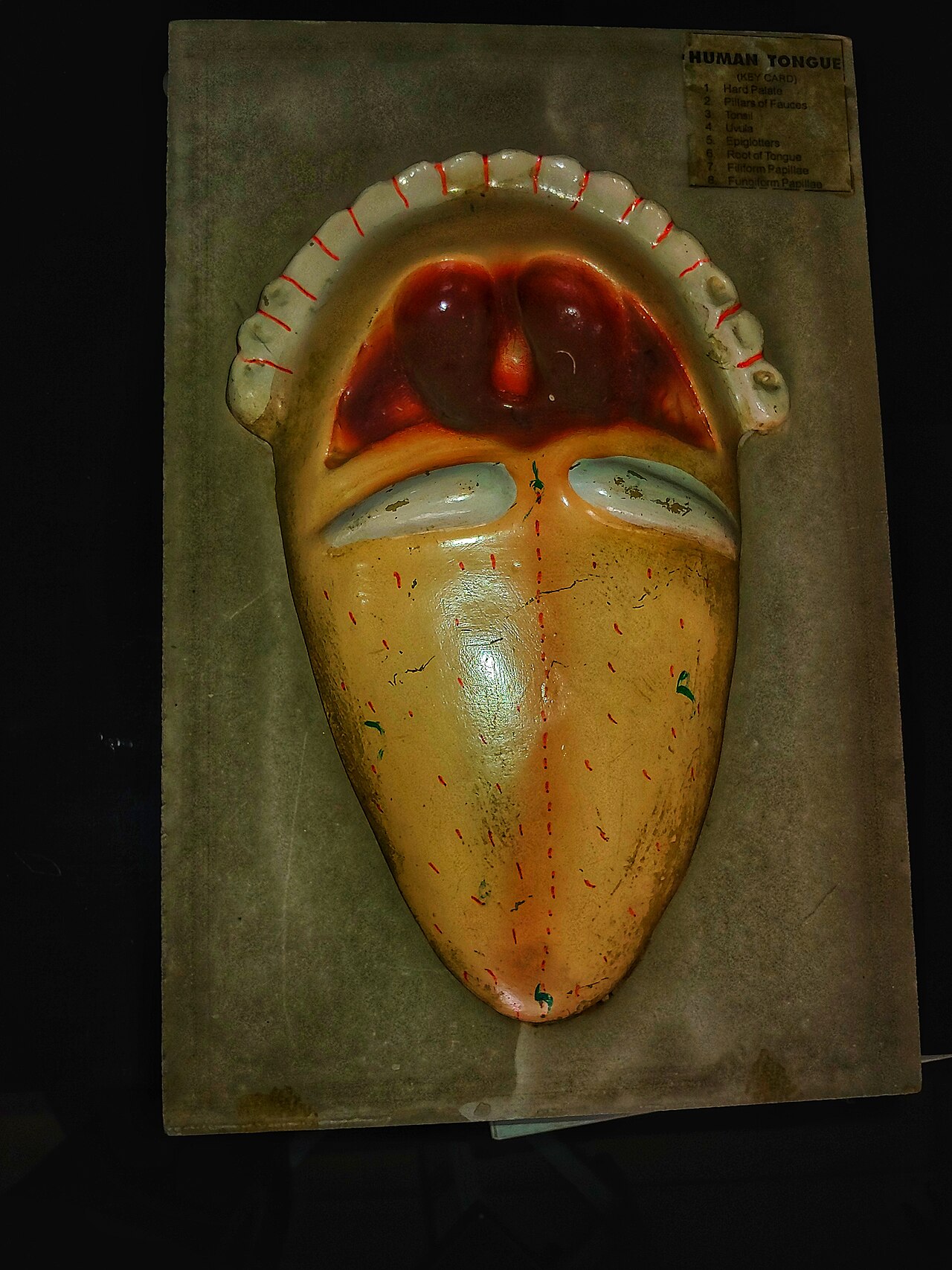
In humans, the tongue is a muscular hydrostat that sits in the floor of the oral cavity. The lingual septum divides the left and right sides along the tongue's length, except at the very back of the pharyngeal part, and this division shows as the median sulcus groove. The terminal sulcus, a V-shaped groove, splits the human tongue into an anterior (front) part and a posterior (back) part. At the tip of this V is a blind hole called the foramen cecum, a leftover from the median thyroid diverticulum in early embryonic development. The anterior oral part is the visible front section, making up about two-thirds of the tongue's length. The posterior pharyngeal part is the section closest to the throat, roughly one-third of the length. These two parts differ in how they develop in the embryo and in their nerve supply.
At its tip, the anterior tongue is thin and narrow, pointing forward against the inner surfaces of the lower incisor teeth. The posterior part, at its root, points backward and connects to the hyoid bone via the hyoglossi and genioglossi muscles and the hyoglossal membrane, to the epiglottis through three glossoepiglottic folds of mucous membrane, to the soft palate via the glossopalatine arches, and to the pharynx through the superior pharyngeal constrictor muscle and mucous membrane. It also forms the front wall of the oropharynx. The average human tongue measures 10 cm from the oropharynx to the tip. In adult males, it weighs about 99 grams, and in adult females, about 79 grams.
In phonetics and phonology, a distinction is made between the tip of the tongue and the blade (the area just behind the tip). Sounds made with the tongue tip are called apical, while those made with the blade are called laminal. Tongue posture refers to the resting position of the tongue in the mouth, and evidence shows the tongue influences mouth and face development.
The upper surface, or dorsum, is divided into symmetrical halves by the median sulcus groove. The foramen cecum marks where this division ends (about 2.5 cm from the tongue's root) and where the terminal sulcus begins. The foramen cecum is also where the thyroglossal duct attaches, formed during the thyroid diverticulum's descent in embryonic development. The terminal sulcus is a shallow V-shaped groove running forward from the foramen cecum to the tongue's borders. It splits the tongue into the posterior pharyngeal part and the anterior oral part. The pharyngeal part gets its nerve supply from the glossopharyngeal nerve, while the oral part gets somatosensory input from the lingual nerve (a branch of the mandibular branch V3 of the trigeminal nerve) and taste input from the chorda tympani (a branch of the facial nerve). Both parts develop from different pharyngeal arches.
On the underside, or ventral surface, a fold of mucous membrane called the frenulum tethers the tongue at the midline to the floor of the mouth. On each side of the frenulum are small bumps called sublingual caruncles, where the major salivary submandibular glands drain.
The eight muscles of the human tongue are either intrinsic or extrinsic. The four intrinsic muscles change the tongue's shape and are not attached to bone. The four extrinsic muscles change the tongue's position and are anchored to bone. The extrinsic muscles originate from bone and extend to the tongue. They are the genioglossus, the hyoglossus (often including the chondroglossus), the styloglossus, and the palatoglossus. Their main roles are moving the tongue for protrusion, retraction, and side-to-side motion. The genioglossus comes from the mandible and pushes the tongue forward; it is called the tongue's "safety muscle" because it is the only muscle that propels the tongue forward. The hyoglossus arises from the hyoid bone and pulls the tongue back and down. The chondroglossus is often included with the hyoglossus.
Quick Facts
- Latin
- lingua
- Greek
- γλῶσσα (glôssa)
- Precursor
- Pharyngeal arches
- lateral lingual swelling
- tuberculum impar
- Artery
- Lingual
- tonsillar branch
- ascending pharyngeal
- Vein
- Lingual
- Lymph
- Deep cervical
- submandibular
- submental
- System
- Alimentary tract, gustatory system
Facts from the source article.
Lore & Background
The word tongue derives from Old English tunge, from Proto-Germanic tungōn, with cognates in many Germanic languages. The ue ending appeared in the fourteenth century as an attempt to show 'proper pronunciation' but is 'neither etymological nor phonetic.' In phonetics, sounds made with the tongue tip are apical, and those with the blade are laminal. Tongue posture plays a role in mouth and face development.
Gallery




Frequently Asked Questions
Who is Tongue?
Tongue is the muscular organ occupying the oral cavity of a typical tetrapod. It spans roughly 10 cm from the oropharynx to its tip and averages about 99 g in an adult male or 79 g in an adult female.
What is Tongue known for?
Tongue manipulates food during chewing and swallowing, serves as the body's principal taste organ, helps clean the teeth, and—uniquely in humans—enables speech while supporting vocalization in other species.
What's Tongue's muscle team?
Eight muscles drive Tongue's movements: four intrinsic muscles reshape it, and four extrinsic muscles reposition it. Motor innervation comes mainly from the hypoglossal nerve (CN XII), with the palatoglossus as the sole exception, supplied instead by the vagus nerve (CN X).
How does Tongue handle taste?
Taste signals from the anterior two-thirds of Tongue travel via the chorda tympani, a branch of the facial nerve (CN VII). Together with posterior sensory pathways, this makes Tongue the body's dedicated organ for detecting flavor.
More in Physiology & Medicine
Spotted an error? Know more?
Reader corrections go straight into our review queue. Suggest an edit · How this site is sourced