
Spleen

Cancer Research UK uploader · via Wikipedia: Spleen · CC BY-SA 4.0
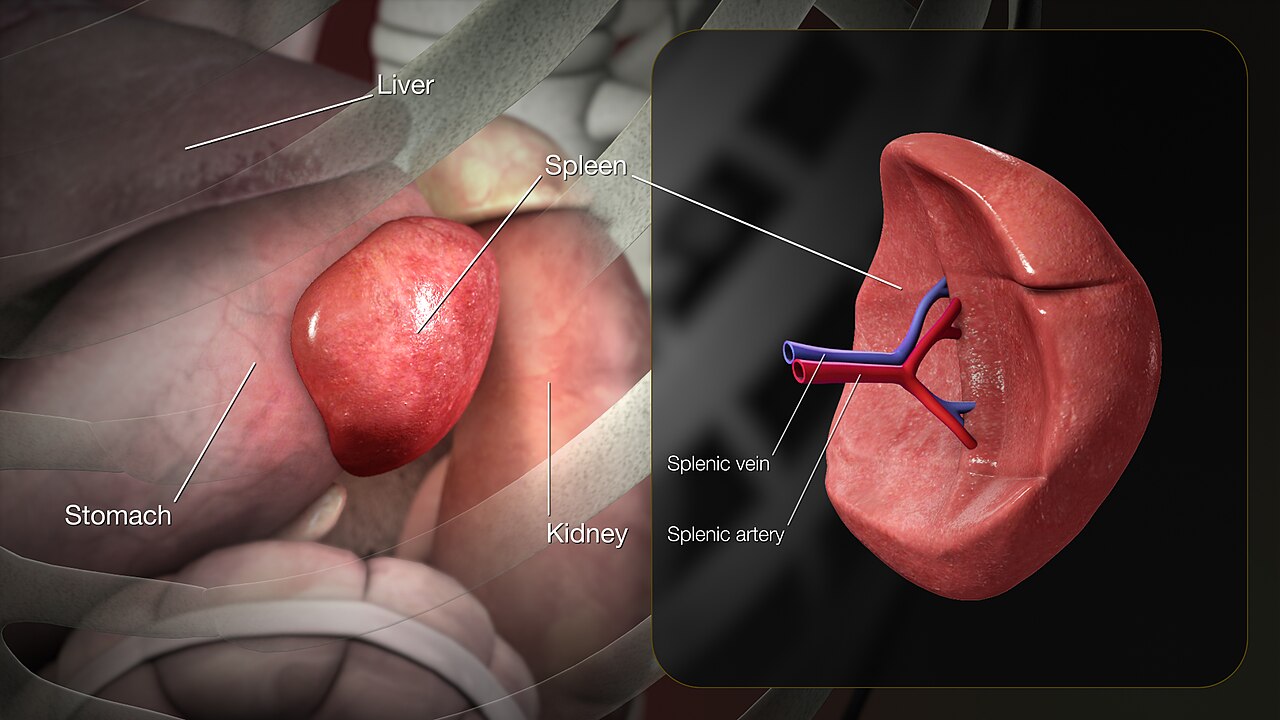
The spleen is an organ found in almost all vertebrates, with lampreys and hagfishes being the only vertebrates that lack one.[1][2] The spleen contributes to both innate and adaptive immunity through its red and white pulp.[3]
Quick Facts
- Latin
- splen, lien
- System
- Immune system (lymphatic system)
- Artery
- Splenic artery
- Vein
- Splenic vein
- Nerve
- Splenic plexus
Facts from the source article.
Key facts and history
White pulp houses T lymphocytes in periarteriolar lymphoid sheaths and B lymphocytes in follicles.[3] In healthy adults, the spleen's length ranges from 7 to 14 cm and its weight falls between 1 and 8 oz.[4] Red pulp and white pulp are the two main tissue types in the spleen, each serving different immune functions.[3] Venous sinuses and splenic cords known as the cords of Billroth make up the red pulp, which encloses the white pulp.[5]
Hematopoietic functions are carried out by the human spleen until the fifth month of gestation.[6] Splenectomy is the term for the surgical removal of the spleen.[7]
What the research sources say
Angelica Lodin‐Sundström and Erika K. A. Schagatay published a 2010 study on spleen contraction during normobaric hypoxia and apnea in humans in Aviation Space and Environmental Medicine.[8] Antonio Di Sabatino, Rita Carsetti, and Gino Roberto Corazza published a 2011 article in The Lancet on post-splenectomy and hyposplenic states.[9]
Gallery
References
- Wikipedia, "Spleen" (CC BY-SA 4.0), which cites: Liddell, Clarendon Press, 1940, p. 1628 (original not read by us) en.wikipedia.org
- Wikipedia, "Spleen" (CC BY-SA 4.0), which cites: Romer, Alfred Sherwood, "The Vertebrate Body", Holt-Saunders International, 1977, p. 410–11 (we also read that source) en.wikipedia.org
- Wikipedia, "Spleen" (CC BY-SA 4.0), which cites: Crane, "Spleen: Development, anatomy and reactive lymphoid proliferations", Seminars in Diagnostic Pathology, 2021-03-01, p. 112–124 (we also read that source) en.wikipedia.org
- Wikipedia, "Spleen" (CC BY-SA 4.0), which cites: Molina, "Normal Organ Weights in Men", The American Journal of Forensic Medicine and Pathology, 2012, p. 368–372; Sprogøe-Jakobsen, "The weight of the normal spleen", Forensic Science International, 1997, p. 215–223 (original not read by us) en.wikipedia.org
- Wikipedia, "Spleen" (CC BY-SA 4.0), which cites: Crane, "Spleen: Development, anatomy and reactive lymphoid proliferations", Seminars in Diagnostic Pathology, 2021-03-01, p. 112–124; Cesta, "Normal Structure, Function, and Histology of the Spleen", Toxicologic Pathology, 2006-08-01, p. 455–465; Swirski, "Identification of splenic reservoir monocytes and their deployment to inflammatory sites", Science, 2009, p. 612–16; Jia, "Immunology: Dispensable but not irrelevant", Science, 2009, p. 549–50; Angier, "Finally, the Spleen Gets Some Respect", The New York Times, August 3, 2009 (we also read th en.wikipedia.org
- Wikipedia, "Spleen" (CC BY-SA 4.0), which cites: Carey, "Horse science: What makes a Derby winner – Spleen acts as a 'natural blood doper,' scientist says", NBC News, May 5, 2006; "Spleen: Information, Surgery and Functions", Chp.edu, 2010-11-17; Lodin-Sundström, "Spleen contraction during 20 min normobaric hypoxia and 2 min apnea in humans", Aviation, Space, and Environmental Medicine, June 2010, p. 545–49 (we also read that source) en.wikipedia.org
- Wikipedia, "Spleen" (CC BY-SA 4.0), which cites: Mebius, "Structure and function of the spleen", Nature Reviews. Immunology, 2005, p. 606–16; "Harrison's principles of internal medicine", McGraw-Hill Medical, 2008 (original not read by us) en.wikipedia.org
- Angelica Lodin‐Sundström, "Spleen Contraction During 20 min Normobaric Hypoxia and 2 min Apnea in Humans", Aviation Space and Environmental Medicine (2010), doi:10.3357/asem.2682.2010. OpenAlex metadata CC0; paper not read. doi.org
- Antonio Di Sabatino, "Post-splenectomy and hyposplenic states", The Lancet (2011), doi:10.1016/s0140-6736(10)61493-6. OpenAlex metadata CC0; paper not read. doi.org
Each numbered sentence above was checked against the source it cites before publication. Sentences citing Wikipedia adapt text from the English Wikipedia article Spleen (contributors), used under CC BY-SA 4.0; this entry is available under the same licence. Other sources were used for facts only; no text or images are copied from them.
More in Physiology & Medicine
Spotted an error? Know more?
Reader corrections go straight into our review queue. Suggest an edit · How this site is sourced