
Stomach

Calicut Medical College · CC BY-SA 4.0
The stomach functions as a vital digestive organ that chemically breaks down food using secreted enzymes and gastric acid.[1][2] In humans and numerous other animals, including some invertebrates, the stomach is a hollow, muscular organ situated in the upper gastrointestinal tract.[1]
Quick Facts
- Latin
- ventriculus, stomachus
- Greek
- στόμαχος (stómakhos)
- Precursor
- Foregut
- System
- Digestive system
- Vein
- Right gastric vein
- left gastric vein
- right gastroepiploic vein
- left gastroepiploic vein
- short gastric veins
- Nerve
- Celiac ganglia, vagus nerve
- Lymph
- Celiac lymph nodes
Facts from the source article.
Key facts and history
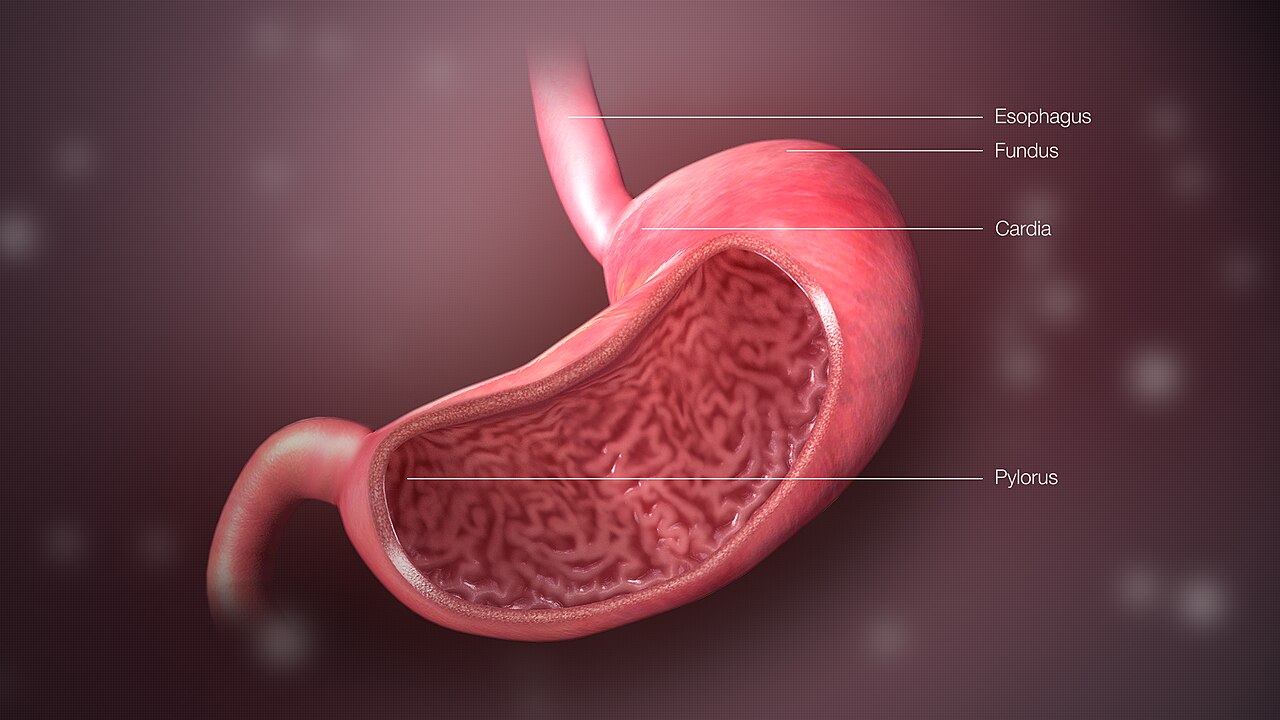
The stomach is divided into four sections: cardia, fundus, body, and pylorus.[3] The stomach wall consists of mucosa, submucosa, muscular layer, subserosa, and serosa.[4] The stomach is distensible; its typical capacity is about one litre, though in adults the maximum volume ranges from 2 to 4 litres, with extreme cases reaching up to 15 litres.[5][6] The stomach's shape varies with distension: it is somewhat J-shaped when empty and becomes pyriform when partially distended.[5]
The cardia is a small zone around the esophageal opening, while the fundus is the upper, dome-shaped part.[7] Philip Polson of the Catholic University School of Medicine, Dublin, first introduced the term "stomach bed" around 1896.[8]
What the research sources say
The stomach holds food and parses only small amounts into the small intestine at a time.[9] The Kenhub histology resource explains that the stomach wall consists of 4 layers of tissue and that the inner wall is thrown into folds called rugae.[10] The Medicine LibreTexts entry states that the stomach has a third layer of muscularis externa, the inner oblique layer, which helps churn chyme.[11] The SIU SOM Histology resource reports that the thick mucosa of the stomach is characterized by closely packed tubular glands beneath a surface of simple columnar epithelium.[12]
Gallery
References
- Wikipedia, "Stomach" (CC BY-SA 4.0), which cites: "Definition of GASTRIC", www.merriam-webster.com, 12 May 2025 (original not read by us) en.wikipedia.org
- Wikipedia, "Stomach" (CC BY-SA 4.0), which cites: Chaurasia, "Human Anatomy", CBS Publishers and Distributors, 2013, p. 250–252 (we also read that source) en.wikipedia.org
- Wikipedia, "Stomach" (CC BY-SA 4.0), which cites: Tortora, "Principles of anatomy and physiology", Wiley, 2009, p. 937–942; "Gray's Anatomy", Elsevier, p. 1160–1163; "Schwartz's principles of surgery", McGraw-Hill, Medical Pub. Division, 2010; "Gray's Anatomy", Elsevier, p. 1160–1163 (original not read by us) en.wikipedia.org
- Wikipedia, "Stomach" (CC BY-SA 4.0), which cites: "University of Rochester medical center", 2020 (original not read by us) en.wikipedia.org
- Wikipedia, "Stomach" (CC BY-SA 4.0), which cites: Sherwood, Lauralee, "Human physiology: from cells to systems", Wadsworth Pub. Co, 1997; Chaurasia, "Human Anatomy", CBS Publishers and Distributors, 2013, p. 250–252 (we also read that source) en.wikipedia.org
- Wikipedia, "Stomach" (CC BY-SA 4.0), which cites: "Respiratory system compliance decreases after cardiopulmonary resuscitation and stomach inflation: impact of large and small tidal volumes on calculated peak airway pressure", Resuscitation, 1998, p. 113–8; Curtis, Helena & N. Sue Barnes, "Invitation to Biology", Worth, 1994; Morris D. Kerstein, Barry Goldberg, Barry Panter, M. David Tilson, Howard Spiro, Gastric Infarction, Gastroenterology, Volume 67, Issue 6, 1974, Pages 1238–1239 (we also read that source) en.wikipedia.org
- Wikipedia, "Stomach" (CC BY-SA 4.0), which cites: "Gray's Anatomy", Elsevier, p. 1160–1163; "Gray's Anatomy", Elsevier, p. 1160–1163; "Anatomy of the Stomach SEER Training", training.seer.cancer.gov; "Anatomy of the Stomach SEER Training", training.seer.cancer.gov (we also read that source) en.wikipedia.org
- Wikipedia, "Stomach" (CC BY-SA 4.0), which cites: Transactions of the Royal Academy of Medicine in Ireland, Volume 14, 1896, "Birmingham, A(mbrose), "Topographical anatomy of the spleen, pancreas, duodenum, kid; The Lancet, Volume 1, Part 1, 22 February 1902. page 524, "Royal Academy of Medicine in Ireland." Retrieved 28 February 2012; The Dublin journal of medical science, Volume 114, page 353."Reviews and bibliographical notes." Retrieved 28 February 2012. (we also read that source) en.wikipedia.org
- Betts, "Anatomy & Physiology", OpenStax CNX, September 13, 2023. facts only, no text reused. openstax.org
- "Stomach histology", Kenhub. facts only, no text reused. kenhub.com
- "22.5C: Muscularis", Medicine LibreTexts, 2018-07-22. facts only, no text reused. med.libretexts.org
- "SIU SOM Histology GI", www.siumed.edu. facts only, no text reused. siumed.edu
Each numbered sentence above was checked against the source it cites before publication. Sentences citing Wikipedia adapt text from the English Wikipedia article Stomach (contributors), used under CC BY-SA 4.0; this entry is available under the same licence. Other sources were used for facts only; no text or images are copied from them.
More in Physiology & Medicine
Spotted an error? Know more?
Reader corrections go straight into our review queue. Suggest an edit · How this site is sourced