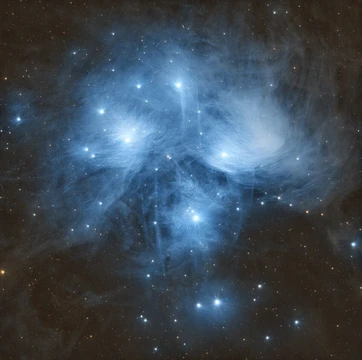
Alpha Persei
Brightest star in Perseus, supergiant anchor of the Alpha Persei Cluster.
Last updated

Giuseppe Donatiello · CC0
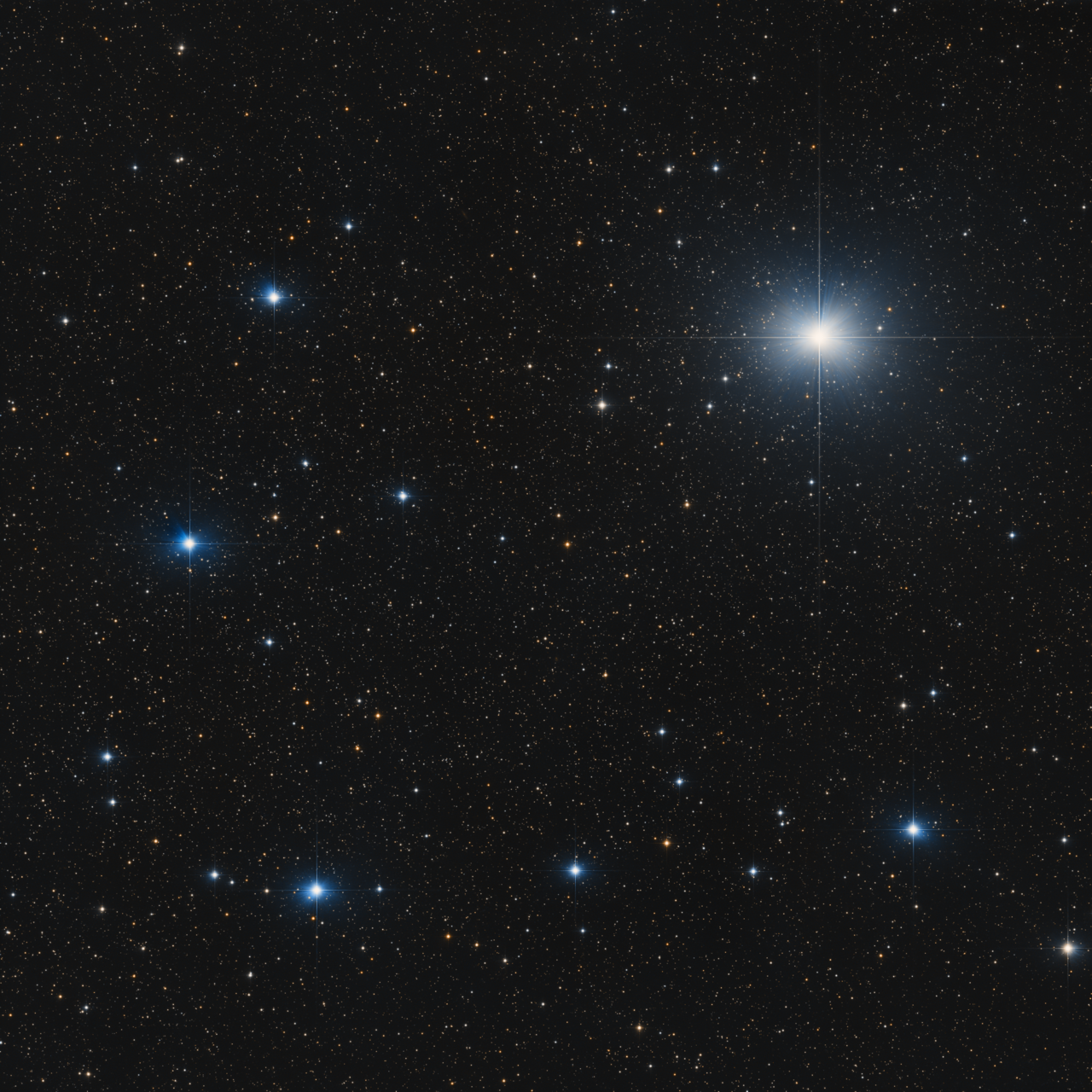
Alpha Persei, formally named Mirfak, is the brightest star in the northern constellation of Perseus, outshining the constellation's best-known star, Algol. With an apparent visual magnitude of 1.8, it is a circumpolar star when viewed from mid-northern latitudes. The star lies in the midst of the eponymous Alpha Persei Cluster (Melotte 20), which is easily visible in binoculars and includes many of the fainter stars in the constellation. Its distance, determined using trigonometric parallax, places it 510 light-years away.
Quick Facts
- Bayer designation
- α Persei
- Apparent visual magnitude
- 1.8
- Distance
- 510 ly (trigonometric parallax)
- Spectral classification
- F5 Ib
- Mass
- 6 to 7 times the Sun's mass
- Radius
- ~54 times the Sun's radius
- Luminosity
- 4,020 times the Sun's luminosity
Facts from the source article.
Lore & Background
Alpha Persei bears the traditional names Mirfak and Algenib, both Arabic in origin. Mirfak, meaning 'Elbow', comes from the Arabic Mirfaq al-Thurayya, while Algenib derives from 'the flank' or 'side'. In 2016, the International Astronomical Union's Working Group on Star Names approved Mirfak as the star's proper name. In Native Hawaiian astronomy, the star is called Hinaliʻi, commemorating a great tsunami and marking the beginning of the migration of Maui; according to some folklore, Hinaliʻi is the point of separation between Earth and sky during the creation of the Milky Way.
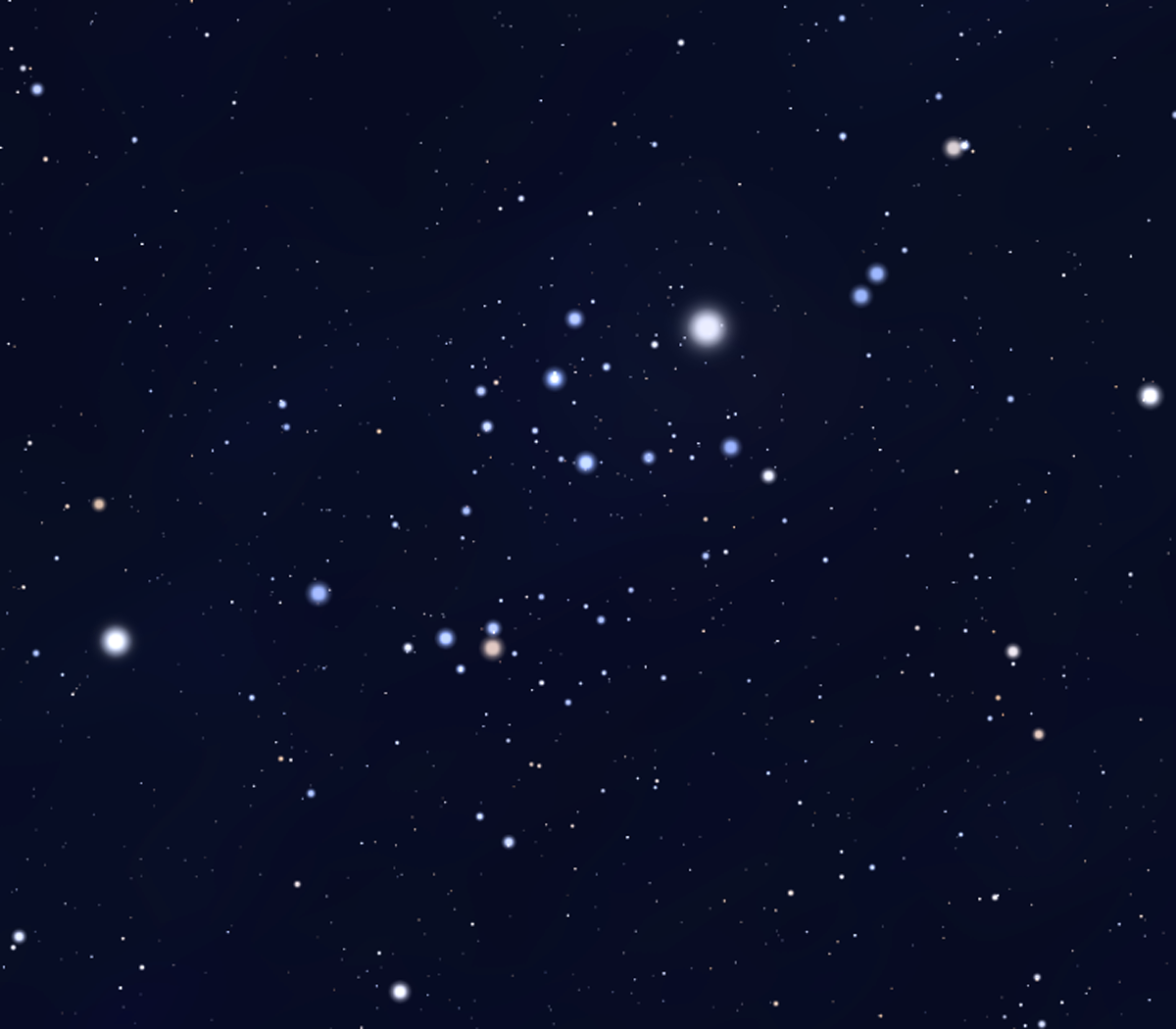
Assemani alluded to a title on the Borgian globe, Mughammid or Muliammir al Thurayya, meaning the Concealer of the Pleiades, which may be for this star. Together with γ, δ, η, σ, and ψ Persei, it has been called the Segment of Perseus. In Chinese astronomy, it is part of an asterism called the Celestial Boat.
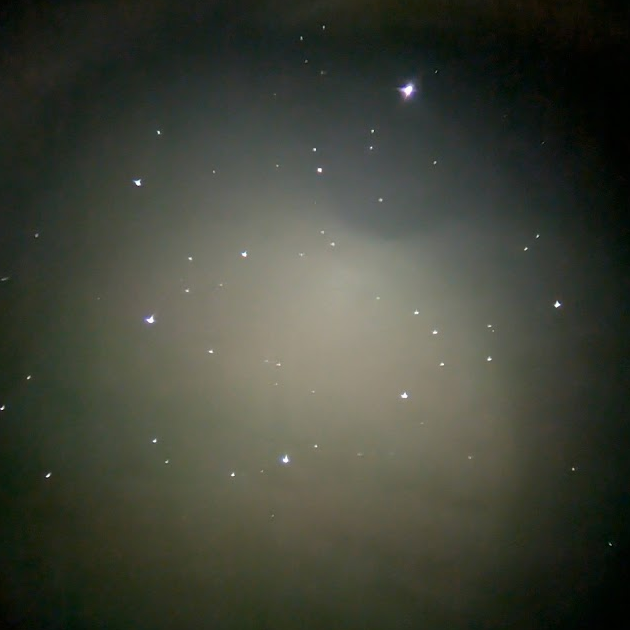
A Blue-Flecked Jewel in Perseus
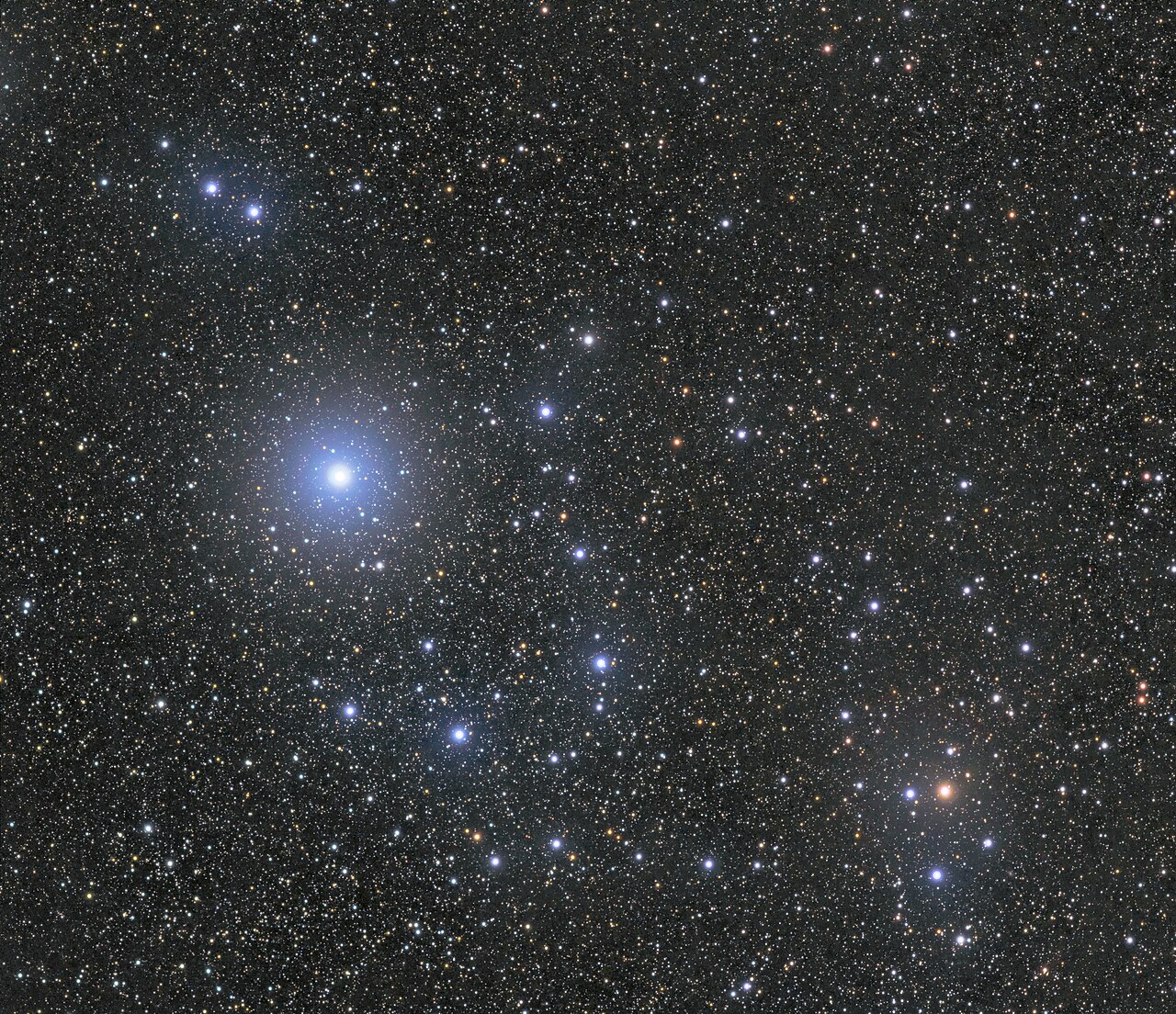
The Alpha Persei Cluster, catalogued as Melotte 20 or Collinder 39, sits in the northern constellation of Perseus and presents a striking sight to unaided eyes. Rather than a single point of light, the cluster resolves into a small grouping of stars that carry a distinctly blue hue, a signature of their spectral type B classification. Dominating the assembly is Mirfak, a yellow supergiant shining at roughly second magnitude, which anchors the cluster's identity and lends it its most familiar name.
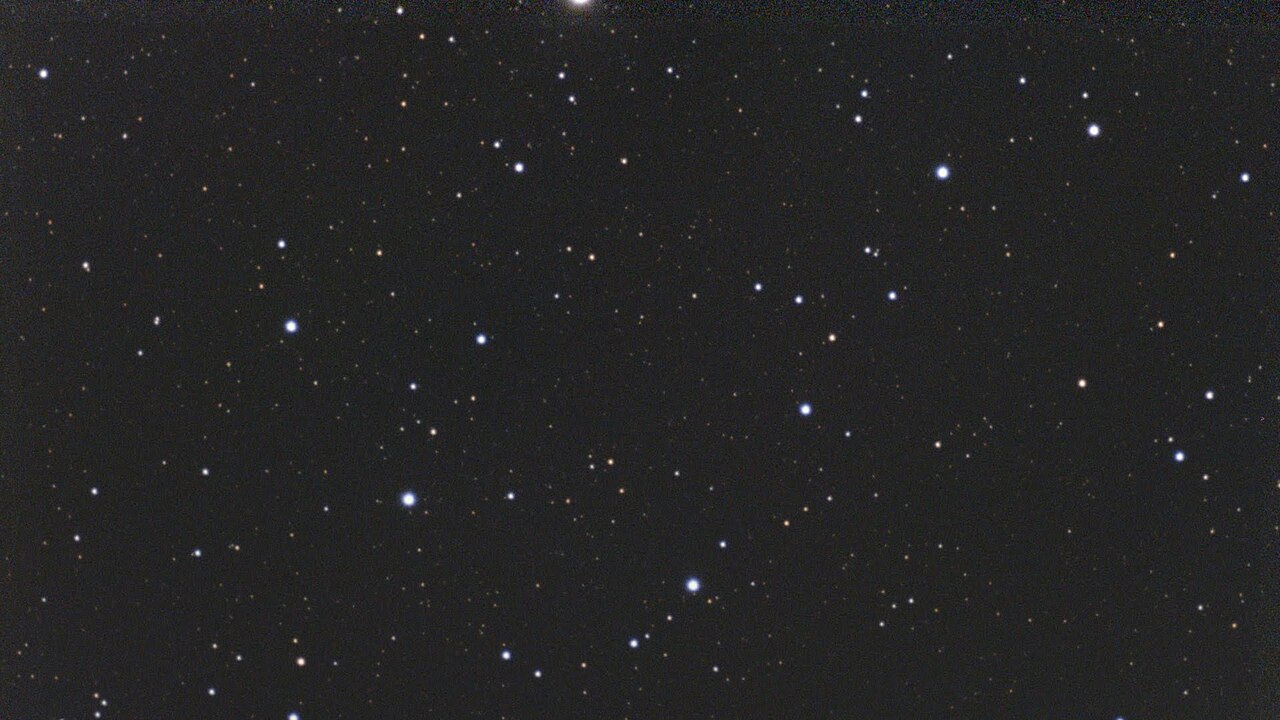
Surrounding this luminous anchor, several other bright contributors—Delta, Sigma, Psi, 29, 30, 34, and 48 Persei—add depth and structure to the naked-eye picture. The cluster's center lies to the northeast of Mirfak itself, meaning the supergiant sits slightly off the geometric heart of the group. Together, these members create a compact, visually coherent patch of stellar light that has drawn the attention of observers for centuries, even before modern instruments could reveal the cluster's true physical extent and internal architecture.
Reader's Guide
Alpha Persei's spectrum matches a stellar classification of F5 Ib, revealing it to be a supergiant star in the latter stages of its evolution. Since 1943, its spectrum has served as one of the stable anchor points by which other stars are classified. In the Hertzsprung–Russell diagram, Alpha Persei lies inside the region where Cepheid variables are found, making it useful in the study of these important standard candles. Hipparcos photometry shows a 0.006-magnitude variation with a period of 9.5 days, though the star is not a Cepheid.
The star has a weak magnetic field, and its rotation period may be either 50 or 90 days. Periodic radial velocity variations have been observed, with an amplitude of 70.8 ± 1.6 m/s. A 2012 study considered the possibility of an orbiting exoplanet with a minimum mass of about 6.6 times that of Jupiter and an orbital period of 128 days, but the claimed period may not be stable over 20 years, so the exoplanet was considered doubtful; rotational modulation due to surface activity such as starspots was suggested as a more likely explanation. A further study in 2025 found that the ~130-day period weakened and disappeared while a 66-day period appeared, and the hypothesis of a planet around Mirfak was discarded; the most reasonable explanation for the radial velocity variations is stellar oscillations.
Frequently Asked Questions
What is the Alpha Persei Cluster?
The Alpha Persei Cluster, catalogued as Melotte 20, is a loose grouping of stars in the northern constellation Perseus that surrounds the brilliant supergiant Mirfak. It is readily visible through binoculars and encompasses many of the fainter stars that make up the constellation's outline.
How far away is the Alpha Persei Cluster?
Trigonometric parallax measurements place the cluster at roughly 510 light-years from Earth, making it one of the more distant naked-eye open clusters visible in the northern sky.
What star anchors the Alpha Persei Cluster?
Mirfak (α Persei), an F5 Ib supergiant with a mass of about six to seven solar masses and a radius roughly 54 times that of the Sun, sits at the heart of the cluster. With an apparent visual magnitude of 1.8, it outshines even the famous variable star Algol.
More in Open Clusters
Sources
Compiled from Wikipedia and the sources listed below. Text from Wikipedia is available under CC BY-SA 4.0; this entry is adapted from it.
- Wikipedia: Alpha Persei (CC BY-SA 4.0).
Spotted an error? Know more?
Reader corrections go straight into our review queue. Suggest an edit · How this site is sourced