HD 21071
A B-type variable star in the Alpha Persei Cluster.
Last updated
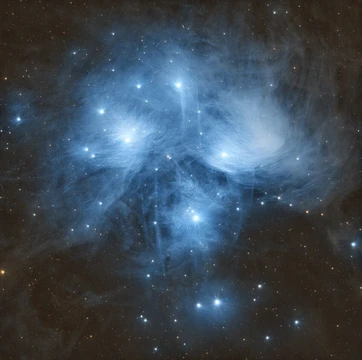
HD 21071, also cataloged as V576 Persei, is a variable star located in the northern constellation Perseus. With an apparent visual magnitude of 6.09, it appears as a faint sixth-magnitude point of light just barely visible to the unaided eye under clear skies. The star belongs to the young Alpha Persei Cluster (Melotte 20) and is moving toward Earth at a heliocentric radial velocity of −1.5 km/s. Its distance, based on annual parallax, is about 535 light-years.
This is a B-type main-sequence star with a stellar classification of B7 V. It is classified as an 'sn' star, a rare type that combines sharp Balmer and metal absorption lines ('s') with broad, coreless helium I lines ('n'). The broad helium lines may result from Stark broadening due to an electric field. HD 21071 is a slowly pulsating B-type (SPB) star. Initially found to vary with a period of 0.84 days, further analysis revealed four distinct frequencies; the two dominant, higher-amplitude cycles occur at 1.19 and 1.15 per day.
Stellar models indicate HD 21071 has 3.7 times the mass of the Sun and 2.21 times its radius. It is about 90 million years old, with near-solar metallicity, and rotates with a projected rotational velocity of 58 km/s. The star radiates 278 times the Sun’s luminosity from its photosphere, which has an effective temperature of 14,768 K.
Quick Facts
- Apparent visual magnitude
- 6.09
- Distance
- 535 light years
- Spectral type
- B7 V
- Effective temperature
- 14,768 K
Facts from the source article.
Lore & Background
HD 21071 is a B-type main-sequence star with a stellar classification of B7 V. It belongs to an unusual stellar population termed 'sn' stars, which seem to be related to chemically peculiar stars but have sharp ('s') Balmer and metal absorption lines with 'broad coreless He I' ('n') lines. The latter wide, 'nebulous' lines may be due to Stark broadening caused by an electric field. The star is 90 million years old with a near-solar metallicity and is spinning with a projected rotational velocity of 58 km/s.
HD 21071 is a slowly pulsating B-type star (SPB star) that was initially found to vary with a period of 0.84 days. Further study revealed four frequencies, with the two dominant, higher amplitude frequencies having similar cycles of 1.19 and 1.15 per day. The brightness of the star varies with a multiperiodic cycle. It is moving closer to Earth with a heliocentric radial velocity of −1.5 km/s.
Reader's Guide
HD 21071's significance lies in its membership in the young Alpha Persei Cluster (Melotte 20), which provides a well-studied stellar population for understanding early stellar evolution. As a slowly pulsating B-type star, it contributes to the study of stellar pulsations and interior structure in intermediate-mass stars. Its classification as an 'sn' star places it within a rare and poorly understood group of chemically peculiar stars, offering insight into atmospheric phenomena such as Stark broadening.
The multiperiodic nature of its variability, with dominant frequencies near 1.19 and 1.15 cycles per day, makes it a valuable target for asteroseismology. Its near-solar metallicity and age of 90 million years help constrain models of B-star evolution in open clusters. The star's proximity at 535 light years and its visibility to the naked eye under good conditions allow for both amateur and professional monitoring of its brightness changes.
More in Open Clusters
Sources
Compiled from Wikipedia and the sources listed below. Text from Wikipedia is available under CC BY-SA 4.0; this entry is adapted from it.
- Wikipedia: HD 21071 (CC BY-SA 4.0).
Spotted an error? Know more?
Reader corrections go straight into our review queue. Suggest an edit · How this site is sourced