IC 2395
A young open cluster in Vela, possibly part of Vela OB1C.
Last updated

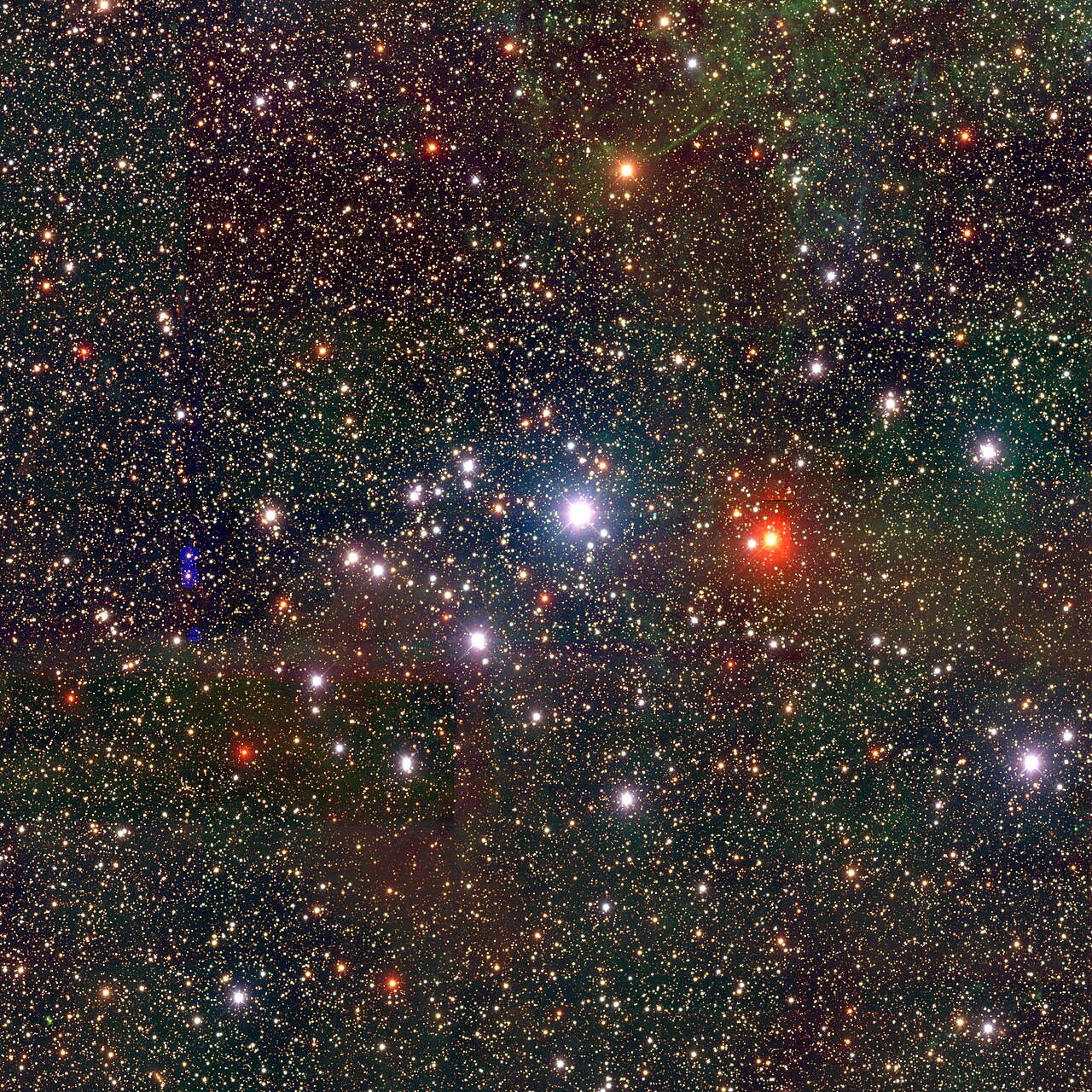
DECaPS / Legacy Surveys / D.Lang (Perimeter Institute) & Meli thev · CC BY 4.0
IC 2395 is an open cluster located in the southern constellation Vela. It is a young cluster, with an age estimated between 6 and 18 million years, and is considered poor to moderate in richness.
The cluster may have been first observed on February 17, 1752, by Nicolas Louis de Lacaille, who recorded an entry (III.3) describing a 6th-magnitude star connected to a fainter southern star by a "nebulous trace." The coordinates he gave place the object about 2 arcminutes west and 1 arcminute south of the position of van den Bergh-Hagen 47, which lies within the cluster’s diameter. The cluster was independently discovered in 1908 by Solon Irving Bailey, and later catalogued by Sidney van den Bergh and Gretchen Luft Hagen in 1975. Although some catalogs list IC 2395 and vdBH 47 as separate objects due to an inaccurate position given by Lund, their coordinates are in fair agreement, and Clariá et al. supported their identity as the same cluster, estimating its angular diameter at 19 arcminutes.
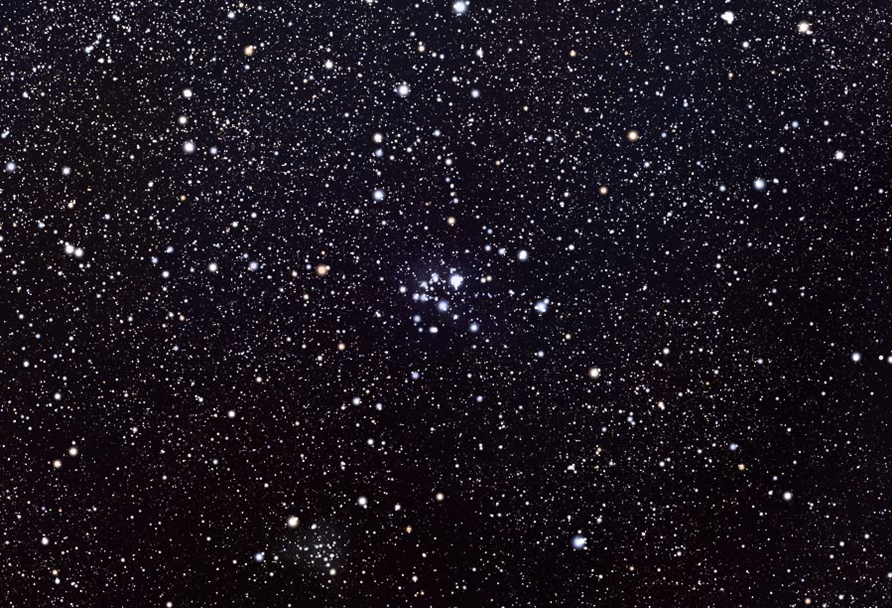
Within the cluster’s central region, 45 stars are considered possible members. Its core radius is 0.53 parsecs (1.6 light-years), while the tidal radius—the average outer limit beyond which a star is unlikely to remain gravitationally bound—ranges from 4.5 to 7.9 parsecs (15 to 26 light-years). Based on its young age and distance, IC 2395 may belong to the Vela OB1C stellar association.
The brightest member has a magnitude of 5.53, and the bluest main-sequence star is of spectral type B5. One member is a candidate Be star. Another member, HD 74339 (magnitude 9.3, spectral type B2/3 II/III), is a beta Cephei variable.
Lore & Background
The history of IC 2395 involves possible earlier observation by Nicolas Louis de Lacaille on February 17, 1752. His entry III.3, often listed as missing, describes a 'Star of 6th magnitude, connected to another more southern one by a nebulous trace' at coordinates RA=08:42.2, Dec=-48:04. These coordinates lie 2' west and 1' south of the location of van den Bergh-Hagen 47, which is within the cluster's diameter.
The cluster was independently discovered in 1908 by Solon Irving Bailey, and later catalogued by Sidney van den Bergh and Gretchen Luft Hagen in 1975. The coordinates of vdBH 47 agree fairly with those of IC 2395, though inaccurate positioning by Lund led Sky Catalogue 2000.0, Deep Sky Field Guide, and the first edition of Uranometria to list two separate clusters. The identity of the two is supported by Clariá et al., who estimated the cluster's angular diameter at 19 arcminutes.
IC 2395 contains 45 possible member stars in its central region. Its core radius is 0.53 parsecs, and its tidal radius ranges from 4.5 to 7.9 parsecs, marking the outer limit beyond which stars are unlikely to remain gravitationally bound.
The brightest member has magnitude 5.53, and the bluest main sequence star is of spectral type B5. One member is a candidate Be star, and HD 74339 (magnitude 9.3, spectral type B2/3 II/III) is a beta Cephei variable. Based on its young age and distance, IC 2395 may be part of the Vela OB1C stellar association.
A Tangled Discovery Spanning Two Centuries
IC 2395 carries a discovery history that stretches back more than two centuries and involves at least three independent observers. In February 1752, Nicolas Louis de Lacaille recorded an object he described as a sixth-magnitude star joined to a fainter southern companion by a wispy nebulous thread. Although his catalogue entry III.3 is frequently cited as lost, the coordinates he noted—right ascension 08:42.2, declination −48:04—sit just two arcminutes west and one arcminute south of the modern position of van den Bergh-Hagen 47, comfortably inside the cluster's known diameter.
The object was then independently rediscovered in 1908 by Solon Irving Bailey, who entered it into the Index Catalogue. In 1975, Sidney van den Bergh and Gretchen Luft Hagen assigned their own designation, vdBH 47, to the same group of stars. The convergence of these three historical records on a single physical cluster was later reinforced by Clariá and colleagues, whose angular-diameter measurement of nineteen arcminutes helped confirm the identification.
A Young Cluster with Surprising Stellar Diversity
Though modest in stellar count, IC 2395 packs a remarkable range of interesting objects into its youthful population. Astronomers classify it as a cluster of poor to moderate richness, with roughly forty-five stars in its central region identified as likely members. Its core extends to a radius of about 0.53 parsecs, roughly 1.6 light years, while the tidal radius—marking the boundary beyond which stars are unlikely to remain gravitationally bound—stretches between 4.5 and 7.9 parsecs, or 15 to 26 light years. At an estimated age of six to eighteen million years, the cluster is firmly in its youth.
The brightest star reaches magnitude 5.53, and the bluest main-sequence member carries a B5 spectral classification. Among the membership, one star is flagged as a candidate Be star, and another, HD 74339, shines at magnitude 9.3 with a B2/3 II/III spectral type and exhibits the pulsation signature of a beta Cephei variable. These features make IC 2395 a valuable laboratory for studying early stellar evolution.
Young Stars in the Vela Complex
Set against the southern sky in the constellation Vela, IC 2395 occupies a region of active star formation. Its estimated age of six to eighteen million years and its distance from Earth suggest a possible membership in the Vela OB1C stellar association, a larger grouping of young stars that shares the same general region of the sky.
This tentative connection places IC 2395 within a broader context of recent star birth in the Vela complex. The cluster spans roughly nineteen arcminutes of angular diameter, a figure established by Clariá and co-workers, making it a small but resolvable object for moderately sized telescopes. Its location in Vela, a constellation visible from much of the Southern Hemisphere, means that observers in the southern latitudes can turn their instruments toward a genuinely young population of stars, some of which—like the B5 main-sequence members and the candidate Be star—are still in the early stages of their nuclear lifetimes.
An Identity Crisis in the Catalogues
One of the most persistent headaches surrounding IC 2395 is its identity confusion in the astronomical literature. Because Lund placed IC 2395 at an inaccurate position in the Index Catalogue, several major references—including the Sky Catalogue 2000.0, the Deep Sky Field Guide, and the first edition of Uranometria—list what appear to be two separate clusters at slightly different positions.
In reality, the coordinates assigned to vdBH 47 by van den Bergh and Hagen in 1975 agree well enough with those of IC 2395 to confirm they describe the same physical group of stars. Lacaille's 1752 coordinates, when compared against the modern Sky Catalogue 2000.0 position of vdBH 47, land only two arcminutes west and one arcminute south, well within the cluster's nineteen-arcminute diameter. Resolving this duplication required cross-referencing multiple historical records and the angular-diameter measurement by Clariá et al., illustrating how a single small open cluster can generate decades of catalogue ambiguity.
Reader's Guide
IC 2395 holds significance as a young open cluster whose identification has been subject to historical confusion. The possibility that Lacaille's missing entry III.3 corresponds to this cluster links it to early southern sky surveys. The independent discovery by Bailey and later cataloguing by van den Bergh and Hagen illustrate the ongoing refinement of cluster catalogues. The discrepancy in positional data between sources, resolved by Clariá et al.'s angular diameter measurement, underscores the challenges of accurate cluster delineation.
Its membership in the Vela OB1C association places it within a larger star-forming region, contributing to understanding of young stellar populations. The presence of a beta Cephei variable and a candidate Be star adds astrophysical interest, as such stars are important for studies of stellar pulsation and mass loss. The cluster's moderate richness and well-defined core and tidal radii provide a useful case for dynamical studies of young open clusters.
Frequently Asked Questions
What is IC 2395?
IC 2395 is a young open cluster in the southern constellation Vela, rated as poor to moderate in stellar richness. It spans roughly 19 arcminutes of sky and contains a small but distinct group of young stars.
Who first recorded IC 2395?
Nicolas Louis de Lacaille likely made the first observation on 17 February 1752, describing a 6th-magnitude star joined to a fainter southern companion by a faint nebulous trace. His listed coordinates fall within what is now recognized as the cluster's extent.
Is IC 2395 part of a larger stellar association?
It is generally considered a member of the Vela OB1C association, a broader grouping of young stars in the same region of the Milky Way. The cluster's brightest visible member shines at about magnitude 5.53, making it a challenging but possible naked-eye target under dark skies.
More in Open Clusters
Sources
Compiled from Wikipedia and the sources listed below. Text from Wikipedia is available under CC BY-SA 4.0; this entry is adapted from it.
- Wikipedia: IC 2395 (CC BY-SA 4.0).
Spotted an error? Know more?
Reader corrections go straight into our review queue. Suggest an edit · How this site is sourced