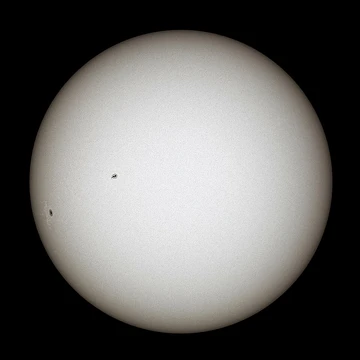
Effective temperature
A black body's temperature that matches the total electromagnetic radiation output of a star or planet defines its effective temperature.[1] When a body's emissivity curve is not known, the effective temperature frequently serves as a proxy for its surface temperature.[1] To position a star on the Hertzsprung–Russell diagram, two essential parameters are required: the effective temperature and the bolometric luminosity.[2]
Key facts and history
The color index of a star indicates its temperature, from cool red M stars to hot blue O stars.[3] The calculation with an emissivity of 1 gives an Earth effective temperature of 254 K.[4] Within a stellar atmosphere, the effective temperature is more precisely the temperature at the radius where the Rosseland optical depth reaches 1.[2] From a star's central core outward to its atmosphere, the temperature steadily decreases.[5]
Published colour-effective temperature relationships are numerous and also depend on stellar metallicity and surface gravity.[3] At Earth's mean orbital radius, the solar irradiance is 1361 W m⁻² and its albedo is about 0.306.[4]
What the cited sources add
The NOAA report states that the actual average surface temperature of Earth is 288 K as of 2020.[6] The IPCC explains that the greenhouse effect results from greenhouse gases and clouds absorbing thermal radiation and reducing emissions to space.[7] Both fluxes are near the confidence ranges reported by the IPCC.[7] The NOAA report notes that the global average surface temperature has been rising because human-produced greenhouse gases cause Earth to absorb more energy than it radiates back to space.[8]
The greenhouse effect is the term for the discrepancy between the actual temperature and the effective temperature.[6] For a 288 K Earth, solving the equation with the surface temperature yields an effective emissivity of roughly 0.61.[7]
References
- Wikipedia, "Effective temperature" (CC BY-SA 4.0), which cites: "Logan's Medical and Scientific Abbreviations", J. B. Lippincott, 1987, p. 182; Archie E. Roy, David Clarke, "Astronomy", CRC Press, 2003; Stull, R. (2000). Meteorology For Scientists and Engineers. A technical companion book with Ahrens' Meteorology Today, Brooks/Cole, Belmont CA, , p. 400. (we also read that source) en.wikipedia.org
- Wikipedia, "Effective temperature" (CC BY-SA 4.0), which cites: Böhm-Vitense, "Introduction to Stellar Astrophysics, Volume 3, Stellar structure and evolution", Cambridge University Press, 1992, p. 14; Baschek, "The parameters R and Teff in stellar models and observations", Astronomy and Astrophysics, June 1991, p. 374–382 (original not read by us) en.wikipedia.org
- Wikipedia, "Effective temperature" (CC BY-SA 4.0), which cites: Casagrande, "The GALAH survey: effective temperature calibration from the InfraRed Flux Method in the Gaia system", MNRAS, 2021, p. 2684–2696 (original not read by us) en.wikipedia.org
- Wikipedia, "Effective temperature" (CC BY-SA 4.0), which cites: "Earth Fact Sheet", nssdc.gsfc.nasa.gov (original not read by us) en.wikipedia.org
- Wikipedia, "Effective temperature" (CC BY-SA 4.0), which cites: "CRC Handbook of Chemistry and Physics", CRC Press, 2004, p. 14<nowiki>-</nowiki>2; Jones, "Life in the Solar System and Beyond", Springer, 2004, p. 7; Prša, "Nominal Values for Selected Solar and Planetary Quantities: IAU 2015 Resolution B3", The Astronomical Journal, 2016, p. 41 (original not read by us) en.wikipedia.org
- Wikipedia, "Effective temperature" (CC BY-SA 4.0), which cites: "Climate Change: Global Temperature", NOAA (we also read that source) en.wikipedia.org
- Wikipedia, "Effective temperature" (CC BY-SA 4.0), which cites: IPCC, "Climate Change 2021: The Physical Science Basis", Cambridge University Press (In Press), 2021 (original not read by us) en.wikipedia.org
- "Climate Change: Global Temperature", NOAA. facts only, no text reused. climate.gov
Each numbered sentence above was checked against the source it cites before publication. Sentences citing Wikipedia adapt text from the English Wikipedia article Effective temperature (contributors), used under CC BY-SA 4.0; this entry is available under the same licence. Other sources were used for facts only; no text or images are copied from them.
More in Stars And Stellar Phenomena
Spotted an error? Know more?
Reader corrections go straight into our review queue. Suggest an edit · How this site is sourced