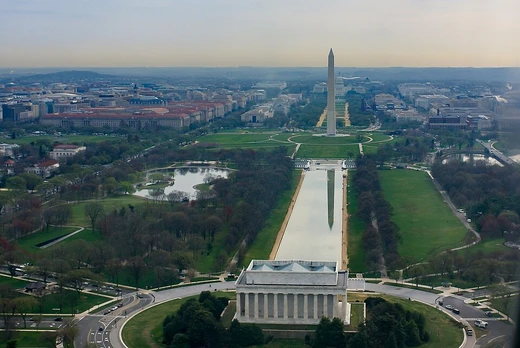
Lafayette Square, Washington, D.C.
Historic park north of the White House with statues of revolutionary heroes.
Last updated
Where it is
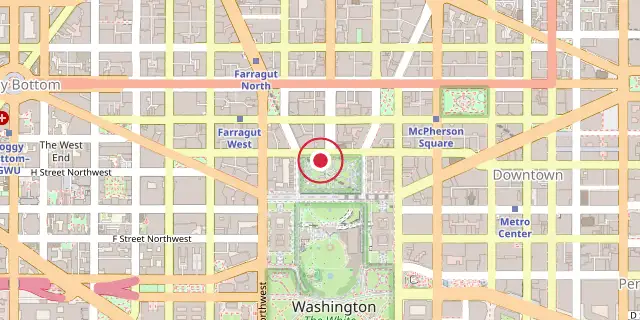
Coordinates: 38°54′00″N 77°02′13″W (38.9000, -77.0370) · Open in OpenStreetMap
Coordinates and connected clubs: the infobox of Wikipedia: Lafayette Square, Washington, D.C. (CC BY-SA 4.0). Map: drawn by Codexery from OpenStreetMap tiles.
Lafayette Square is a seven-acre public park in Washington, D.C., located directly north of the White House. It is named for the Marquis de Lafayette, a French aristocrat and hero of the American Revolutionary War. The square is part of President's Park and features a central equestrian statue of Andrew Jackson.
Quick Facts
- Area
- 7 acres / 0.028 km²
Facts from the source article.
History
Lafayette Square was originally part of the pleasure grounds Pierre L'Enfant designed around the Executive Mansion. It belongs to President's Park, a larger National Park Service unit that also covers the White House grounds, The Ellipse, the Eisenhower Executive Office Building and grounds, and the Treasury Building and grounds. In 1804, President Thomas Jefferson ordered Pennsylvania Avenue cut through the park, splitting what would become Lafayette Square from the White House grounds.
The north side square was renamed in 1824 for the Marquis de Lafayette, the French general crucial to the American Revolutionary War. Before that, the land served as a racetrack, a graveyard, a zoo, a slave market, a War of 1812 encampment for soldiers, and a site for political protests and celebrations. Bordering the square, Decatur House—named for naval hero Commodore Stephen Decatur—was used for slave trading and remains one of the few surviving urban slave markets.
19th century
In the early and mid-1800s, the square was ringed by homes of Washington’s most notable figures, including William Wilson Corcoran, Martin van Buren, Henry Clay, Dolley Madison, John Hay, and Henry Adams. President Millard Fillmore hired Andrew Jackson Downing in 1851 to landscape the square in the picturesque style. On February 27, 1859, Representative Daniel Sickles killed Philip Barton Key II in the park after discovering Key’s affair with Sickles’s wife.
20th century
During the 20th century, especially the 1920s, the area shifted from residential to offices and professional groups, with the Treasury Annex built nearby. The last resident, Mary Chase Morris of the O’Toole House at 730 Jackson Place, died in the Great Depression, and her home became an office. The park’s current layout dates from the 1930s. It holds five large statues.
At the center is Clark Mills’s equestrian statue of President Andrew Jackson, erected in 1853 and the first bronze statue cast in the United States. In the four corners stand statues of foreign Revolutionary War heroes, including one of the Marquis de Lafayette, installed in 1891.
Cruising for gay sex
Before the Lavender Scare of the 1950s, Lafayette Square was a known cruising spot for gay men in Washington, D.C. In 1892, police arrested 18 men there for oral sex, most of them African American. Jeb Alexander’s 1920s diaries describe his own cruising; after meeting men on the square, he would walk with them to the Lincoln Memorial or Potomac Park for sex. He gave three benches the nicknames “Wishing Bench,” “Magnolia Bench,” and “Nighthawk’s Bench,” and would wait on them for hours hoping to be approached. He often turned down Henry Gerber, who later founded the first U.S. gay rights group.
More in National Park Service Areas in Washington, D.C.
Sources
Compiled from Wikipedia and the sources listed below. Text from Wikipedia is available under CC BY-SA 4.0; this entry is adapted from it.
- Wikipedia: Lafayette Square, Washington, D.C. (CC BY-SA 4.0).
Spotted an error? Know more?
Reader corrections go straight into our review queue. Suggest an edit · How this site is sourced