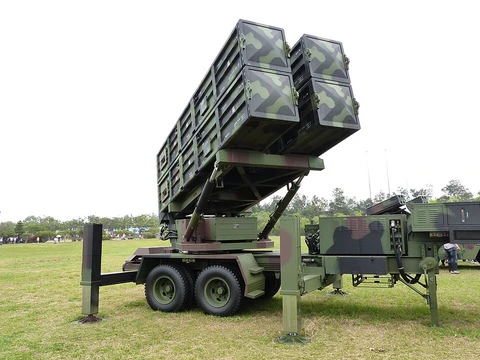
Hsiung Feng I
Taiwanese anti-ship missile based on the Gabriel Mk I.
Last updated

via Wikipedia: Hsiung Feng I · see source
The Hsiung Feng I (HF-1) is an anti-ship missile system developed by the National Chung-Shan Institute of Science and Technology in Taiwan between 1975 and 1978. It was created in response to the SY-1 missile entering service with the opposing People's Liberation Army Navy.
Quick Facts
- Designation
- Hsiung Feng I (HF-1)
- Type
- Anti-ship missile
- Developer
- National Chung-Shan Institute of Science and Technology
- Development period
- 1975–1978
- First test-fire
- 1977
- Initial production start
- 1979
- Service end
- 2012
Facts from the source article.
Development
NCSIST had limited prior experience with anti-ship missiles, having only experimentally fitted warheads onto MQM-33B drones. The weapon was based on the Israeli Gabriel Mk I, with modifications to compete against the SY-1 missile, effectively making it a Taiwanese interpretation of the Gabriel Mk II. The Republic of China Navy, which imported Gabriel Mk II systems for three Allen M. Sumner class destroyers, required the HF-1 to be interchangeable with Israeli ordnance. The system uses the Taiwanese CS/SPG-21A radar, initially with a 37 km range later upgraded to 46 km.
Service history
The Hsiung Feng I was officially a reverse-engineered version of the Gabriel Mk.2, though Israel is believed to have cooperated with Taiwan. Sun Yat-sen Institute and NCSIST redesigned the missile to include Taiwanese components. First test-fire occurred in 1977, with initial production starting in 1979. Design flaws in the radar radio frequency altimeter, cooling system, and rocket motor undermined effectiveness, leading to a redesigned HF-1A variant that entered production in 1981.
The missile served until 2012. Before the Hsiung Feng II entered service, the HF-1 was the primary anti-ship weapon on all ROC Navy frontline surface combatants, including most Gearing and Allen M. Sumner class destroyers. It remains deployed on Hai Ou class missile boats and some land-based facilities, but is being phased out as larger craft convert to the HF-2. The last ship converted in early 2013, and the missiles were sent back to NCSIST for decommissioning.
More in National Chung-Shan Institute of Science and Technology
Sources
Compiled from Wikipedia and the sources listed below. Text from Wikipedia is available under CC BY-SA 4.0; this entry is adapted from it.
- Wikipedia: Hsiung Feng I (CC BY-SA 4.0).
Spotted an error? Know more?
Reader corrections go straight into our review queue. Suggest an edit · How this site is sourced