Sea Oryx
Infrared homing short-range air defense system for Taiwan Navy.
Last updated

via Wikipedia: Sea Oryx · see source
The Sea Oryx is a lightweight, short-range air defense system for the Republic of China Navy, using infrared homing. It is based on the TC-1L missile and defends against anti-ship missiles, helicopters, and low-flying jets. Often considered a copy of the RIM-116 Rolling Airframe Missile, it incorporates parts from the Sky Sword I air-to-air missile.
Quick Facts
- Origin
- Taiwan
Facts from the source article.
Development
The Sea Oryx is a lightweight, infrared-homing short-range air defense system for the Republic of China (Taiwan) Navy, based on the TC-1L missile. It defends against anti-ship missiles, helicopters, and low-flying jets and is reported to copy the RIM-116 Rolling Airframe Missile, using Sky Sword I components. A 2015 concept model showed a TC-1 with an imaging infrared seeker, folding control surfaces, free-rolling tailfins, a stronger rocket motor, and a trainable launcher holding eight or sixteen rounds with a FLIR sensor on the left.
The 2017 final design enlarged the missile’s aft section for more fuel and replaced four rolling tailfins with eight smaller fixed ones. Two launcher variants emerged: one integrated into the ship’s combat management system, holding 24 missiles with no onboard sensors and relying entirely on the ship for targeting; and an autonomous version with twelve missiles, its own rotating search/tracking radar, and a FLIR/electro-optical sensor, similar to SeaRAM.
In 2021, a Sea Oryx system was tested aboard the test ship ROCS Kao Hsiung. A 2019 concept video showed a truck-mounted version defending Taiwan’s PAVE PAWS radar against a Chinese cruise missile.
Variants
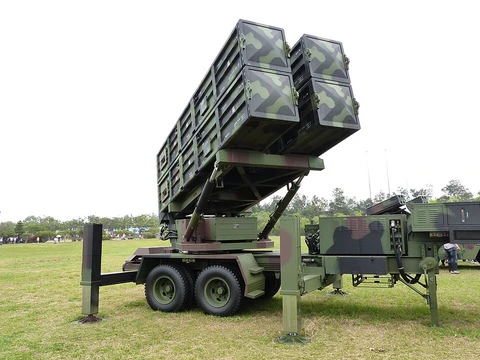
During the 2019 Taipei Aerospace & Defense Technology Exhibition, NCSIST presented a concept video showing the Sea Oryx system mounted on a truck defending Taiwan's AN/FPS-115 PAVE PAWS early warning radar against a Chinese cruise missile attack.
More in National Chung-Shan Institute of Science and Technology
Sources
Compiled from Wikipedia and the sources listed below. Text from Wikipedia is available under CC BY-SA 4.0; this entry is adapted from it.
- Wikipedia: Sea Oryx (CC BY-SA 4.0).
Spotted an error? Know more?
Reader corrections go straight into our review queue. Suggest an edit · How this site is sourced