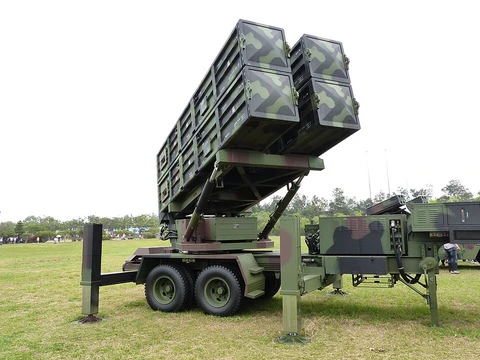
Kung Feng multiple launch rocket system
Taiwanese multiple rocket launcher family, including the Kung Feng VI.
Last updated
The Kung Feng MLR series is a family of multiple rocket launcher systems used by the Republic of China (Taiwan). The latest variant, the Kung Feng VI, began development in 1975 and was formally revealed to the public during the Taiwan National Day Parade in 1981.
History
The Kung Feng IV project started in 1960 and wrapped up in 1975, with the launchers mounted on M113 armored vehicles. Towed versions hit service in 1972, and self-propelled ones followed in 1976; the towed units were first assigned to the chemical weapons artillery division. Because these launchers were small, they got adapted for platforms like the M151 jeep and LVTP5-RL. By 2000, only the marine corps’ LVTP5-RL variants were still active.
In the 1970s, early Kung Feng VI prototypes had a range of just 10 kilometers, making them less capable than the older Kung Feng IV. Artillery chief Hau Pei-tsun pushed the Academia Sinica research division to boost the range to 22 kilometers and work on cluster bomb and airburst fuse designs. This led to B-type rockets that were finished but never put into service. As other nations advanced their rocket systems, the ROC armed forces fell behind.
The Kung Feng VI was originally meant for an M42 Duster chassis, but procurement issues forced a switch to the M113 chassis, which couldn’t handle the weight. The army then moved the system to M809 five-ton wheeled trucks and added the FAC-202R fire control system for better accuracy. The ROC military quickly retired its Kung Feng IV launchers in favor of the VI model, but the new system couldn’t reload fast and had no dedicated transport trailer.
After firing, soldiers needed 15 minutes to load the next rockets by hand. High logistical demands meant few units were built. The Kung Feng VI remains in service today, but plans from 2001 call for its mass replacement by the Thunderbolt-2000 system.
Design
The Kung Feng IV carries its 126mm rockets in two groups of 20 tubes, for a total of 40 launchers, and can discharge all of them in 16 seconds. Each rocket weighs 24.4 kilograms, is 0.91 meters long, and has a range of 10,500 meters. The Kung Feng VI is similar in design to the Soviet BM-21 Grad but uses a smaller caliber and more tubes.
Its 45 launchers, each 117mm in diameter, fire A-type rockets. All rockets can be launched in 22.5 seconds, saturating an area 800 by 600 meters. The A-type rockets measure 2.166 meters, weigh 42.64 kilograms, reach up to 15,000 meters, and accept either high explosive or white phosphorus warheads.
Variants
The Kung Feng I, II, and V were prototypes that never entered service. The Kung Feng III is a 126 mm x 40 round launcher mounted on a trailer. The Kung Feng IV Army variant is a 126 mm x 40 (2x20 round) launcher on a CM21 APC, while the Kung Feng IV Marines variant uses an LVTP-5 chassis. The Kung Feng VI is a 117mm x 45 round launcher on an M52A1 truck, with A-type rockets carrying HE or WP warheads, and a B-type with air burst fuse and 6,400 6.4mm steel balls covering 30,000 square meters.
More in National Chung-Shan Institute of Science and Technology
Sources
Compiled from Wikipedia and the sources listed below. Text from Wikipedia is available under CC BY-SA 4.0; this entry is adapted from it.
- Wikipedia: Kung Feng multiple launch rocket system (CC BY-SA 4.0).
- Word definitions: the Codexery glossary, each quoted from its Wikipedia article.
Spotted an error? Know more?
Reader corrections go straight into our review queue. Suggest an edit · How this site is sourced