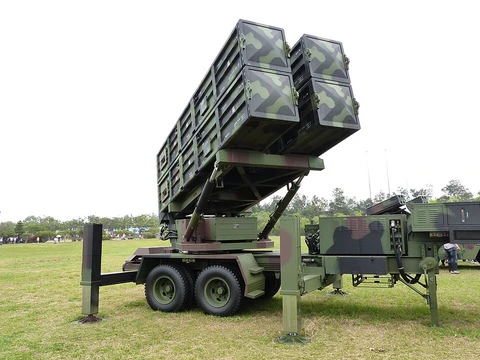
Hsiung Feng III
Taiwanese supersonic anti-ship and land-attack missile.
Last updated

via Wikipedia: Hsiung Feng III · see source
The Hsiung Feng III (HF-3; "Brave Wind III") is a medium range supersonic missile developed by the National Chung-Shan Institute of Science and Technology (NCSIST) in Taiwan. It is capable of destroying both land based targets and naval targets.
History
The Hsiung Feng III missile traces its roots to a ramjet test vehicle program launched by CSIST in 1994, which was later folded into the larger Hsiung Feng project. A prototype began flight testing in 1997, and operational evaluations took place aboard ROCS from 2004 to 2005. The Yun Feng supersonic cruise missile’s development was concealed within the HF-3’s test program. According to the Jamestown Foundation, the HF-3 was designed to counter the SS-N-22 Sunburn missile, which China had acquired for its Sovremennyy-class destroyers.
The missile was first shown to the public on October 10, 2007, during a military parade in Taipei. It now serves on La Fayette/Kang Ding-class frigates, Jin Chiang-class patrol gunboats, and road-mobile launchers. In 2019, President Tsai Ing-wen ordered accelerated mass production in response to China’s growing military strength. On July 1, 2016, the patrol boat Chinchiang (PGG-610) accidentally launched an HF-3 during training; the missile traveled about 75 kilometers and struck a fishing boat, killing its captain and injuring three crew members.
The defense ministry blamed the incident on failures to follow standard procedures by the ship’s commander, senior arms officer, and missile launch control sergeant.
Design
The missile uses an integrated rocket ramjet design, with a solid fuel main booster and two side-by-side solid-propellant jettisonable strap-on rocket boosters for initial acceleration, while a liquid-fueled ramjet sustains cruise. It is cylindrical, composed of guidance and control, warhead, and propulsion sections, with four inlet ducts and four clipped delta control surfaces. The air intake arrangement was optimized for evasive maneuvering at terminal sea-skimming altitudes.
The missile employs electronic counter-countermeasures (ECCM), inertial navigation for mid-course guidance, and an active radar seeker for terminal guidance. It can perform way-pointing, fly offset attack axes, and execute high-G lateral terminal "random weaving" maneuvers. The armor-piercing warhead, triggered by a smart fuze, directs most energy downward into a target ship's hull.
Variants
A larger, longer-range Hsiung Feng III was developed under the "Panlong Project" during the Presidency of Tsai Ing-wen, with an expected range of 400 kilometers. NCSIST conducted multiple live-fire tests from 2017 to 2019, and the mass production budget was approved in 2021. The extended-range missile was deployed for the first time in Han Kuang Exercise 41. An air-launched variant, the Hsiung Chih, was disclosed in 2022; it is expected to be significantly lighter and use the F-CK-1 as a launch platform, and was spotted undergoing testing in 2025.
More in National Chung-Shan Institute of Science and Technology
Sources
Compiled from Wikipedia and the sources listed below. Text from Wikipedia is available under CC BY-SA 4.0; this entry is adapted from it.
- Wikipedia: Hsiung Feng III (CC BY-SA 4.0).
Spotted an error? Know more?
Reader corrections go straight into our review queue. Suggest an edit · How this site is sourced