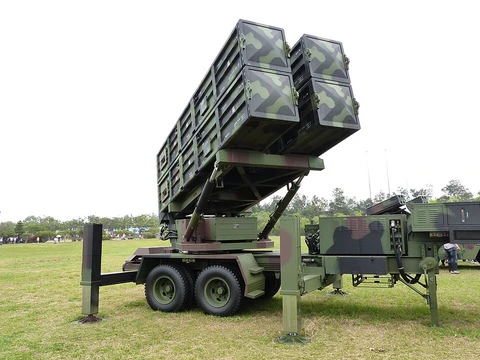
Sky Bow
Taiwanese surface-to-air missile and anti-ballistic missile defense series.
Last updated

via Wikipedia: Sky Bow · see source
The Sky Bow (Tien Kung) series comprises surface-to-air anti-ballistic missile and anti-aircraft defense systems developed by Taiwan's National Chung-Shan Institute of Science and Technology. The TK-1 was completed in 1986 and has since been retired, while the TK-2, TK-3, and TK-4 remain in service with the Military of the Republic of China.
Quick Facts
- First system completed
- 1986
Facts from the source article.
Development
Research leading to the Sky Bow project began after the United States ended bilateral relations with the Republic of China in 1979. Chief engineer Chen Chuan-hao proposed alternative names such as Sky Horse (Pegasus) and Flying Horse, but upon formal approval in October 1980 the project became known as Sky Bow. Under aerospace engineer and rocket scientist Huang Hsiao-tsung, the project expanded to include ramjet motor testing. In 1981, minister of defense Sung Chang-chih increased support and expanded the project into a general-purpose air defense effort benchmarked to the American Patriot and Soviet 2K12 Kub, setting a seven-year deadline.
The first test flight in 1982 failed, as did other early flights; Huang left that year for an executive role at NCSIST. In 1984, Taiwan gained cooperation from Raytheon and was permitted to examine semi-obsolete missiles in detail. NCSIST experts traveled to the United States to study the technology but were not allowed to ask questions and concluded that many missiles were old and damaged from storage. Dedicated facilities, including Taiwan's first hypersonic wind tunnel, were constructed.
The 12th flight test in 1986 achieved the system's first successful intercept of a target aircraft. The system was officially unveiled that year at a ceremony presided over by premier Yu Kuo-hua, receiving the designation Zhongzheng 100/Sky Bow 1, referring to its 100 km range. Early missiles used a semi-active radar homing seeker; a passive infrared homing terminal seeker was developed and tested against a HAWK missile target but never produced. NCSIST also developed the Chang Bai (long white) large multifunction phased-array radar for the series.
Sky Bow I
The Sky Bow I (TK-1) is a surface-to-air missile system originally based on the aerodynamics of the MIM-23 Hawk missile, with an initial design resembling a scaled-up Raytheon AIM-54 Phoenix. After the U.S. government allowed Raytheon to transfer 85 percent of MIM-104 Patriot missile technology, the missile was redesigned and became very similar in appearance to the Patriot. It lacks track-via-missile (TVM) homing capability, as that technology was not included in the licensed package; the system operates like the U.S. Standard SM2 missile, requiring an illuminating radar during the terminal phase.
The TK-1 is designed primarily for low and medium altitude attacks. Each battery has one Change Bai 1 (Long White 1) S-Band phased-array radar for search and tracking, and two CS/MPG-25 target illuminator radars operating in the X-Band (18–32 GHz) for the terminal phase, servicing three or four 4-round missile launchers. Inertial/autopilot and mid-course command guidance combined with a terminal semi-active radar seeker allow the missile to fly an energy-efficient path, giving the target minimal time to evade or employ electronic countermeasures.
Two launcher versions exist: one housed in underground shelters for survivability, and a towed mobile version integrated into Taiwan's dense air defense network. The TK-1 has been deployed on Taiwan proper and on the outlying islands of Penghu and Dong Ying, bringing the Taiwan Strait and parts of Fujian, Zhejiang, and Guangdong Provinces within range. According to a 2006 report, the TK-1 system would be retired, with missiles replaced by TK-2 rounds and the system upgraded to Tien Kung II standard.
Sky Bow II
The Sky Bow II (TK-2) is a surface-to-air missile system that began as a TK-1 with a first-stage booster, evolving into a slightly enlarged modified version using an X-Band active-radar seeker, offering longer range and limited anti-missile capability. The active radar seeker operates in the 28–32 GHz frequency range and provides good performance against typical aircraft-sized targets; it was developed from licensed radar technology purchased from the U.S. in the 1980s.
The system uses the improved Change Bai 2 (Long White 2) multifunction radar, which entered service in the late 1990s. The first public test, codenamed Magic Arrow 43, occurred on May 10, 2002 during the Han kuang 18 exercise. The TK-2 can use the same box launcher as the TK-1; internal components were miniaturized to free space for more fuel and a more powerful main rocket motor. It possesses modest capabilities against ballistic missiles but is highly effective against aircraft.
The missile is powered by a single-stage dual-thrust solid-fuel rocket motor, launched from underground silos or mobile vehicles. It has a length of 5.673 m, diameter of 0.42 m, weight of 1,135 kg, top speed of Mach 4.5, warhead of 90 kg, and range of 150 km. Guidance is inertial with mid-course updates from ground-based phased array radar and active radar homing for terminal guidance. The TK-2 was deployed in 1997.
Variants
It has also been modified as a sounding rocket for upper atmospheric research; a test vehicle launched on December 24, 2003, measured 7.7 m in length and 1,680 kg in launch weight, reaching an altitude of almost 270 km and splashing 142 km down range after about 8 minutes. The science payload was in the 220 lb weight class, and burnout velocity was 2,000 m/s. Depending on payload and launch parameters, the rocket can attain a horizontal maximum range of up to 500 km.
Sky Bow III
Sky Bow III, also known as TK-3, is the third version of this missile system. Taiwan originally asked the United States to jointly build a missile defense interceptor and requested American technical help for a homegrown anti-tactical ballistic missile project. This included Hit-to-Kill technology like a Ka-band active radar seeker and precision attitude control. The National Chung-Shan Institute of Science and Technology reportedly tried to get the traveling-wave tube transmitter for that Ka-band seeker, but the U.S. refused to export a complete Ka-band seeker without tamper protection or to provide the TWT separately.
This forced the institute to adopt a different active radar seeker technology that includes some European parts. The TK-3, previously called the TK-2 ATBM, is a lower-tier missile defense system built on the TK-2 missile. It uses an imported Ku-band active radar seeker, a directed fragmentation warhead, and better precision controls to hit fast, low-radar-cross-section targets like tactical ballistic missiles. It is built for greater mobility than the earlier TK-1 and TK-2 systems, includes an integrated battle management system, and works with either an upgraded Chang Bai phased array radar or a new mobile phased-array radar reportedly named the Mobile 3-Dimensional Air Defense Fire Control Phased Array Radar.
Did You Know?
- The Chang Bai (Long White) phased-array radar has a reported maximum range of 450 km and 120-degree coverage.
- The CS/MPG-25 target illuminator radar is estimated to be 60 percent more powerful than the I-HAWK AN/MPQ-46 High-Power Illuminator radar.
More in National Chung-Shan Institute of Science and Technology
Sources
Compiled from Wikipedia and the sources listed below. Text from Wikipedia is available under CC BY-SA 4.0; this entry is adapted from it.
- Wikipedia: Sky Bow (CC BY-SA 4.0).
Spotted an error? Know more?
Reader corrections go straight into our review queue. Suggest an edit · How this site is sourced