Hsiung Feng II
Taiwanese anti-ship missile with ship, air, and land variants.
Last updated

via Wikipedia: Hsiung Feng II · see source
The Hsiung Feng II (HF-2; "Brave Wind II") is an anti-ship missile system developed by the National Chung-Shan Institute of Science and Technology (NCSIST) in Taiwan. Designed for deployment aboard ships, at land-based facilities, or in the air, the HF-2 is carried by ROC Air Force F-CK fighters and features electronic counter-countermeasures (ECCM) capabilities. It is deployed on the ROC Navy's frigates and at several land-based sites. The system entered service in the early 1990s, with ship, air, and land variants developed over time, including a mobile launcher version accepted in 2005 and a Block II extended-range version tested by 2017.
Versions
The ship-based HF-2 was the first to enter service, initially installed as two twin box launchers on destroyer DD-915 for trials. Later, all major surface combatants in the ROC Navy except the Knox class received two quad-launchers; the seven World War II-era guided missile destroyers upgraded to WC3 standard from the late 1980s to mid-1990s each had one quad-launcher added by the mid-1990s to provide anti-surface capability. An air-launched version appeared in the early 1990s, carried by two AIDC AT-3B trainer/attackers and a single A-3 attacker, though the small number of aircraft limited its threat.
The upgraded IDF (F-CK-1C/D) will add the capacity to carry and launch the HF-2, enhancing future air-to-surface capability. The air-launched version on the AT-3 differs from that intended for the original IDF (F-CK-1A/B) prototype because of length differences between the HF-2 Mark 3 and Mark 4 missiles; the rocket designed for one aircraft cannot fit on the other. It is unknown whether the air-launched HF-2 program is continuing. The land-launch version is the most secretive due to its relation to the land-attack HF-2E.
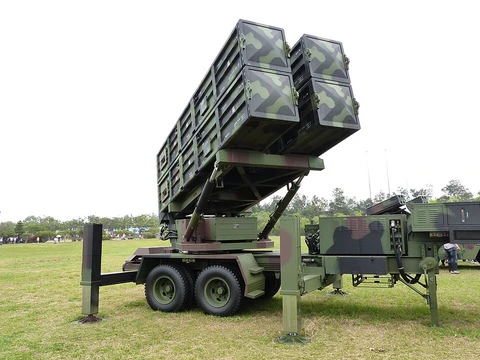
Fixed-base versions were produced first, and all major outlying islands of Taiwan received fortified HF-2 bases in the late 1990s, replacing old HF-1 bases. Fixed HF-1 bases on the main island were also replaced with fixed HF-2 launchers in fortified positions. The mobile launcher version was accepted in 2005 and entered mass production in 2006. Mobile launchers, along with a mobile command center (with data-link), mobile surface search radar, and portable electric generators, are kept in hardened shelters and driven out when needed.
The HF-2 mobile launchers displayed in the 10 October 2007 parade were designed to carry both HF-2 and the larger HF-3 AShM by leaving room for the larger missile boxes. Starting in 2001, each frigate's new HF-2 launchers after major overhaul were similarly modified to accommodate the larger HF-3 AShM. The twelve built ships are undergoing the same upgrade to carry two twin-mounted HF-2/3 anti-ship missiles. The thirty-one built ships carry two twin-mounted HF-2 anti-ship missiles, while other ships carry four quad-mounted HF-2/HF-3 anti-ship missiles.
Did You Know?
- The HF-2 has a top speed of 0.85 Mach and a weight of 685 kg.
- In 2019, mass production of an improved Block IIB was approved, with production to be completed by 2023.
- The HF-2B, a new short-range anti-ship missile tested in November 2019, has a reported range of 250 km while weighing significantly less than the HF-2.
- A submarine-launched version was planned and designed in the mid-1990s, but nothing more was heard.
More in National Chung-Shan Institute of Science and Technology
Sources
Compiled from Wikipedia and the sources listed below. Text from Wikipedia is available under CC BY-SA 4.0; this entry is adapted from it.
- Wikipedia: Hsiung Feng II (CC BY-SA 4.0).
Spotted an error? Know more?
Reader corrections go straight into our review queue. Suggest an edit · How this site is sourced