Hsiung Feng IIE
Taiwanese land-attack cruise missile with extended-range variants.
Last updated
The Hsiung Feng IIE (HF-2E) is a surface-to-surface land-attack cruise missile system developed by the National Chung-Shan Institute of Science and Technology (NCSIST) in Taiwan. Despite its designation, the HF-2E is not a derivative of the Hsiung Feng 2 anti-ship missile; that confusion was intentional misinformation to divert attention from its true nature as a long-range offensive cruise missile. It serves a similar function in Taiwan's military as the US Navy's Tomahawk cruise missile, designed for tactical strikes against military target sets like air-defense fire units and command-and-control facilities.
Development
The Hsiung Feng IIE (HF-2E) is a land attack cruise missile that is often mistakenly thought to be a modified version of the Hsiung Feng 2 anti-ship missile. In reality, the similar name was a deliberate deception to hide the fact that it is an entirely new, long-range offensive weapon, comparable in role to the U.S. Tomahawk. Designed to strike military targets like air defense units and command centers, its small warhead and planned limited purchase indicate it is not meant for a first strike. The project was revealed in 2001.
After tests in 2004 and early 2005 at the Jiu Peng Missile Range, the initial Block I version passed its operational evaluation in 2005, flying a low-altitude loop off Taiwan’s southeast coast. An upgraded variant was tested on February 2, 2007. In 2017, the missiles underwent a major upgrade to improve their capability against naval targets.
Description
The baseline HF-2E Block I is powered by an indigenously-developed Taiwanese turbofan engine rated in the 800 lbf thrust range, developed partially based on technology from the Microturbo 078 turbojet engine used on the Hsiung Feng 2 anti-ship missile. With a standard unitary 1000 lb-class warhead, its maximum range is 700 km. Other warhead types, such as cluster submunitions and a hard target penetrator, are in development. Through engine modification and redesign of control and electronic systems, CSIST freed up internal space for additional fuel, extending range to over 2,000 km, though one report claimed only 800 km.
The ultimate objective is a missile with a range over 5,000 km using a more advanced power plant and lighter warhead. The Block I uses inertial guidance with GPS and TERCOM updates, and for terminal guidance, infrared homing (imaging infrared) with an autonomous digital target recognition system. The IIR seeker compares the target image against digitized files in the on-board guidance computer (DSMAC terminal guidance). Cruising speed is high subsonic, typically Mach 0.75–0.85.
Approaching hostile territory, it descends to 15–30 m altitude, then climbs on final approach to allow the seeker to acquire the target before plunging onto the impact point. Pre-terminal accuracy is around 15 m. The primary difference between the two main variants is the engine; the longer-ranged variant has a turbofan engine.
Production and fielding
The Block I version of the missile had its low-rate production scheduled for July 2005, using leftover research funds to build at least five units. Each missile cost roughly US$3.08 million in 2003 dollars. A 2006 report indicated three batteries—twenty-four mobile launchers and forty-eight missiles—were nearing the end of testing and could be deployed within two years. The HF-2E entered low-volume output under Project ChiChun.
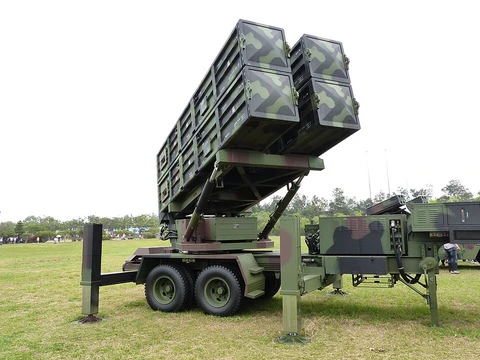
In 2008, President Ma Ying Jeou ordered 500 to 1,000 missiles, and full serial production was approved in 2011. The missile is fielded on ground-mobile launchers, which store the rounds in aluminum box containers with folded wings and fins.
These launchers stay in hardened shelters during normal conditions and move to pre-surveyed sites during alerts. In 2022, the combined annual output of the HF-2E and Hsiung Sheng reached 81 units, as they share a production line. By 2025, the navy planned to equip Kee Lung-class destroyers with the HF-2E.
Did You Know?
- The baseline Block I missile completed its operational evaluation in 2005 after flying a low-altitude circuit off Taiwan's southeastern coastline between Pingtung and Lanyu Island.
- Through engine modification and redesign, CSIST extended the missile's range to over 2,000 km, though a Defense News report claimed only 800 km.
More in National Chung-Shan Institute of Science and Technology
Sources
Compiled from Wikipedia and the sources listed below. Text from Wikipedia is available under CC BY-SA 4.0; this entry is adapted from it.
- Wikipedia: Hsiung Feng IIE (CC BY-SA 4.0).
- Word definitions: the Codexery glossary, each quoted from its Wikipedia article.
Spotted an error? Know more?
Reader corrections go straight into our review queue. Suggest an edit · How this site is sourced