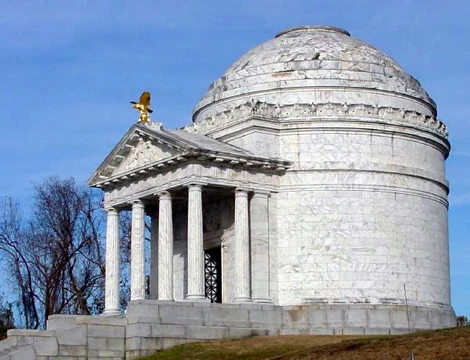
Fort Necessity National Battlefield
Site of Washington's first battle and surrender in the French and Indian War.
Last updated
Where it is
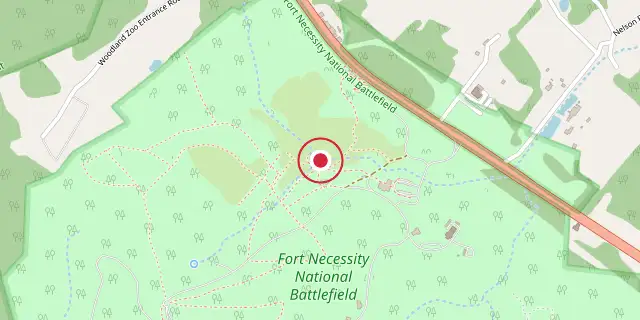
Coordinates: 39°48′54″N 79°35′20″W (39.8150, -79.5890) · Open in OpenStreetMap
Coordinates and connected clubs: the infobox of Wikipedia: Fort Necessity National Battlefield (CC BY-SA 4.0). Map: drawn by Codexery from OpenStreetMap tiles.
Fort Necessity National Battlefield, located in Fayette County, Pennsylvania, preserves the site of the Battle of Fort Necessity, an early engagement of the French and Indian War fought on July 3, 1754. The battle resulted in the surrender of British colonial forces under Colonel George Washington to French and Indian forces commanded by Louis Coulon de Villiers. The park also includes the Mount Washington Tavern, the grave of General Edward Braddock, and the site of the Battle of Jumonville Glen.
Battle of Fort Necessity (1754)
After returning to the Great Meadows in what is now Fayette County, Pennsylvania, George Washington felt it wise to strengthen his position. He supposedly gave the structure the name Fort Necessity or Fort of Necessity. It housed a store of gunpowder, rum, and flour. The simple wooden fence they put up was meant more to keep those supplies safe from Washington’s own men—whom he called “loose and idle”—than to guard against an enemy attack.
The camp’s sutler was John Fraser, who had previously been second-in-command at Fort Prince George. By June 13, 1754, Washington led 295 colonial soldiers and had nominal command of 100 more regular British troops from South Carolina. He spent the rest of that month pushing a wilderness road farther west and down the western slopes of the Allegheny range into the Monongahela River valley. His goal was to create a crossing point about 41 miles away, near Redstone Creek and Redstone Old Fort.
That fort was a prehistoric Native American earthwork mound on a bluff above the river, possibly once part of a fortification. To reach the navigable waters of the Ohio River basin on the Monongahela, Washington chose to follow Nemacolin’s Trail, a Native American path that colonists had improved with Nemacolin’s help. The trail’s end at Redstone was a natural spot for an advance base, as it offered one of the few good crossings where both sides of the wide, deep river had low, accessible banks.
Park formation and structure
During the Great Depression, efforts to preserve the location of Fort Necessity were undertaken. Congress declared the site a National Battlefield Site under War Department management on March 4, 1931. It was transferred to the National Park Service in 1933 and redesignated a National Battlefield on August 10, 1961. The battlefield was listed on the National Register of Historic Places on October 15, 1966.
Archaeological research uncovered much of the original fort's position, shape, and design, leading to the construction of a replica in the 1970s. A new visitor center, also housing a National Road interpretive center, opened on October 8, 2005. Pollen analysis in the 1990s helped determine the historical tree line, and trees were planted beginning in the 2010s to restore it.
Mount Washington Tavern
Within the park boundaries, on a hillside adjacent to the battlefield, stands Mount Washington Tavern, a classic example of the many inns that once lined the National Road, the first federally funded highway in the United States. The land was originally owned by George Washington, who purchased the site in 1770. Around the 1830s, Judge Nathanial Ewing of Uniontown constructed the tavern. James Sampey acquired it in 1840, and his family operated it until the railroad construction boom caused the National Road to decline in popularity, making the inn unprofitable.
In 1855, the Fazenbaker family purchased it and used it as a private home for 75 years. The Commonwealth of Pennsylvania bought the property in 1932, and the National Park Service purchased it from the state in 1961, incorporating it into Fort Necessity. The tavern features standard early American tavern features, including a simple barroom, a more refined parlor, and bedrooms where many people would crowd to sleep.
More in National Battlefields and Military Parks of the United States
Sources
Compiled from Wikipedia and the sources listed below. Text from Wikipedia is available under CC BY-SA 4.0; this entry is adapted from it.
- Wikipedia: Fort Necessity National Battlefield (CC BY-SA 4.0).
Spotted an error? Know more?
Reader corrections go straight into our review queue. Suggest an edit · How this site is sourced