
Comet NEOWISE
The brightest northern comet since Hale–Bopp, retroactively called the Great Comet of 2020.

Laurie Nevay · CC BY-SA 2.0
C/2020 F3 (NEOWISE) is a long-period comet with a nearly parabolic orbit, discovered on March 27, 2020, by astronomers working with the NEOWISE program on the Wide-field Infrared Survey Explorer (WISE) space telescope. At discovery, it was an 18th-magnitude object, 2.0 AU (300 million km) from the Sun and 1.7 AU (250 million km) from Earth. It is remembered as the brightest comet in the northern hemisphere since Comet Hale–Bopp in 1997, and is retroactively called the Great Comet of 2020.
The comet was first spotted on March 27, 2020, classified as a comet on March 31, and named after the NEOWISE mission on April 1. Its systematic designation, C/2020 F3, marks it as a non-periodic comet—the third discovered in the second half of March 2020. It made its closest approach to the Sun (perihelion) on July 3, 2020, at 0.29 AU (43 million km), and its closest approach to Earth on July 23, 2020, at 01:09 UTC, when it was 0.69 AU (103 million km) away in Ursa Major. This passage through the inner Solar System increased its orbital period from about 4500 years to roughly 6800 years.
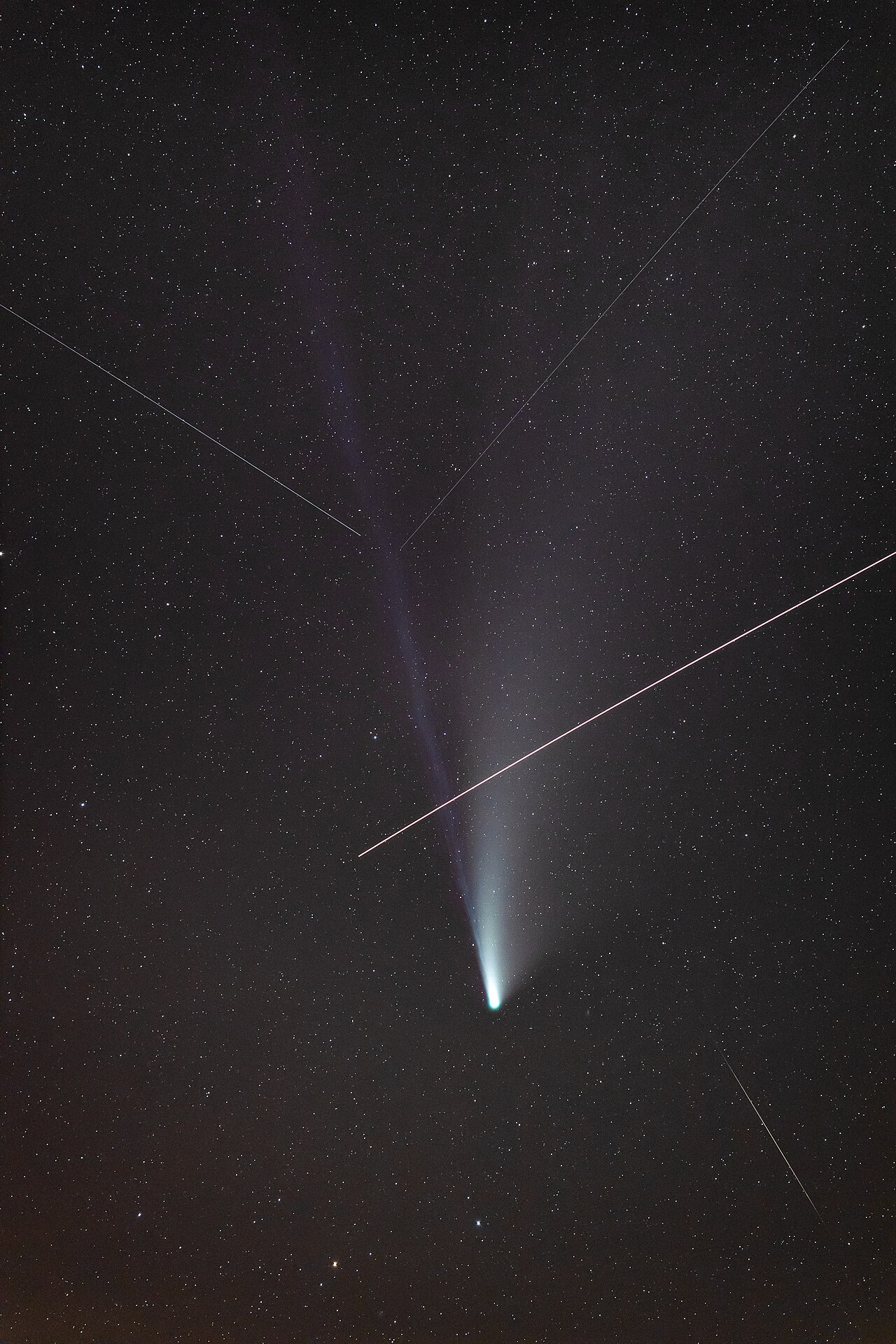
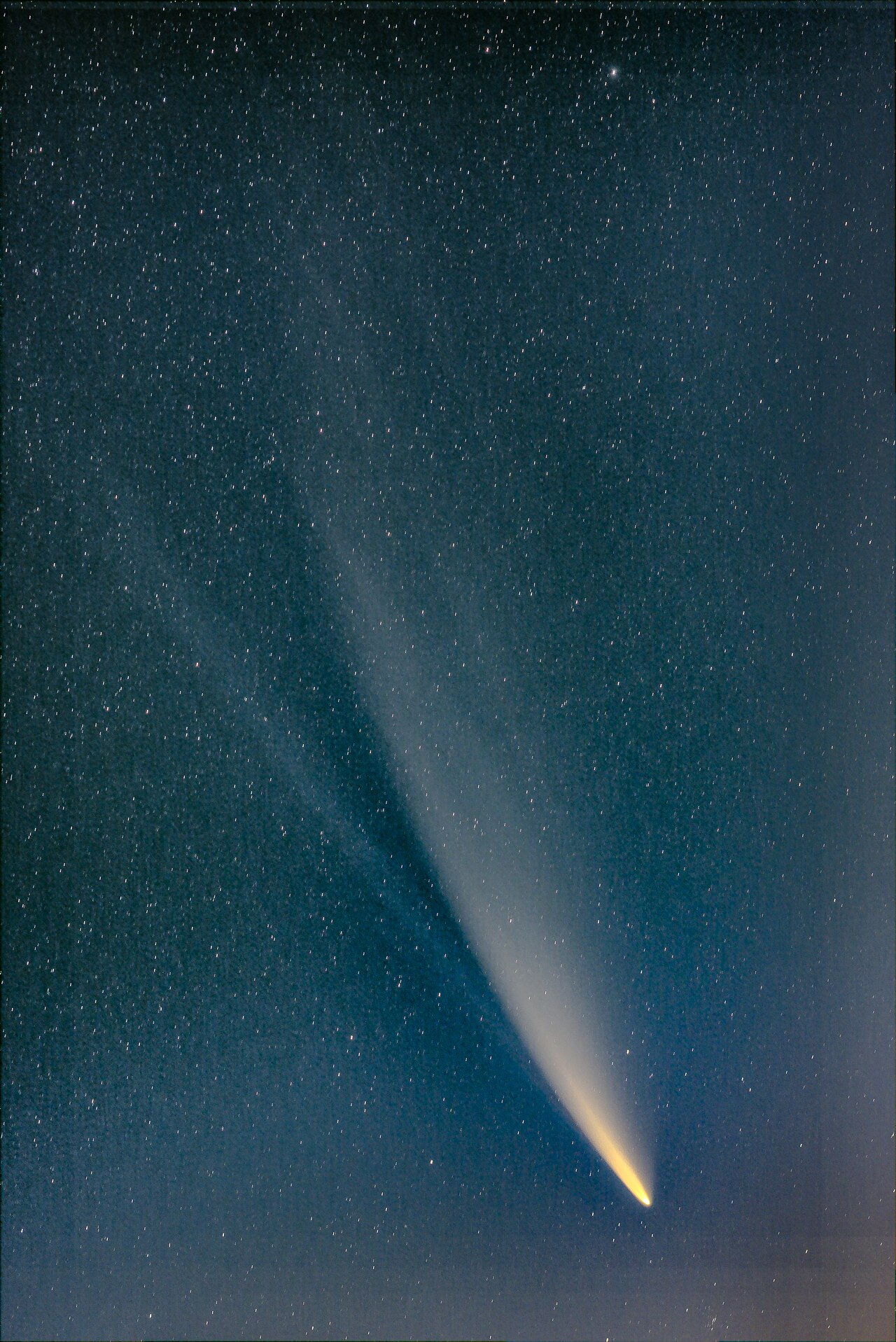
Although too close to the Sun to observe at perihelion, the comet emerged around magnitude 0.5 to 1, bright enough for naked-eye visibility. Under dark skies, it remained visible without aid throughout July 2020. By July 30, it had faded to magnitude 5, requiring binoculars near urban areas. It was widely photographed by both professional and amateur observers, and even spotted by people in city centers with light pollution. For Northern Hemisphere viewers, it appeared on the northwestern horizon below the Big Dipper; north of 45°N, it was visible all night in mid-July. On July 30, it entered Coma Berenices, below the bright star Arcturus.
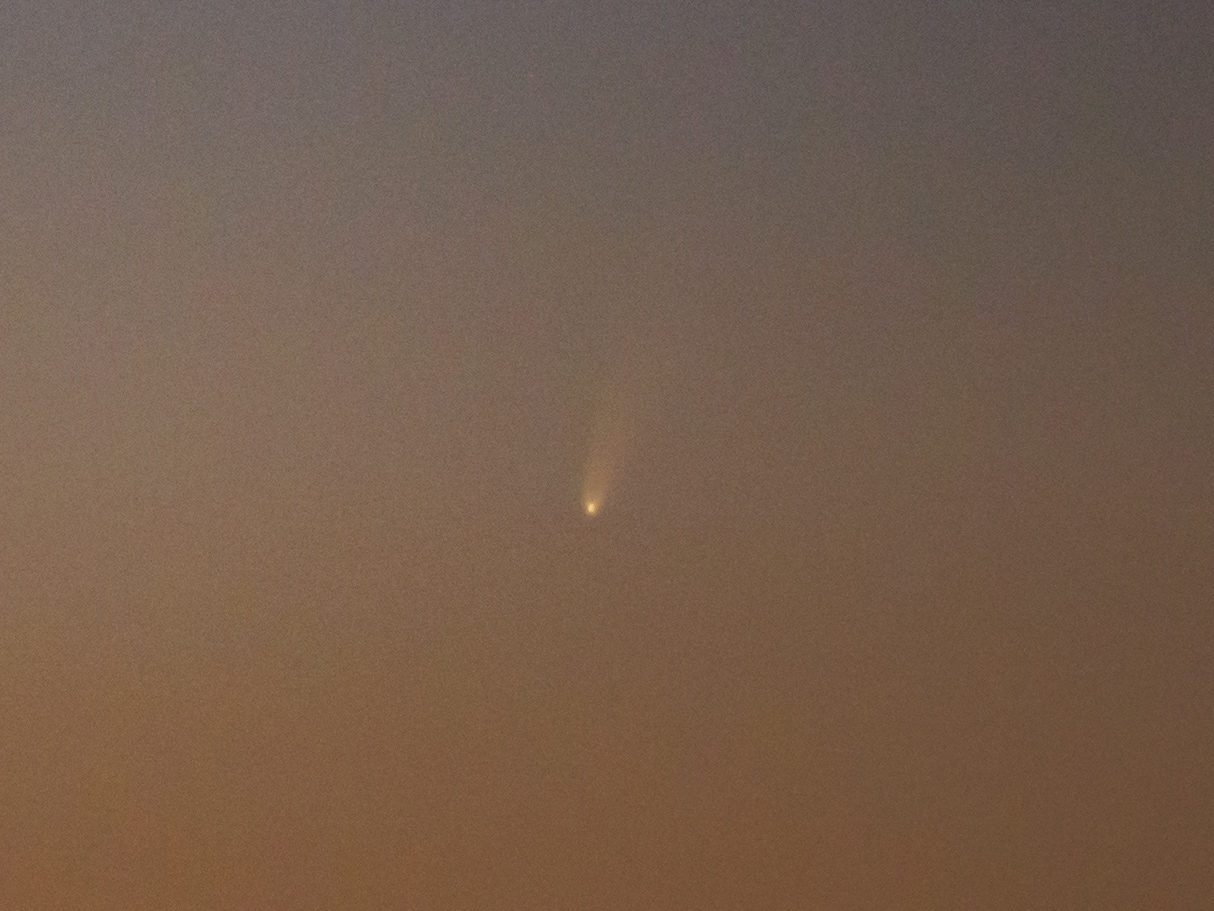
In early July, the comet could be seen in the morning sky just above the northeastern horizon, below Capella. From Earth, it was less than 20 degrees from the Sun between June 11 and July 9. By June 10, as it was lost to the Sun’s glare, it was magnitude 7.0, at 0.7 AU from the Sun and 1.6 AU from Earth. When it entered the field of view of the SOHO spacecraft’s LASCO C3 instrument on June 22, it had brightened to about magnitude 3.0, at 0.4 AU from the Sun and 1.4 AU from Earth. By early July, it reached magnitude 1.0, far outshining earlier comets from that year, C/2020 F8 (SWAN) and C/2019 Y4 (ATLAS).
Quick Facts
- Discovery Ref
- Mace_2020
- Discoverer
- NEOWISE
- Discovery Date
- March 27, 2020
- Designations
- CK20F030
- Orbit Ref
- Horizons · jpldata
- Epoch
- July 6, 2020 (JD 2459036.5)
- Observation Arc
- 1.2 years (438 days)
- Obs
- 1,315
- Perihelion
- 0.295 AU
- Aphelion
- 538 AU (inbound) / 710 AU (outbound)
- Semimajor
- 270 AU (inbound) / 355 AU (outbound)
- Period
- ~4,500 yrs (inbound) / ~6,800 yrs (outbound)
Facts from the source article.
Lore & Background
Comet NEOWISE was discovered as an 18th-magnitude object 2.0 AU from the Sun and 1.7 AU from Earth. It was classified as a comet on March 31, 2020, and named after NEOWISE on April 1. The comet made its closest approach to the Sun on July 3, 2020, at 0.29 AU, and its closest approach to Earth on July 23, 2020, at 0.69 AU. Its orbit is retrograde, inclined about 129 degrees to the ecliptic, and its high eccentricity of 0.99921 indicates a nearly parabolic trajectory typical of long-period comets from the Oort cloud.
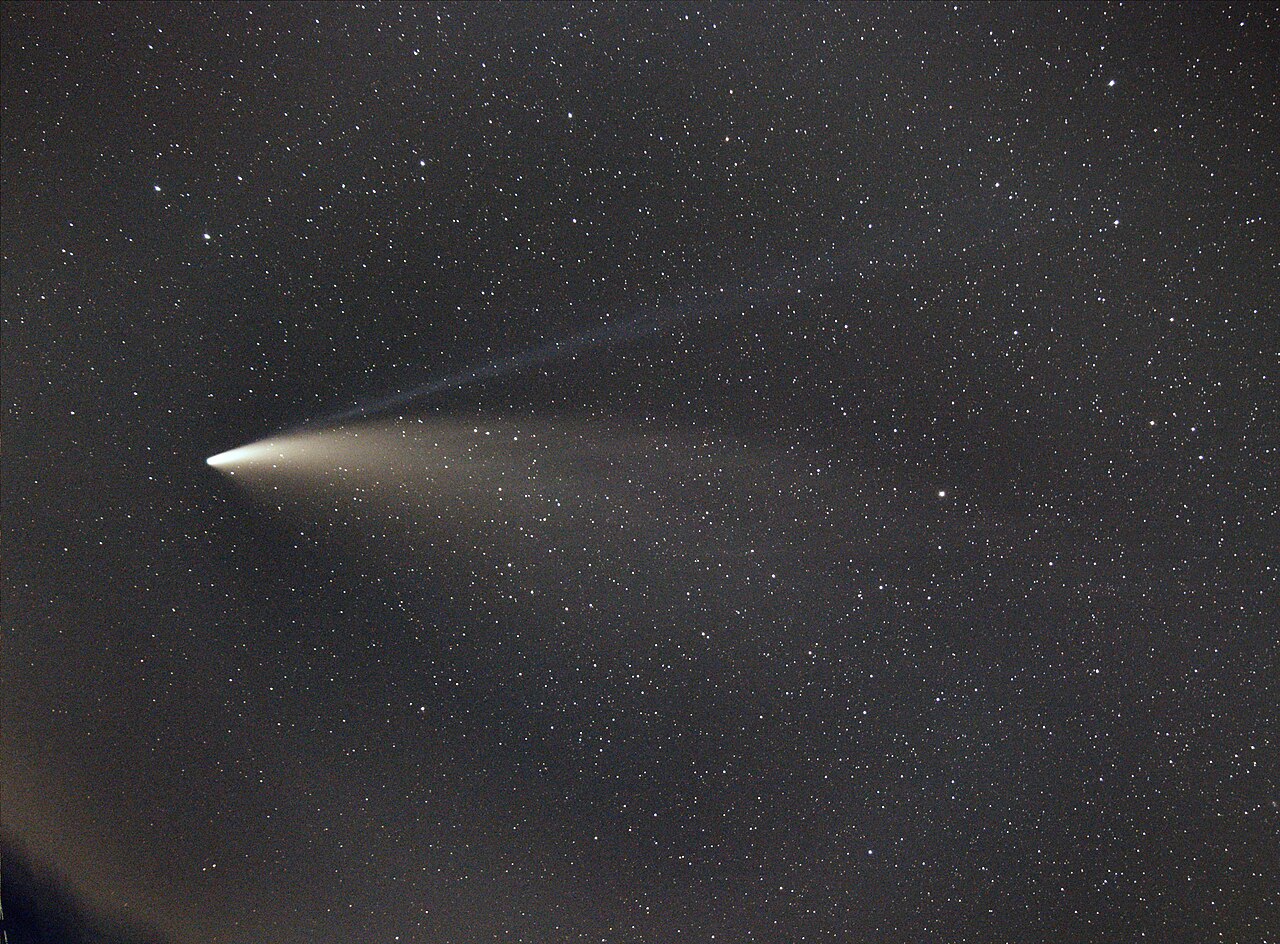
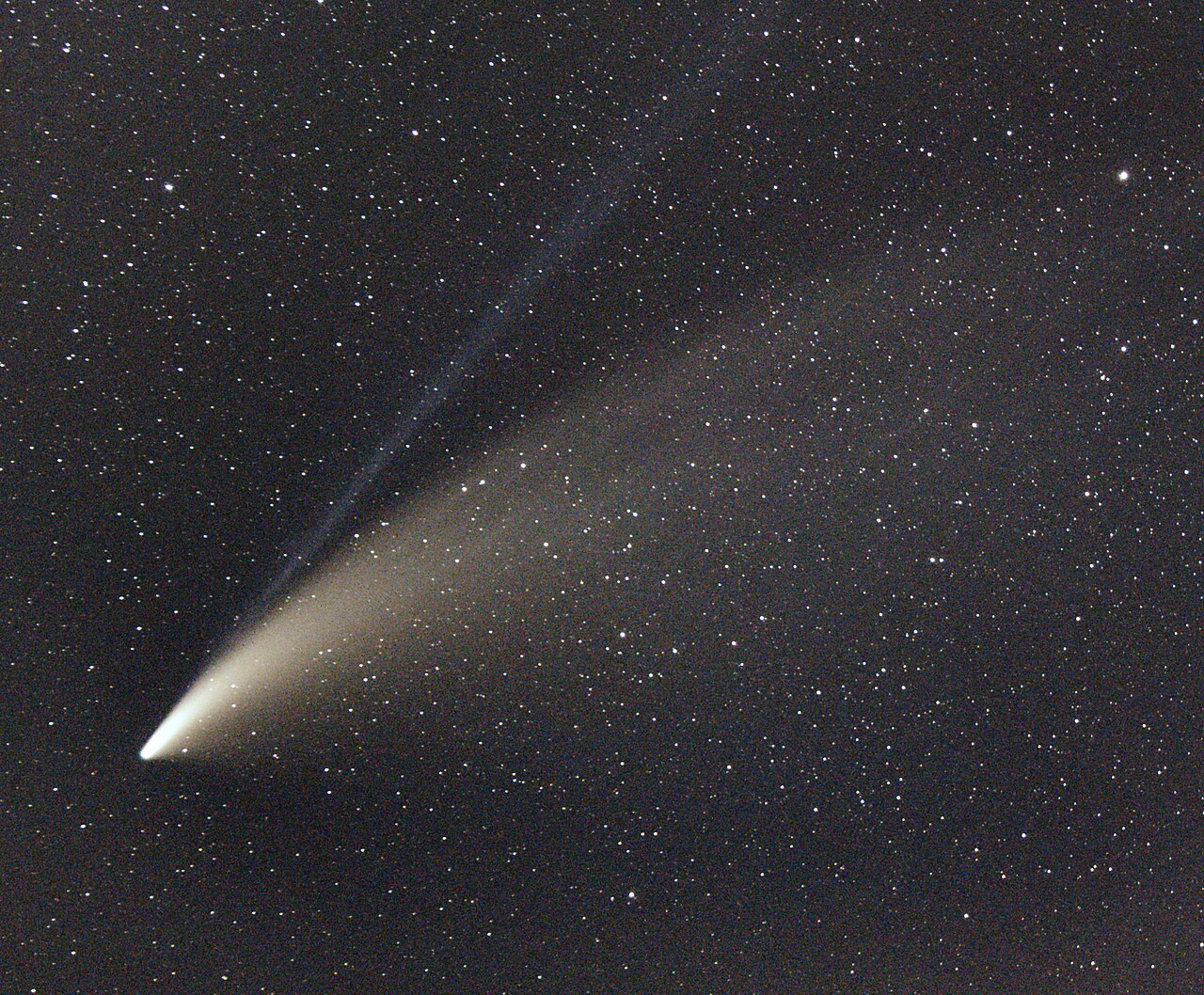
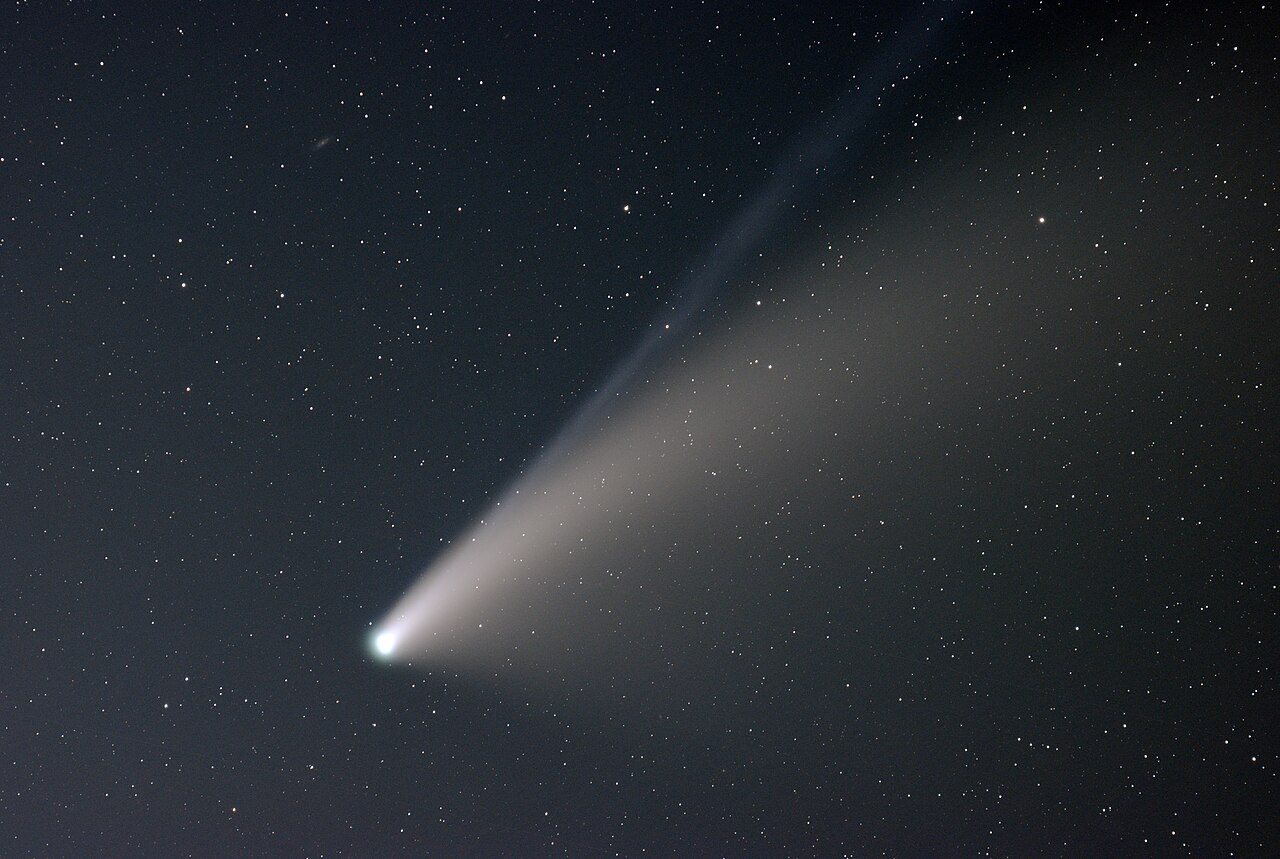
After emerging from perihelion, the comet brightened to magnitude 0.5 to 1, becoming visible to the naked eye. It developed two tails: a blue gas-and-ion tail and a golden dust tail, with a sodium tail confirmed on July 13, 2020—a feature seen only in very bright comets such as Hale–Bopp and C/2012 S1 (ISON). The nucleus, estimated at about 5 km in diameter, showed subdued activity after mid-July, and its green coma became clearly visible. The comet remained visible to the naked eye throughout July 2020, and by July 30 it had faded to about magnitude 5, requiring binoculars near urban areas.
For Northern Hemisphere observers, the comet appeared on the northwestern horizon below the Big Dipper. North of 45 degrees north, it was visible all night in mid-July 2020. On July 30, it entered the constellation Coma Berenices below the star Arcturus. The comet's rotation period was reported as 7.58±0.03 hours on August 14, 2020.
Reader's Guide
Comet NEOWISE is significant as the brightest comet in the northern hemisphere in over two decades, bridging a gap since Comet Hale–Bopp in 1997. Its visibility to the naked eye even from areas with light pollution made it widely photographed by professional and amateur observers. The comet's brightness at perihelion—magnitude 0.5 to 1—far exceeded that of other comets in 2020, such as C/2020 F8 (SWAN) and C/2019 Y4 (ATLAS). Its legacy includes being retroactively called the Great Comet of 2020, though some argued it lacked the brightness and visible tail to qualify for that title. The comet's sodium tail, confirmed by the Planetary Science Institute, placed it among an elite group of comets. In popular culture, it loosely inspired the fictional comet Dibiasky in the 2021 film Don't Look Up. The comet's orbital passage increased its period from about 4,400 years to about 6,700 years, a result of gravitational perturbations from the planets.
Did You Know?
- Comet NEOWISE was discovered on March 27, 2020, as an 18th-magnitude object by the NEOWISE program using the WISE space telescope.
- It developed a sodium tail on July 13, 2020, a feature previously observed only in very bright comets like Hale–Bopp and C/2012 S1 (ISON).
- The comet's nucleus is approximately 5 km in diameter, similar in size to Comet Hyakutake and several short-period comets.
- Its orbital period increased from about 4,400 years to about 6,700 years due to gravitational perturbations during its passage through the planetary region.
Gallery
More in Named Comets, Part 5 1-24
Spotted an error? Know more?
Reader corrections go straight into our review queue. Suggest an edit · How this site is sourced