Comet McNaught
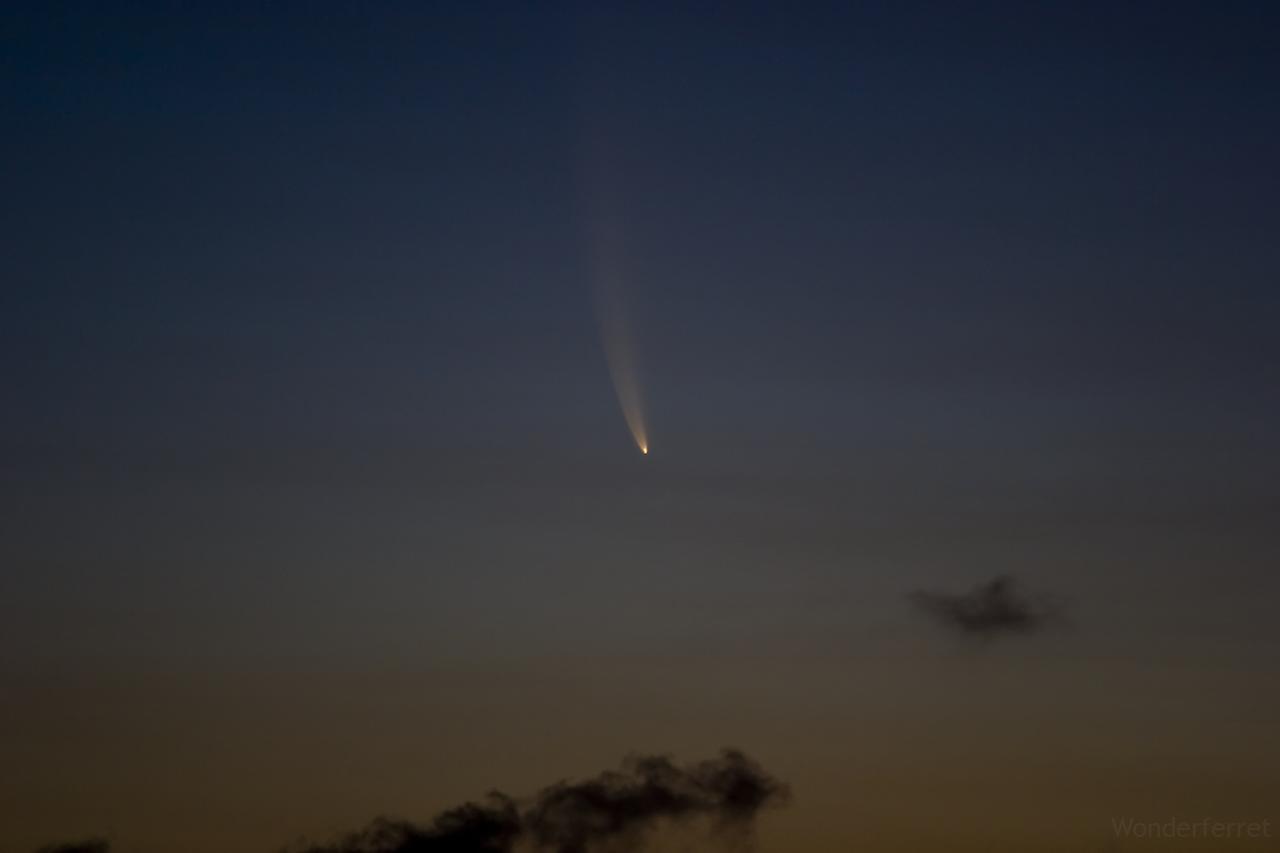
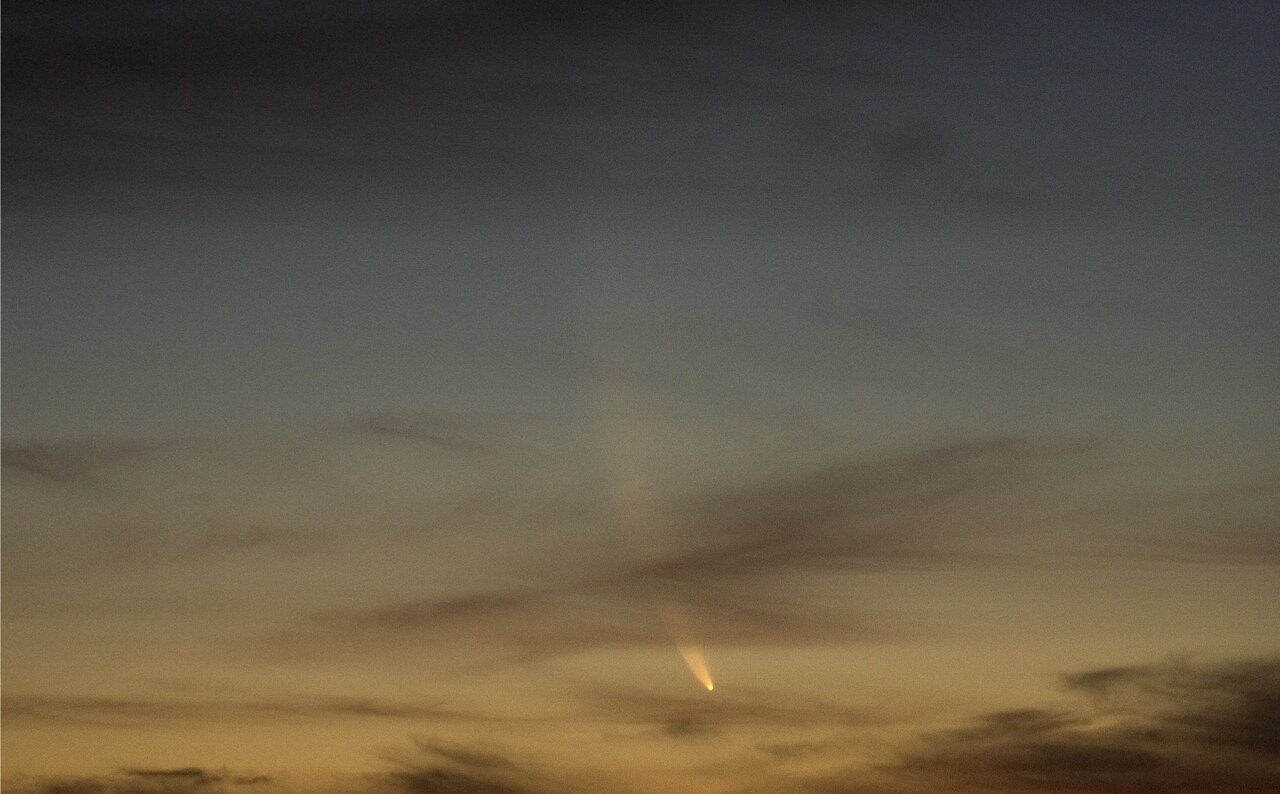
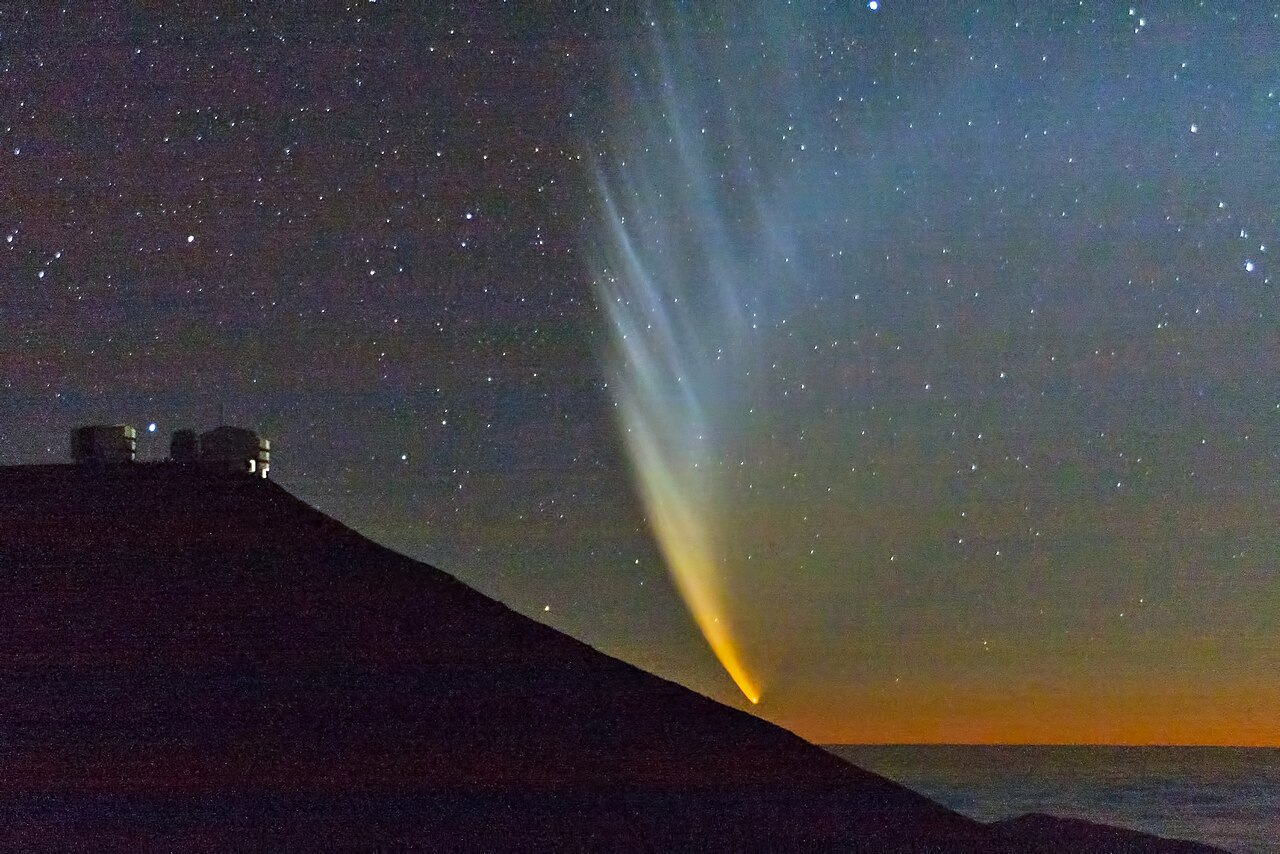
The brightest comet in over 40 years, visible in daylight.

Don Heffernan · CC BY 4.0
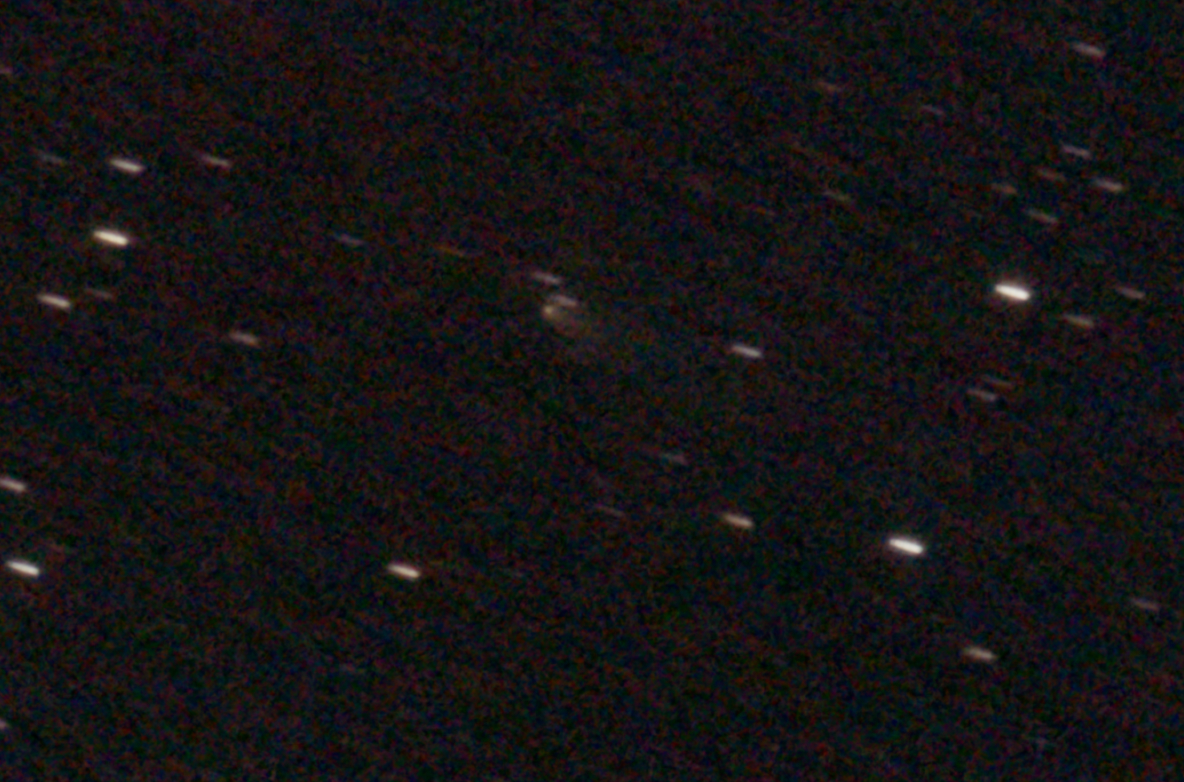
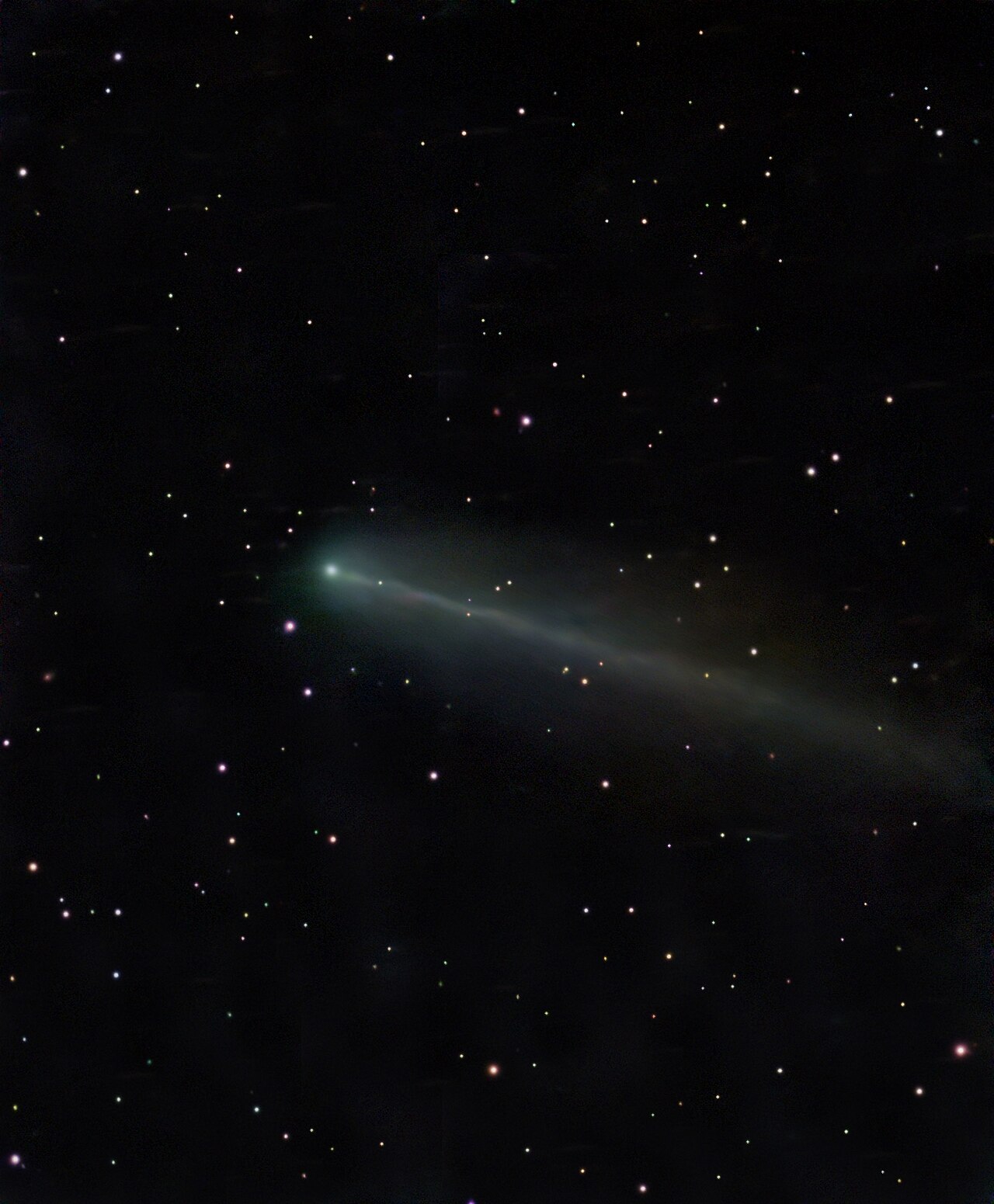
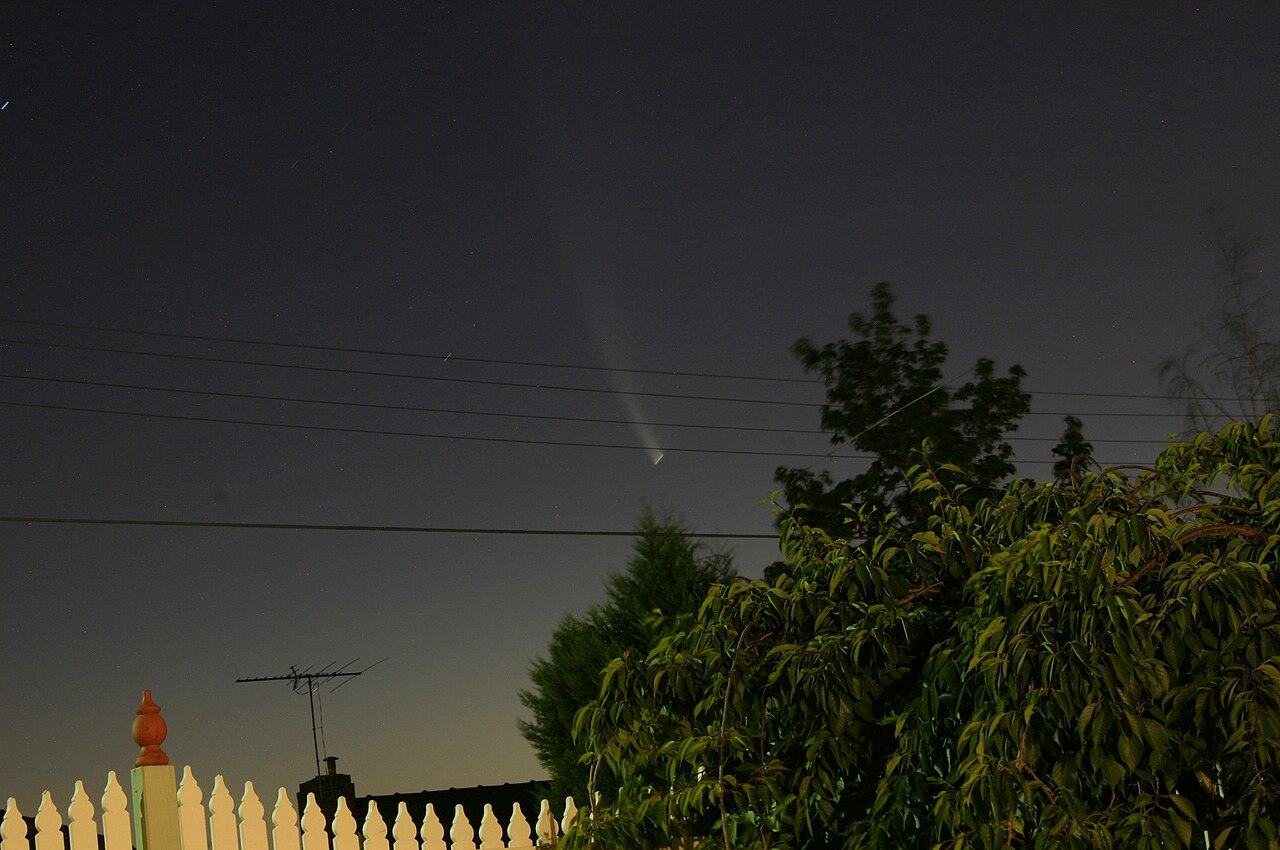
Comet McNaught (officially C/2006 P1) was discovered on 7 August 2006 by British-Australian astronomer Robert H. McNaught using the Uppsala Southern Schmidt Telescope. It is a non-periodic comet that became the brightest seen in over 40 years, earning the nickname the Great Comet of 2007. Observers in the Southern Hemisphere could easily see it with the naked eye during January and February 2007. Its peak magnitude reached an estimated −5.5, making it the second-brightest comet since 1935. Around its perihelion on 12 January, it was visible worldwide in broad daylight. At its peak, its tail stretched 35 degrees across the sky and measured roughly 74.935 million kilometers (0.501 AU) in length. The comet’s brightness near perihelion was boosted by forward scattering.
McNaught first spotted the comet in a CCD image on 7 August 2006 during routine observations for the Siding Spring Survey, which searches for near-Earth objects that could threaten Earth. At the time, it was in Ophiuchus and shone very dimly at about magnitude +17. From August through November 2006, the comet was tracked as it moved through Ophiuchus and Scorpius, brightening to magnitude +9, still too faint for the unaided eye. For most of December, it was lost in the Sun’s glare. When recovered, it became clear the comet was brightening rapidly, reaching naked-eye visibility in early January 2007. Northern hemisphere observers could see it in Sagittarius and nearby constellations until about 13 January. Perihelion occurred on 12 January at a distance of 0.17 AU (25 million kilometers). This closeness allowed the Solar and Heliospheric Observatory (SOHO) to observe it; the comet entered SOHO’s LASCO C3 camera’s field of view on 12 January and was viewable in near real-time online, leaving on 16 January. Because of its proximity to the Sun, northern ground-based viewers had only a short window, spotting it during bright twilight. On 12 January, it became the brightest comet since Comet Ikeya–Seki in 1965. Space.com dubbed it the Great Comet of 2007. On 13 and 14 January, it reached an estimated maximum apparent magnitude of −5.5 and was bright enough to see in daylight about 5°–10° southeast of the Sun. Its closest approach to Earth was on 15 January 2007, at 0.82 AU. After passing the Sun, McNaught became visible in the Southern Hemisphere.
Quick Facts
- Discoverer
- Robert H. McNaught
- Discovery Site
- Siding Spring Observatory / (Uppsala Southern Schmidt Telescope)
- Discovery Date
- 7 August 2006
- Orbit Ref
- barycenter · jpldata · Perth
- Epoch
- 26 November 2006 (JD 2454065.5)
- Orbit
- Oort cloud
- Observation Arc
- 338 days
- Obs
- 331
- Perihelion
- 0.171 AU
- Aphelion
- ~67,000 AU (inbound) / ~4,100 AU (outbound)
- Semimajor
- ~33,000 AU (inbound) / ~2,000 AU (outbound)
- Eccentricity
- 1.000019 (inbound) / 0.99917 (outbound)
Facts from the source article.
Lore & Background
McNaught discovered the comet in a CCD image on 7 August 2006 during routine observations for the Siding Spring Survey, which searched for Near-Earth Objects. The comet was initially in Ophiuchus, shining dimly at magnitude +17. From August through November 2006, it moved through Ophiuchus and Scorpius, brightening to magnitude +9, still too dim for the unaided eye. For most of December, it was lost in the Sun's glare. Upon recovery, it brightened rapidly, reaching naked-eye visibility in early January 2007. Northern hemisphere observers saw it in Sagittarius and surrounding constellations until about 13 January. Perihelion occurred on 12 January at 0.17 AU from the Sun, close enough to be observed by the Solar and Heliospheric Observatory (SOHO), which captured it from 12 to 16 January. Around perihelion, the comet was visible worldwide in broad daylight, and its brightness was enhanced by forward scattering. On 13 and 14 January, it attained an estimated maximum apparent magnitude of −5.5. The closest approach to Earth was on 15 January at 0.82 AU. After passing the Sun, it became visible in the Southern Hemisphere; on 15 January, the Perth Observatory estimated its magnitude at −4.0.
Reader's Guide
The Ulysses spacecraft made an unexpected pass through the comet's tail on 3 February 2007, 260 million km (1.7 AU) from the comet's core. Instrument readings showed complex chemistry in the region. The Solar Wind Ion Composition Spectrometer (SWICS) aboard Ulysses detected unexpected ions, including O3+ oxygen ions for the first time near a comet, suggesting solar wind ions gained electrons while passing through the comet's atmosphere. SWICS also measured the solar wind speed inside the tail at less than 401 km per second, half its normal speed of about 700 km per second at that distance from the Sun. Professor George Gloeckler, principal investigator on SWICS, noted the discovery was important because cometary composition reveals conditions from about 4.5 billion years ago when the Solar System formed, providing a direct sample of ancient material. The observations constrain interactions of comets with the Sun, including mass loss, and examine how neutral and cold material interacts with hot solar-like plasmas, a process occurring elsewhere in the universe. The comet took millions of years coming from the Oort cloud and follows a hyperbolic trajectory during its passage through the inner Solar System, but will remain bound as an Oort cloud comet after leaving planetary influence. Barycentric orbital elements for epoch 2050 give a semi-major axis of 2050 AU and a period of approximately 92,700 years. Studies in 2010 revealed striae on the tail likely caused by three local active domains on the nucleus, with an initial rotation period calculated at 21 hours, but morphological analysis through narrowband imaging from La Silla Observatory indicated a faster rotational period of 11.8 hours.
Did You Know?
- Comet McNaught was the second-brightest comet since 1935, with an estimated peak magnitude of −5.5.
- Its tail measured an estimated 74.935 million km (0.501 AU) in length and stretched 35 degrees across the sky at its peak.
- The Ulysses spacecraft flew through the comet's ion tail 260 million km from the nucleus, detecting O3+ oxygen ions for the first time near a comet.
- The comet's rotation period was initially calculated as 21 hours, but later analysis suggested a faster period of 11.8 hours.
The Icy Core and Its Hidden Chemistry
Comet McNaught, like every comet in our Solar System, is built around a solid nucleus composed of rock, dust, water ice, and frozen gases including carbon dioxide, carbon monoxide, methane, and ammonia. For decades, scientists described these cores as "dirty snowballs," a phrase coined by Fred Whipple. Yet the 2005 Deep Impact mission's collision with Comet Tempel 1 suggested a more accurate picture: "icy dirtballs." A 2014 study even compared cometary structure to deep-fried ice cream, with a dense crystalline crust over a colder, less dense interior. Beneath a dry, dusty surface crust several metres thick, the nucleus harbours a rich chemistry—methanol, hydrogen cyanide, formaldehyde, ethanol, and possibly long-chain hydrocarbons and amino acids. In 2009, NASA's Stardust mission confirmed glycine in comet dust, and later studies hinted that even DNA and RNA building blocks like adenine and guanine may form in these icy bodies. McNaught's nucleus, therefore, is not merely a frozen lump but a complex chemical archive.
Orbital Origins and the Long Journey Inward
Comet McNaught follows one of the highly eccentric elliptical paths that define cometary motion, swinging far beyond the familiar planets before plunging close to the Sun. Where such a comet originates determines its period. Short-period comets, typically 1.5 to 5 kilometres across, are thought to come from the Kuiper belt and its associated scattered disc beyond Neptune. Long-period comets, often larger at 4 to 20 kilometres in diameter, are believed to reside in the Oort cloud—a vast spherical shell of icy bodies stretching from outside the Kuiper belt to roughly halfway toward the nearest star. Gravitational nudges from passing stars and the galactic tide set these distant wanderers on their long inward journey. Some comets, called hyperbolic, pass through the inner Solar System only once before being ejected into interstellar space. McNaught's apparition, like all cometary appearances, is the brief moment when this ancient icy body crosses close enough to the Sun for solar radiation and the solar wind to strip gases from its surface, creating the visible coma and tail.
A Spectacle Written in Light and Dust
When Comet McNaught brightened in the sky, it joined the small group of "great comets" that catch the naked eye without any optical aid. Roughly one comet per year is visible to the unaided eye, though most are faint and unremarkable; the truly spectacular ones are rare. The visual drama comes from outgassing: as solar radiation and the streaming solar-wind plasma strike the nucleus, volatile ices sublimate and release gas and dust. This builds a gravitationally unbound atmosphere called the coma, which can swell to up to fifteen times Earth's diameter, and a tail of gas and dust blown outward that may stretch beyond one astronomical unit. A sufficiently bright comet can subtend an arc of up to thirty degrees across the sky—equivalent to sixty full Moons lined up. The dark, low-albedo surface of the nucleus absorbs sunlight efficiently, driving the very outgassing that produces the spectacle. McNaught's appearance was one of these fleeting, ancient encounters between a Sun-warmed ice body and the watching eyes of a small rocky planet.
Where the Line Between Comet and Asteroid Blurs
Comet McNaught belongs to a family of objects that, for centuries, were thought to be cleanly distinct from asteroids. Comets carry volatile ices that sublimate near the Sun to produce their characteristic tails, while asteroids are rocky bodies that form no tail. Their origins differ too: asteroids are believed to have formed inside Jupiter's orbit, whereas comets assembled in the outer Solar System. Yet the boundary has grown fuzzy. Main-belt comets and active centaur minor planets have been identified, muddying the simple rock-versus-ice divide. In the early 21st century, astronomers discovered minor bodies with long-period comet orbits but the physical characteristics of inner-solar-system asteroids; these were dubbed "Manx comets." Twenty-seven such objects were catalogued between 2013 and 2017, and they are still officially classified as comets. As of November 2021, 4,584 comets had been identified—a tiny sliver of the estimated one-trillion-body reservoir in the Oort cloud. McNaught, like all comets, sits at the heart of this ongoing reclassification.
Gallery
More in Named Comets, Part 5 1-24
Spotted an error? Know more?
Reader corrections go straight into our review queue. Suggest an edit · How this site is sourced