C/1957 P1 (Mrkos)
A great comet discovered in 1957 with two distinct tails.

Alan McClure · Public domain
C/1957 P1 (Mrkos) was a non-periodic comet discovered in 1957 by Czech astronomer Antonín Mrkos. It was one of two bright comets that reached perihelion in 1957, alongside Comet Arend–Roland, and has been characterized as a great comet, with a peak magnitude estimated around 1.0.
Quick Facts
- Discoverer
- Antonín Mrkos
- Discovery Site
- Lomnický štít, Czechoslovakia
- Discovery Date
- 29 July 1957
- Designations
- 1957 V, 1957eICQ1
- Orbit Ref
- Horizons · jpldata
- Epoch
- 10 March 1958 (JD 2436272.5)
- Observation Arc
- 312 days
- Obs
- 16
- Perihelion
- 0.355 AU
- Aphelion
- ~980 AU (inbound) / ~640 AU (outbound)
- Semimajor
- ~540 AU
- Period
- ~10,900 years (inbound) / ~5,750 years (outbound)
Facts from the source article.
Lore & Background
The comet was discovered by Czech astronomer Antonín Mrkos by naked eye at the observatory on Lomnický štít, Czechoslovakia. He announced its discovery on August 2, 1957, though it had already been independently observed, with a report from Japan dated July 29. The comet became known as Comet Mrkos because his telegram arrived first at the IAU. At discovery, the comet was near perihelion and located near Pollux in the constellation Gemini, with an apparent magnitude estimated around 2.0. By August 4 it had brightened to magnitude 1.0.
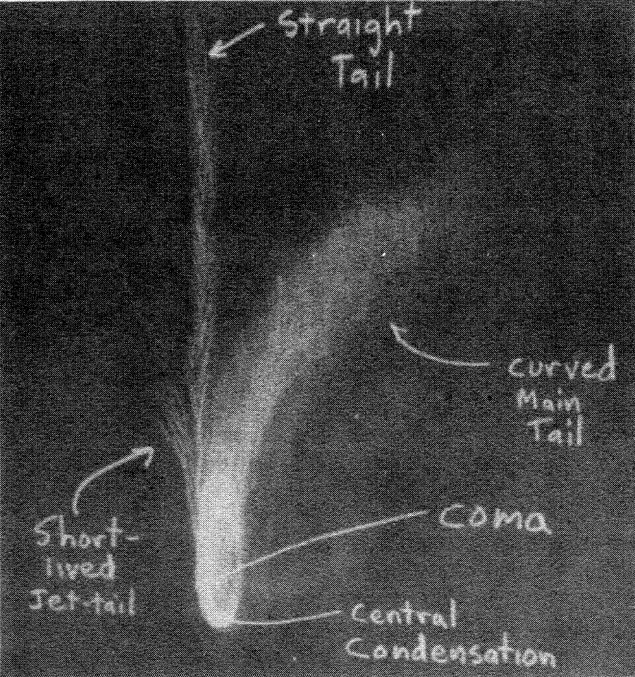
The comet moved north of the Sun and was visible in both the evening and morning sky. It gradually moved away from the Sun and became a conspicuous object after sunset, with a tail estimated to be more than 5 degrees long. The comet displayed two tails: one initially brighter and curved, and a straight tail with knots that became brighter at the end of August and showed rapid changes in appearance. From August 10 to August 15 the tail appeared striated. The comet moved from the southern part of Ursa Major to Coma Berenices while fading slowly. In September it crossed into Virgo as a third-magnitude object and remained visible to the naked eye until the end of September.
By the end of October 1957, the comet had moved close to the Sun again and was not observable. It was recovered at the end of January 1958 and last observed on July 9, 1958, when it was photographed as a diffuse 19th-magnitude object. Observation of the comet revealed the presence of sodium and cyanide in its spectrum in the predicted values.
Reader's Guide
C/1957 P1 (Mrkos) holds significance as one of two great comets of 1957, alongside Comet Arend–Roland, and as a notable discovery by Czech astronomer Antonín Mrkos. Its peak magnitude of 1.0 and characterization as a great comet place it among the brightest comets of the mid-20th century. The comet's observational history highlights its rapid brightening near perihelion and its dual-tail structure, with a curved tail and a straight tail exhibiting knots and rapid changes. The striations observed in its tail from August 10 to 15 provided valuable data on cometary morphology. The comet's visibility to the naked eye until the end of September 1957 allowed widespread observation across the Northern Hemisphere. Its recovery in early 1958 and final observation as a faint 19th-magnitude object in July 1958 extended the observational arc. The detection of sodium and cyanide in its spectrum at predicted values contributed to the understanding of cometary composition. The comet's legacy is tied to its role in the history of comet discovery and its status as a great comet of the 1950s.
Did You Know?
- It was one of two bright comets with perihelion in 1957, the other being Comet Arend–Roland.
- The comet had two tails: one curved and one straight with knots that showed rapid changes.
- Its spectrum revealed the presence of sodium and cyanide in predicted values.
Discovery and the Naming Question
Czech astronomer Antonín Mrkos first laid eyes on this wandering light with his unaided eye from the summit observatory at Lomnický štít in what was then Czechoslovakia. His formal announcement reached the astronomical community on August 2, 1957, yet the comet had already been spotted independently by observers in Japan, whose records carry a date of July 29. The question of credit hinged on a single logistical detail: whose telegram arrived at the International Astronomical Union first. Mrkos' message beat the Japanese report to the desk, and the object carried his name into the record books. By the time of his announcement, the comet was already near its closest approach to the Sun, shining at roughly second magnitude. Within just two days it had surged to first magnitude, confirming that observers across the hemisphere were witnessing something genuinely spectacular. The naming controversy, while ultimately resolved by bureaucratic timing, underscores how quickly a new sky object could be claimed by multiple observers in the pre-digital era of comet reporting.
A Spectacle in Two Tails
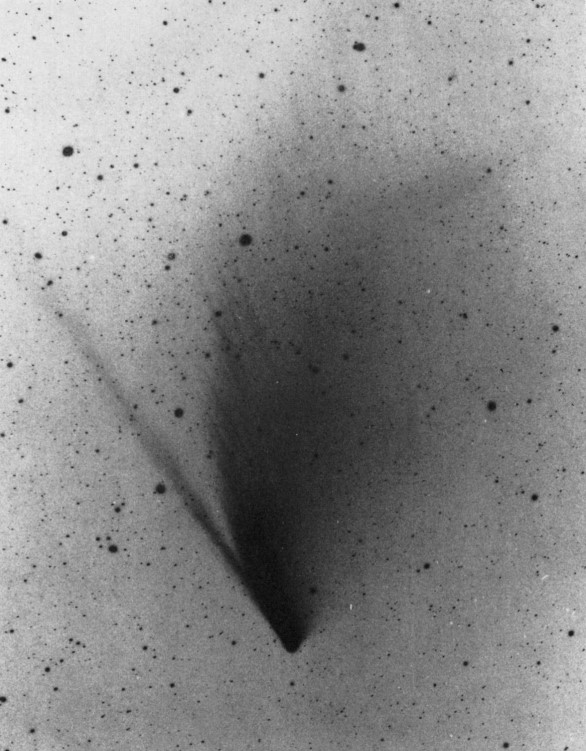
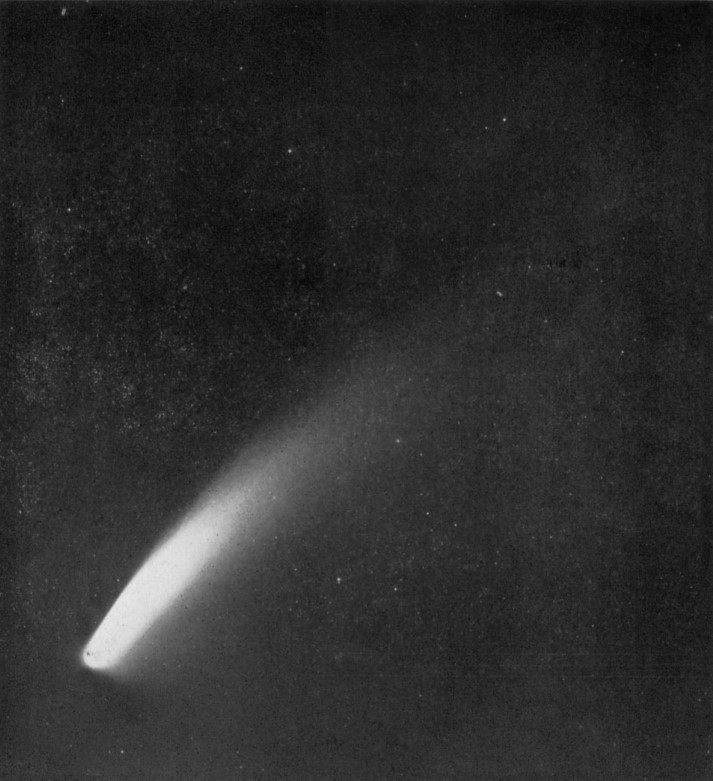
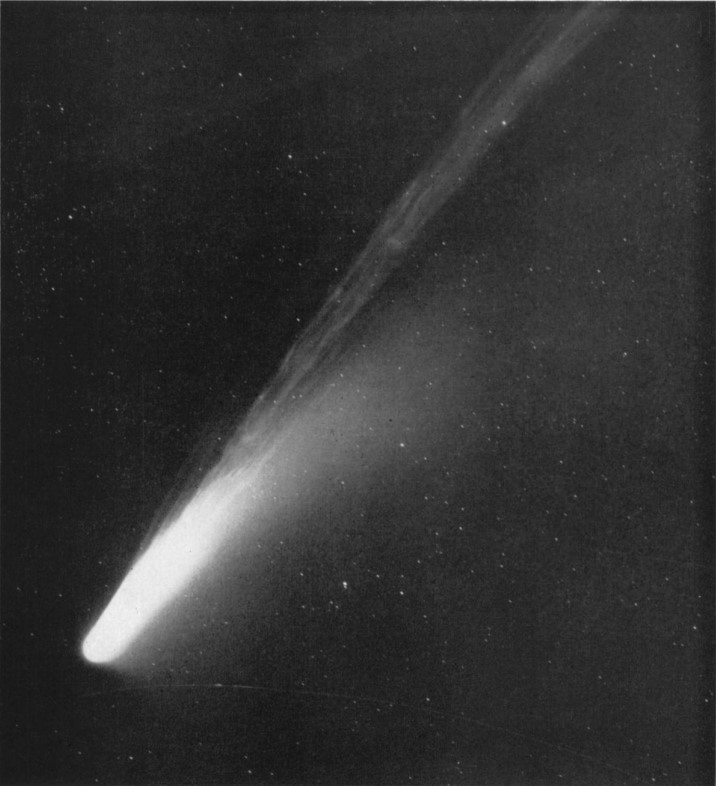
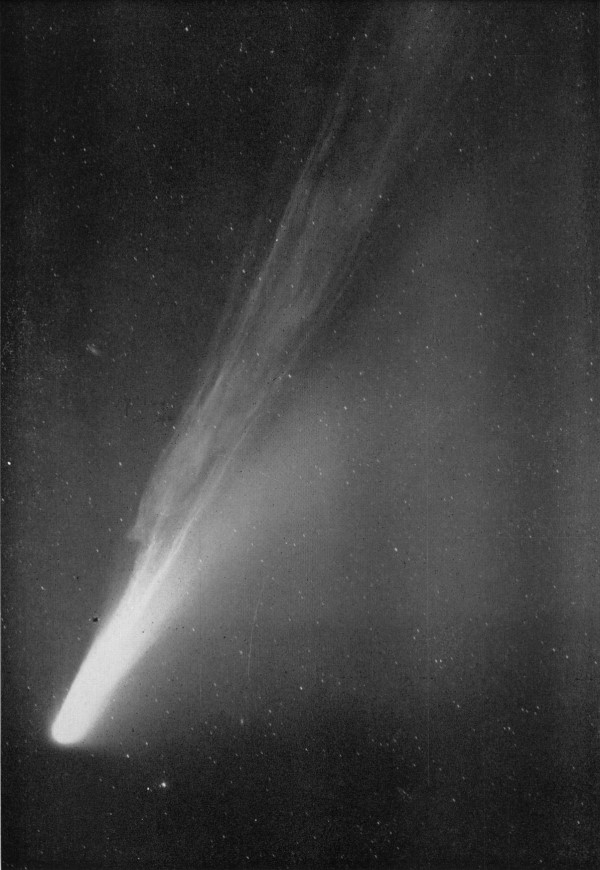
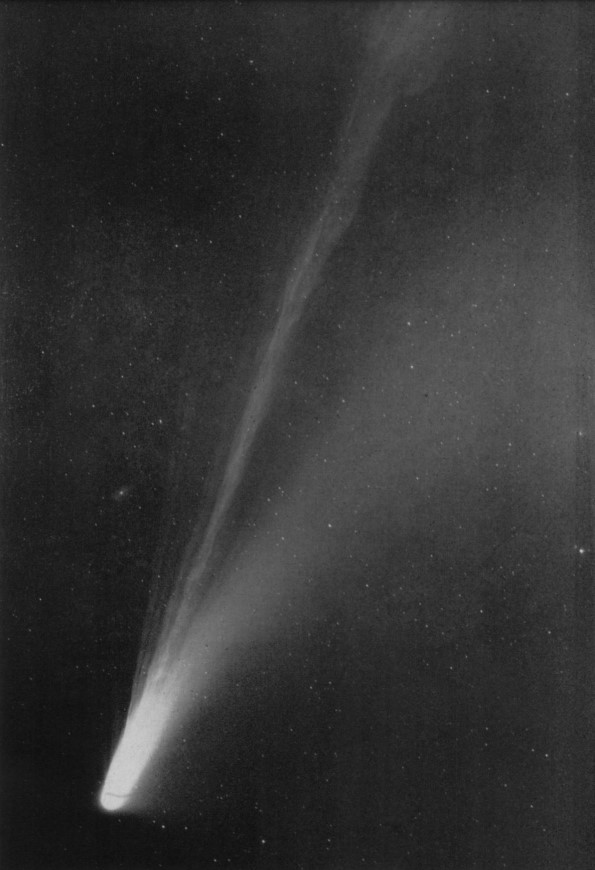
Few comets of the twentieth century matched the visual drama of Mrkos at its zenith, when its apparent brightness reached first magnitude and it earned the designation of a great comet. The most striking feature was its dual-tail structure. One tail, initially the brighter of the pair, arced gracefully through the sky with a pronounced curve. The second tail ran straight and bore a series of knots—condensations of material that gave it a beaded appearance. As August drew to a close, this straight tail intensified in brightness and underwent rapid, almost day-to-day shifts in its visual character. Between August 10 and 15, the tail displayed a striated texture, suggesting internal structure visible even to modest instruments. The combined tail spanned more than five degrees of sky, a vast angular width. Because the comet passed north of the Sun, it graced both evening and morning horizons, and as it drifted away from solar glare it became a conspicuous post-sunset object. Its journey carried it from the vicinity of Pollux in Gemini, through the southern reaches of Ursa Major, and onward into Coma Berenices, slowly dimming but remaining a naked-eye spectacle until late September.
The 1957 Comet Season
The year 1957 proved unusually generous to skywatchers, producing two bright comets that both reached perihelion within the same twelve-month window. Mrkos shared this distinction with Comet Arend–Roland, and together they made the season memorable. Classified as a non-periodic visitor, Mrkos bore the formal designation C/1957 P1, with the older-style label 1957d also appearing in contemporary records. The C prefix signified that its orbit would not bring it back on a predictable cycle, making each apparition a one-of-a-kind event. Its perihelion passage occurred in early August, placing it near the bright star Pollux in Gemini at the moment of discovery. From there it traced a graceful arc northward, crossing the summer constellations. By September it had drifted into Virgo, dimming to roughly third magnitude yet still plainly visible without optical aid. The comet's visibility window closed by the end of October, when its orbit brought it back close to the Sun and it vanished into the glare, unobservable for the remainder of the year. For those who watched, the entire summer of 1957 offered a rare double-comet spectacle unmatched in recent memory.
Fading, Recovery, and Spectral Chemistry
Once Mrkos slipped behind the Sun's glare in late October 1957, it disappeared from view for several months. Astronomers recovered the faint object at the end of January 1958, tracking its continued slow decline. The final recorded observation came on July 9, 1958, when it was captured photographically as a diffuse smudge of nineteenth magnitude—barely distinguishable from a faint star. The long observational arc from first-magnitude brilliance to a ghostly photographic trace documented the full life cycle of a non-periodic comet's apparition. Beyond mere brightness tracking, spectroscopic analysis of the comet's coma yielded chemically significant results. Both sodium and cyanide were identified in its emission spectrum, and crucially, the measured values aligned with theoretical predictions for cometary composition. This confirmation added a data point to the growing understanding of the volatile ices and organic compounds that comets carry from the outer solar system. The Lick Observatory also contributed a telescopic view of the comet, preserving a detailed image of its structure for the astronomical record. Together, these observations cemented Mrkos as both a visual marvel and a scientifically informative visitor.
Gallery
More in Named Comets, Part 5 1-24
Spotted an error? Know more?
Reader corrections go straight into our review queue. Suggest an edit · How this site is sourced