C/2002 V1 (NEAT)
Eighth-brightest comet since 1935, survived close perihelion.

Juan lacruz · CC BY 4.0
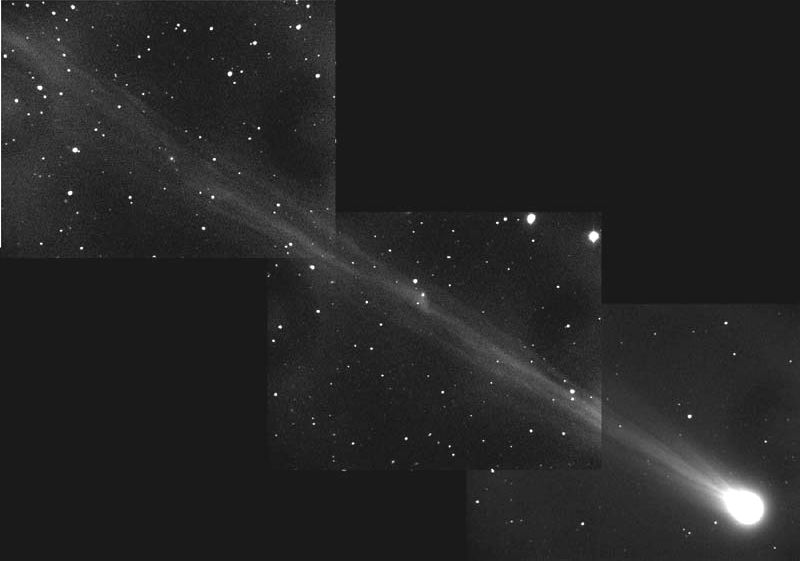
C/2002 V1 (NEAT) is a non-periodic comet discovered in November 2002 by the Near-Earth Asteroid Tracking (NEAT) survey. It became notable for reaching an apparent magnitude of approximately –0.5, making it the eighth-brightest comet observed since 1935.
Quick Facts
- Discovery Ref
- MPEC_2002-V31
- Discoverer
- S. H. Pravdo
- Discovery Site
- NEAT–Haleakalā (608)
- Discovery Date
- 6 November 2002
- Designations
- CK02V010MPEC_2002-V31
- Orbit Ref
- barycenter · jpl
- Epoch
- 26 December 2002 (JD 2452634.5)
- Observation Arc
- 350 days
- Obs
- 1,510
- Semimajor
- 1,010 AU
- Perihelion
- 0.0992 AU
- Aphelion
- 2,020 AU
Facts from the source article.
Lore & Background
Comet NEAT was discovered as a magnitude-17 object on 6 November 2002 using the 1.2 m Schmidt telescope of the Haleakalā Observatory during the Near-Earth Asteroid Tracking (NEAT) survey. By January 2003 it became visible to the naked eye. At perihelion on 18 February 2003, the comet was only 0.0992 AU from the Sun and just 5.7 degrees from the Sun as seen from Earth. During this close approach, it was struck by a coronal mass ejection (CME). Scientists dismissed speculation that the comet caused the CME, noting that 56 CMEs were recorded in February 2003 and that comets and CMEs occur close together only by coincidence. The comet appeared impressive in observations by the Solar and Heliospheric Observatory (SOHO) due to forward scattering of light off dust in its coma and tail. It remained observable with telescopes until October 2003.
Reader's Guide
C/2002 V1 (NEAT) is significant for its brightness and its survival of a very close perihelion passage. Initially expected to disintegrate at 0.0992 AU from the Sun, reanalysis of its orbit indicated that it had survived many previous perihelia, making breakup unlikely. Its peak magnitude of –0.5 placed it among the brightest comets of the modern era. The comet's encounter with a coronal mass ejection during perihelion provided a rare observational event, though scientists emphasized the coincidence rather than a causal link. The comet's long-period orbit, with a barycentric semi-major axis of 1,100 AU and an apoapsis of 2,230 AU, gives it an orbital period of approximately 37,000 years. Its visibility to SOHO and the forward-scattering effect highlighted the role of dust in cometary brightness. The comet remained a telescopic target for months after perihelion, contributing to studies of long-period comet behavior.
Did You Know?
- It was hit by a coronal mass ejection on 18 February 2003 during perihelion.
- The comet's perihelion distance was only 0.0992 AU (14.84 million km) from the Sun.
- Reanalysis of its orbit suggests it has survived many previous perihelia, making breakup unlikely.
The Frozen Heart
C/2002 V1 (NEAT), like every comet in the Solar System, carries at its core a nucleus built from a jumbled mixture of rock, dust, water ice, and frozen gases including carbon dioxide, carbon monoxide, methane, and ammonia. For decades, Fred Whipple's "dirty snowball" model captured the popular imagination, yet the 2005 Deep Impact collision with Comet Tempel 1 nudged scientists toward the phrase "icy dirtball" instead. A 2014 study pushed the metaphor further, comparing cometary structure to deep-fried ice cream: a dense, crystalline outer shell laced with organic compounds wrapping a colder, less dense interior. The surface itself tends to be dry, dusty, or rocky, with the volatile ices buried beneath a crust several metres thick. Nuclei also harbour a rich chemistry—methanol, hydrogen cyanide, formaldehyde, ethanol, ethane, and possibly long-chain hydrocarbons and even amino acids. Their albedos are extraordinarily low, among the darkest objects in the Solar System, because solar heating strips away lighter molecules and leaves behind tar-like organic residues that absorb whatever light reaches them.
A Journey Through Eccentric Space
Comets trace paths through the Solar System that are profoundly different from the near-circular orbits of planets. Their trajectories are highly eccentric ellipses, and their orbital periods span an enormous range—from mere years to potentially millions of years. Short-period members of the family are thought to originate in the Kuiper belt or the associated scattered disc, regions lying beyond Neptune's orbit. Long-period comets, by contrast, are believed to come from the Oort cloud, a vast spherical reservoir of icy bodies stretching from outside the Kuiper belt out to roughly halfway toward the nearest star. These distant wanderers are set on their inward journey by gravitational nudges from passing stars and the subtle pull of the galactic tide. A small subset, called hyperbolic comets, may thread through the inner Solar System just once before being ejected entirely into interstellar space. C/2002 V1 (NEAT) belongs to this grand population of icy travellers whose orbits are shaped by forces far beyond the immediate planetary neighbourhood.
The Apparition: Coma, Tail, and Light
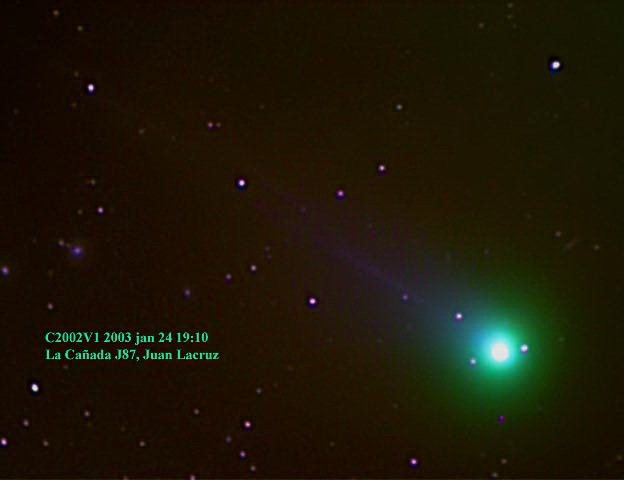
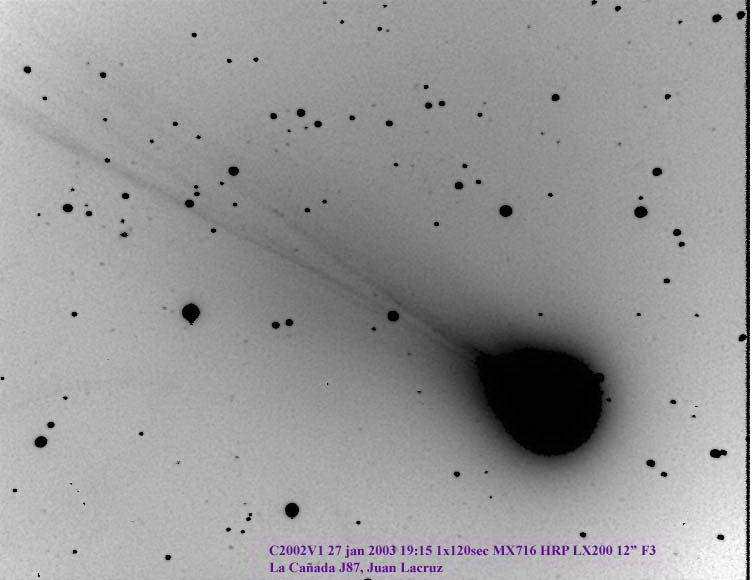
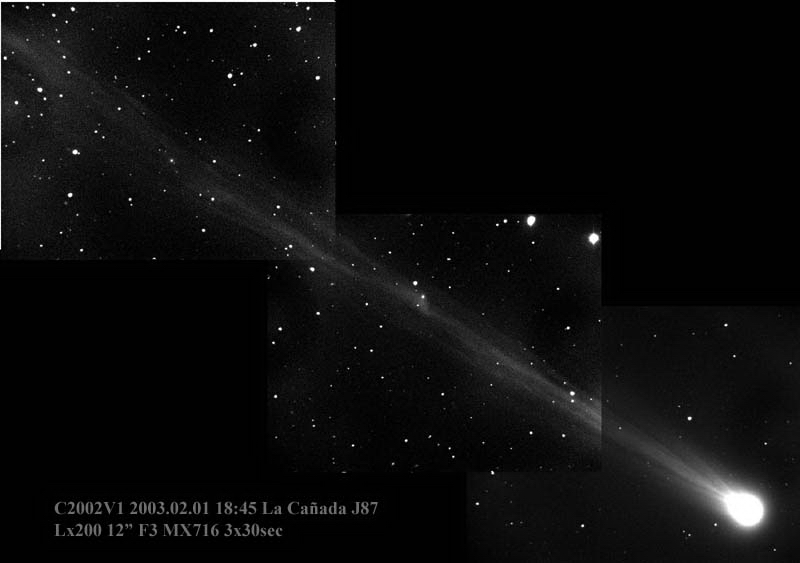
When a comet like C/2002 V1 (NEAT) draws close enough to the Sun, solar radiation and the streaming solar-wind plasma begin to strip volatiles from the nucleus in a process called outgassing. The result is a spectacular transformation: an extended, gravitationally unbound atmosphere called the coma swells around the core, and a tail of gas and dust is blown outward. The coma can grow to roughly fifteen times Earth's diameter, while the tail may stretch beyond one astronomical unit. If the comet is sufficiently close and bright, it becomes visible to the unaided human eye and can sweep an arc of up to thirty degrees across the sky—equivalent to sixty full Moons lined up end to end. Astronomers call each such showing an apparition. On average, about one comet per year is naked-eye visible, though many are faint and unremarkable. The truly brilliant ones earn the title "great comet," a designation that speaks to the rare, awe-inspiring spectacle of a frozen body igniting under solar fire.
One Among a Trillion
As of November 2021, humanity had catalogued 4,584 known comets, yet this number represents only a tiny sliver of the true population. The Oort cloud alone is estimated to hold around one trillion comet-like bodies, making C/2002 V1 (NEAT) one member of an almost incomprehensibly vast family. Comets are distinguished from asteroids by their volatile content, which sublimes near the Sun to produce the characteristic tail; asteroids, by contrast, are rocky bodies that form no such feature and are thought to have originated inside Jupiter's orbit rather than in the outer Solar System. The boundary between the two categories has grown fuzzier over time: main-belt comets and active centaur minor planets blur the distinction, and in the early 21st century, a handful of minor bodies with long-period comet orbits but asteroid-like characteristics were dubbed "Manx comets," with twenty-seven identified between 2013 and 2017. Uncrewed probes have also begun to visit these icy worlds directly, from NASA's Deep Impact to ESA's Rosetta, deepening our understanding of what C/2002 V1 (NEAT) and its kin truly are.
Gallery
More in Named Comets, Part 5 1-24
Spotted an error? Know more?
Reader corrections go straight into our review queue. Suggest an edit · How this site is sourced