C/2014 Q1 (PanSTARRS)
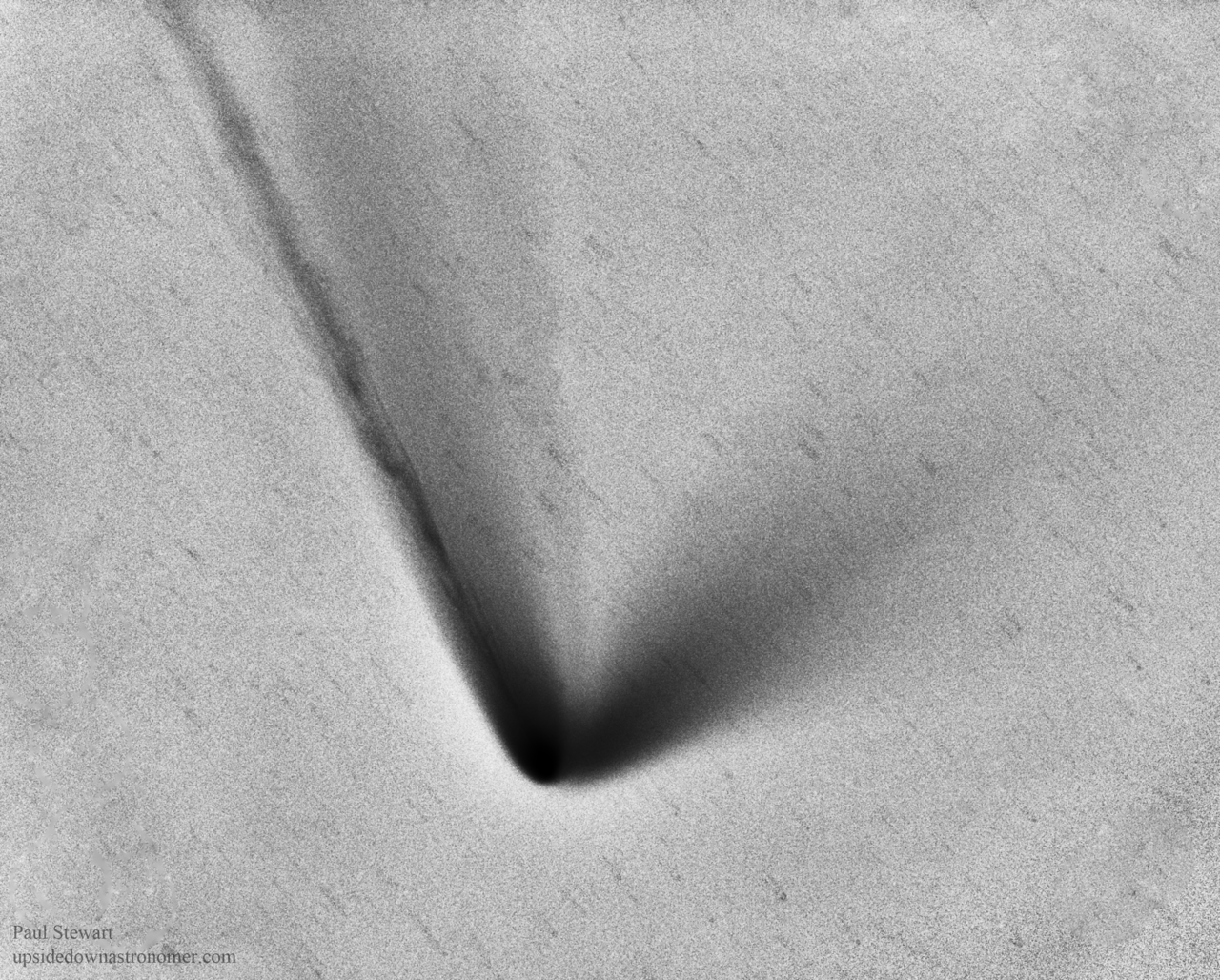
Non-periodic comet with three tails after perihelion.

ESO/A. Ghizzi Panizza · CC BY 4.0
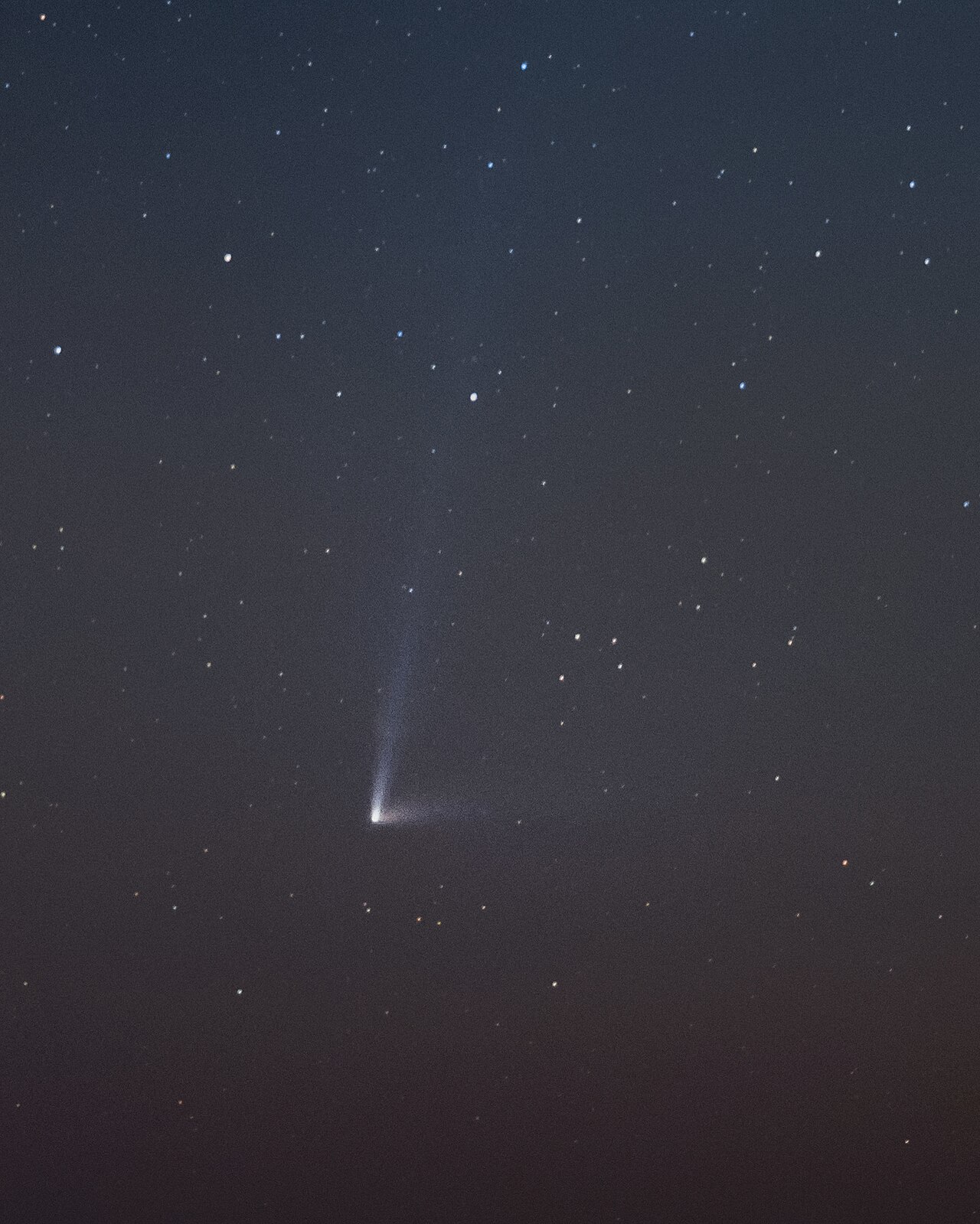
C/2014 Q1 (PanSTARRS) is a non-periodic comet first spotted on 16 August 2014 by the Panoramic Survey Telescope and Rapid Response System (Pan-STARRS). Following its closest approach to the Sun on 6 July 2015, it brightened to magnitude +4 while visible in the evening twilight, and on its way out of the inner solar system it developed three distinct tails.
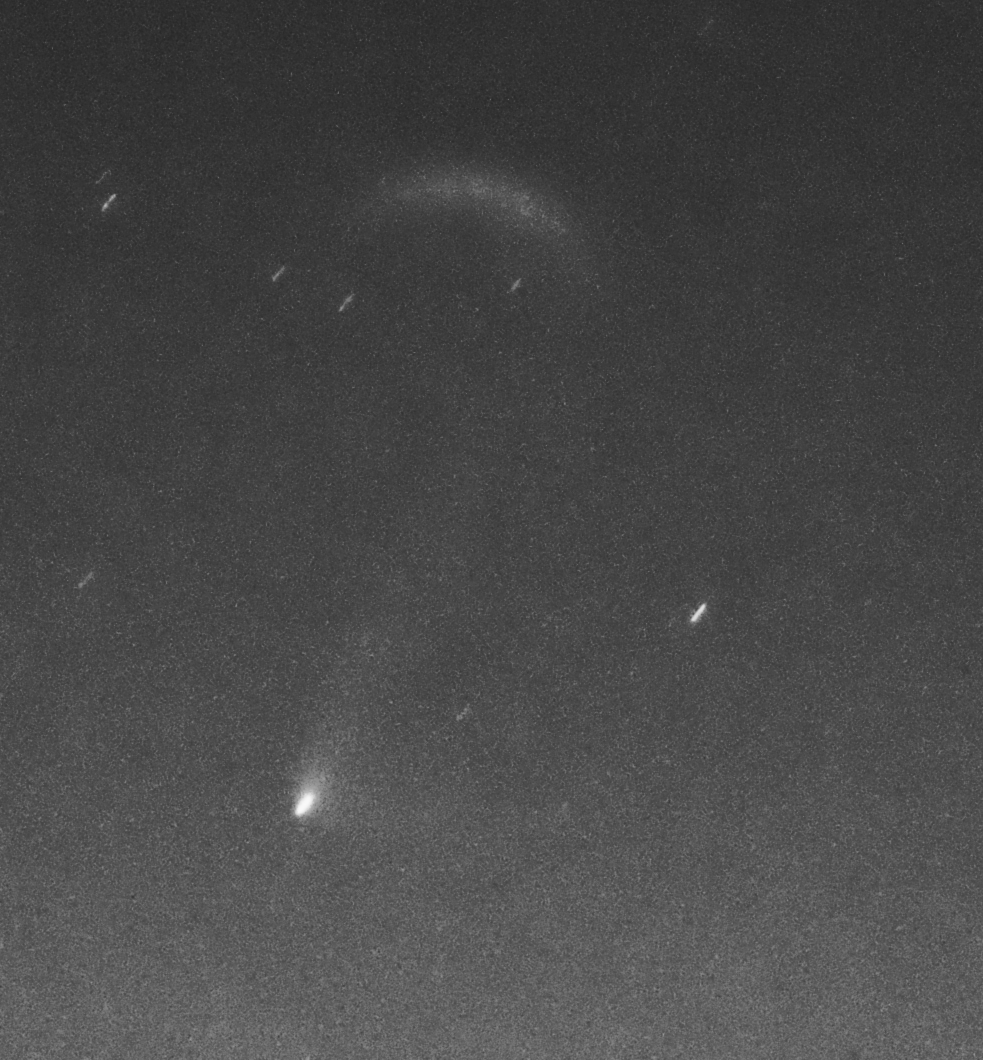
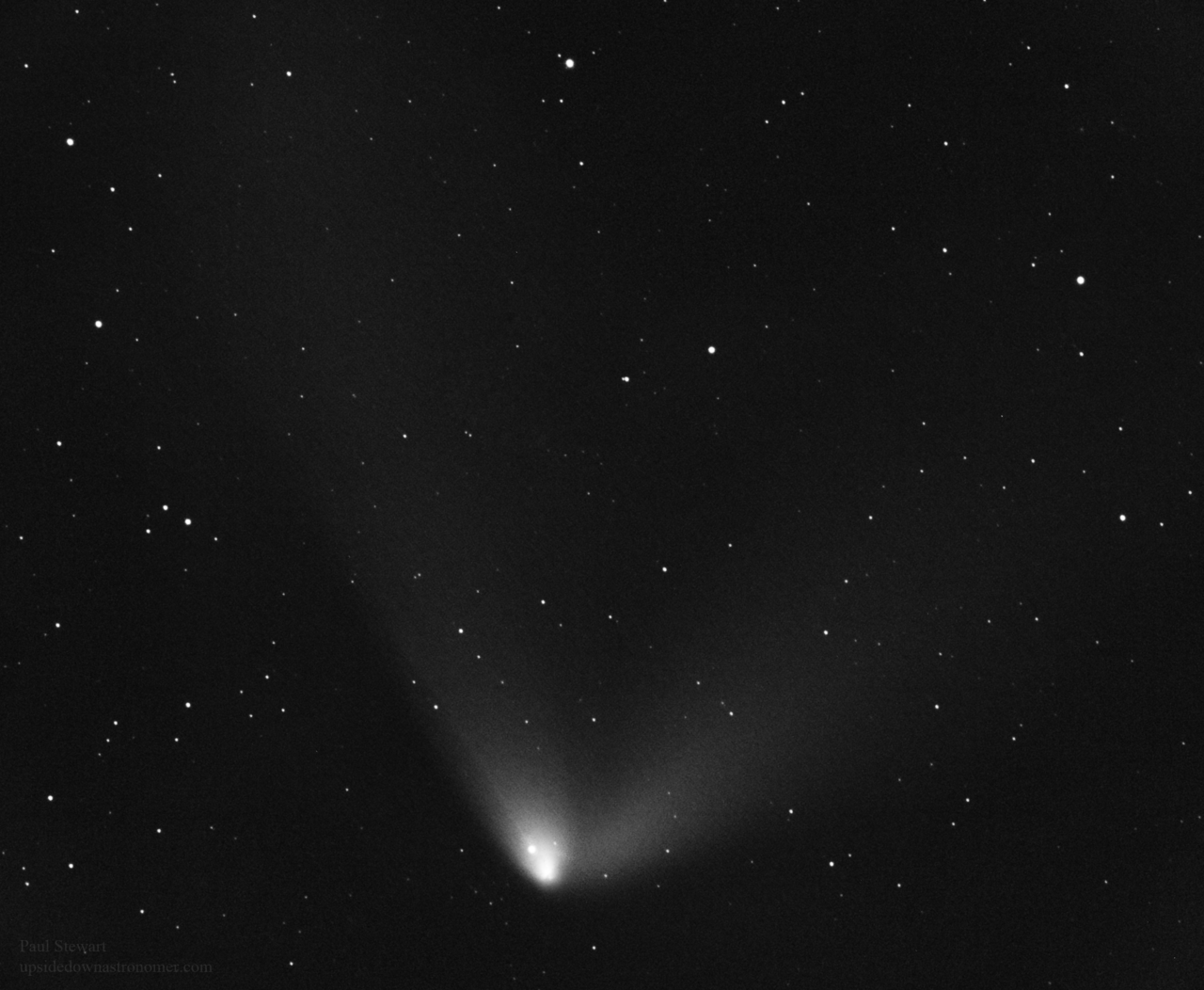
The comet was discovered in images from Pan-STARRS’s 1.8-meter Ritchey-Chrétien telescope, at which time its magnitude was 18.4. A preliminary orbit was published three days later, on 19 August. As the comet moved northward, Alan Hale observed it in the morning sky on 14 June 2015, noting a condensed coma and an estimated magnitude of 8. After perihelion on 6 July, it reached magnitude +4 in evening twilight. On 15–16 July, it was reported at magnitude +5.2 but remained invisible to the naked eye due to twilight. The comet exhibited three tails: an ion tail 1.5 degrees long that appeared to fork, a main dust tail half a degree long, and a broad dust tail oriented at a right angle to the other two. The dust tail showed a gap that appeared on 14 July 2015, eight days after perihelion at 0.318 AU, and progressed along the tail, matching the expected motion of dust that should have been present. This gap corresponded to dust ejected between 5 and 12 July, indicating that the comet’s activity dropped sharply between 6 and 12 July.
The SWAN instrument aboard the SOHO spacecraft observed the comet during its perihelion. The water production rate rose sharply in the days near perihelion, when the comet was less than 0.7 AU from the Sun, reaching 2×10³⁰ molecules per second. This sharp increase suggests that grainy ices and ice chunks were continuously stripped from the comet’s surface, boosting sublimation. Calculations indicate that the nucleus lost more than half its mass during this passage.
Quick Facts
- Discovery Ref
- CBET_3933 · MPEC_2014-Q09
- Discoverer
- PanSTARRS
- Discovery Date
- 16 August 2014
- Orbit Ref
- jpldata
- Epoch
- 17 February 2015 (JD 2457070.5)
- Observation Arc
- 1.74 years (636 days)
- Obs
- 704
- Perihelion
- 0.315 AU
- Aphelion
- ~2,260 AU
- Semimajor
- ~1,130 AU
- Eccentricity
- 0.99972
- Period
- ~38,100 years
Facts from the source article.
Lore & Background
C/2014 Q1 (PanSTARRS) was discovered in images taken by the 1.8m Ritchey-Chretien telescope of the Panoramic Survey Telescope and Rapid Response System (Pan-STARRS) on 16 August 2014, when the comet had a magnitude of 18.4. A preliminary orbit was published on August 19. The comet was observed as it moved northwards, and Alan Hale observed it in the morning sky on June 14, 2015, when it featured a condensed coma and its magnitude was estimated to be 8.
After its perihelion on July 6, 2015, the comet reached a magnitude of +4 while in evening twilight. On July 15–16 the comet was reported to have a magnitude of +5.2, but was not visible to the naked eye because of its position in the twilight. The comet displayed three tails: an ion tail, the main dust tail, and a broad dust tail at a right angle to them. The ion tail was 1.5 degrees long and appeared to fork, while the main dust tail was half a degree long. The dust tail indicated that the activity of the comet reduced rapidly between July 6 and July 12, as a gap in the dust tail appeared on July 14, 8 days after perihelion at 0.318 au, and progressed along the tail, following the expected motion of the dust that should have been present. The gap corresponds to dust ejected between July 5 and July 12.
The comet was observed by the SWAN instrument onboard SOHO during its perihelion. The water production rate rose sharply during the days near perihelion, when the comet was less than 0.7 AU from the Sun, at 2×10^30 molecules per second. The sharp increase indicates that grainy ices and chunks of ice were continuously removed from the surface of the comet, resulting in increased sublimation. It is calculated that the nucleus of the comet lost more than half of its mass during the passage.
Reader's Guide
C/2014 Q1 (PanSTARRS) is significant for its dramatic post-perihelion display, reaching magnitude +4 while immersed in evening twilight, and for the rare sight of three distinct tails—an ion tail, a main dust tail, and a broad dust tail at a right angle to the others. The structure of the dust tail provided a clear record of the comet's rapidly declining activity: a gap in the tail, appearing 8 days after perihelion, corresponded to a hiatus in dust ejection between July 5 and July 12, 2015. This gap allowed astronomers to trace the motion of dust released near perihelion and to infer the timing of the comet's outburst. Observations by the SWAN instrument on SOHO revealed a sharp spike in water production near perihelion, reaching 2×10^30 molecules per second, consistent with the continuous removal of grainy ices and ice chunks from the nucleus. The comet's mass loss was calculated to exceed half of its original nucleus mass during the passage, marking it as a highly disrupted object. Its legacy lies in the detailed correlation between tail morphology and the comet's activity history, as well as the extreme mass loss observed in a sungrazing comet.
The Frozen Core and Its Volatile Envelope
A comet's nucleus is a compact amalgamation of rock, dust, water ice, and frozen gases including carbon dioxide, carbon monoxide, methane, and ammonia. For decades the popular "dirty snowball" model, proposed by Fred Whipple, painted these bodies as ice-dominant. Yet the 2005 Deep Impact collision with Comet 9P/Tempel 1 suggested a more rock-rich interior, prompting the "icy dirtball" alternative. A 2014 research finding added another layer: the surface resembles "deep fried ice cream," with dense crystalline ice intermixed with organic compounds, while the deeper interior remains colder and less dense. The outer shell is typically dry, dusty, or rocky, with ices sequestered beneath a crust several metres thick. Nuclei harbour a rich chemistry—methanol, hydrogen cyanide, formaldehyde, ethanol, ethane, and even long-chain hydrocarbons. In 2009, NASA's Stardust mission confirmed the presence of the amino acid glycine in recovered comet dust. These surfaces rank among the darkest in the Solar System; Halley's Comet reflects roughly four percent of incident light, and Comet Borrelly less than three percent, compared to seven percent for asphalt. Solar heating drives off lighter volatiles, leaving behind dark, tar-like organic residues that further lower reflectivity and fuel the outgassing cycle.
Orbital Architecture and the Solar System's Icy Reservoirs
Comets trace highly eccentric elliptical paths around the Sun, with orbital periods spanning from mere years to potentially millions of years. Short-period members originate in the Kuiper belt or its associated scattered disc, regions lying beyond Neptune's orbit. Long-period comets, by contrast, are thought to be drawn from the Oort cloud—a vast spherical shell of icy bodies extending from outside the Kuiper belt to roughly halfway toward the nearest star. These distant wanderers are nudged sunward by gravitational perturbations from passing stars and the galactic tide. A rarer class, hyperbolic comets, may thread through the inner Solar System only once before being ejected into interstellar space. As of November 2021, astronomers had catalogued 4,584 known comets, a tiny sliver of the estimated one-trillion-body reservoir in the Oort cloud. Roughly one comet per year reaches naked-eye visibility from Earth, though many of these are faint and unremarkable. The particularly brilliant ones earn the title "great comets," and their apparitions have been recorded across cultures since antiquity.
Drawing the Line: Comets, Asteroids, and the Manx Category
The classic distinction between comets and asteroids rests on volatile content and origin. Comets carry ices and other volatile material that sublimate as they approach the Sun, generating the characteristic coma and tail. Asteroids, by contrast, behave more like bare rocks and produce no tail. Their formation locations differ as well: asteroids are thought to have assembled inside Jupiter's orbit, while comets formed in the outer Solar System. Yet the boundary has grown increasingly porous. The discovery of main-belt comets and active centaur minor planets has muddied the simple rock-versus-ice dichotomy. In the early 21st century a new category emerged: so-called Manx comets—minor bodies that follow long-period comet orbits yet display the physical characteristics of inner-solar-system asteroids. They remain officially classified as comets. Twenty-seven Manx comets were identified between 2013 and 2017, underscoring how much the taxonomy of small Solar System bodies is still being refined. For any individual object in the PanSTARRS survey family, these overlapping categories remind us that the Solar System's small-body population resists easy classification.
From Ancient Skies to Robotic Encounters
The word "comet" travels a long linguistic path: from Old English cometa, borrowed from Latin comēta, which itself romanizes the Greek κομήτης, meaning "wearing long hair." That Greek term derives from κομᾶν, "to wear the hair long," rooted in κόμη, "the hair of the head," a word also used for a comet's tail. The astronomical symbol for comets, encoded in Unicode as U+2604, depicts a small disc with three hairlike extensions—a visual echo of that ancient imagery. When a comet's coma swells to up to fifteen times Earth's diameter and its tail stretches beyond one astronomical unit, the object can subtend an arc of as much as thirty degrees—roughly sixty full Moons—across the night sky. Uncrewed probes have brought these bodies into sharp focus: NASA's Deep Impact blasted a crater into Comet Tempel 1 to study its interior, while the European Space Agency's Rosetta achieved the first robotic landing on a cometary surface. These missions, alongside Stardust's recovery of glycine-bearing dust, have transformed comets from mythic omens into objects of precise physical inquiry.
Gallery
More in Named Comets, Part 5 1-24
Spotted an error? Know more?
Reader corrections go straight into our review queue. Suggest an edit · How this site is sourced