
C/2011 L4 (PanSTARRS)
Non-periodic comet discovered in 2011, visible to the naked eye in March 2013.

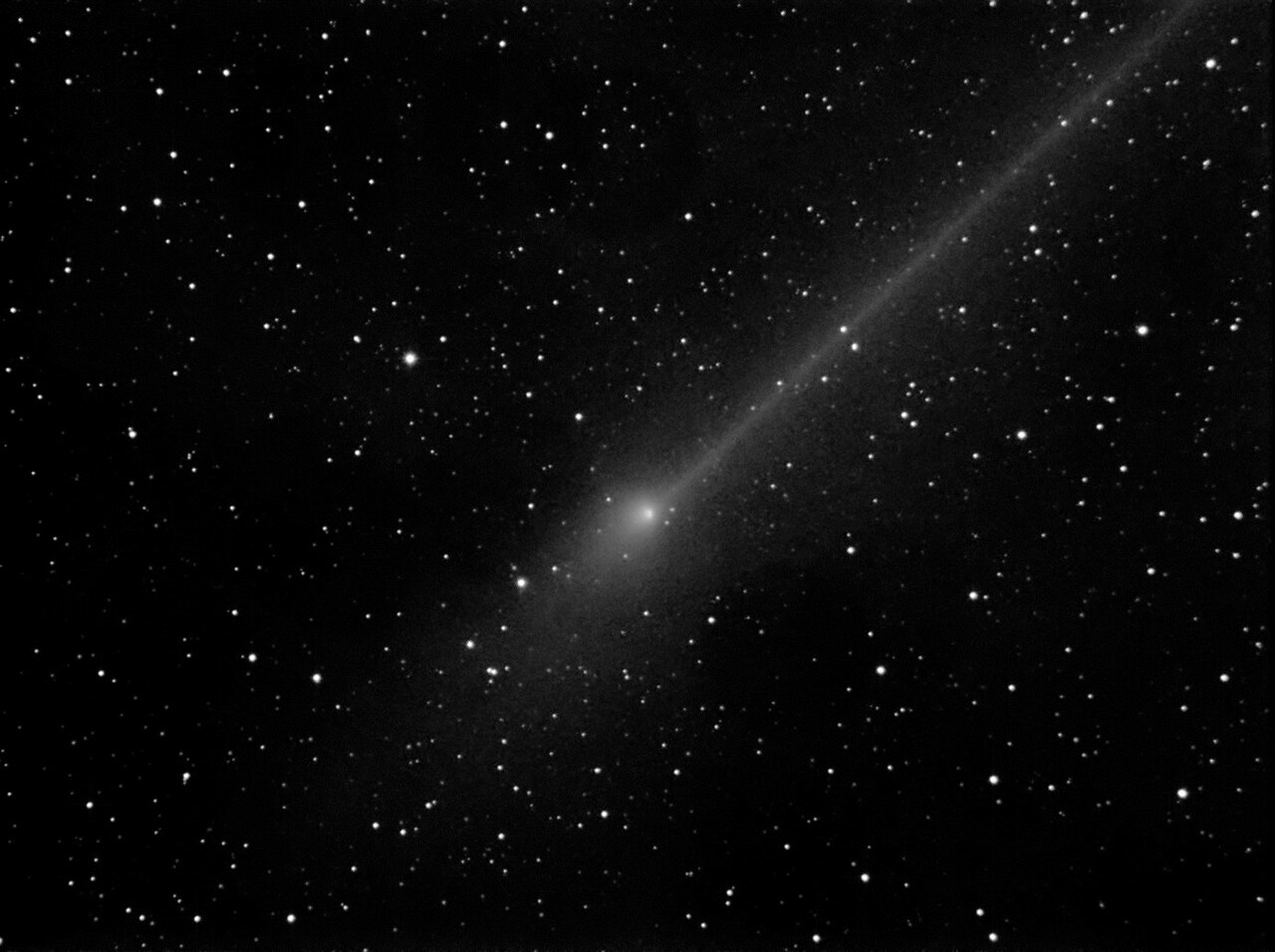
Mallorcasaint / Mallorcasaint at English Wikipedia · CC BY-SA 3.0
C/2011 L4 (PanSTARRS) is a non-periodic comet first spotted in June 2011. It became bright enough to see without a telescope as it approached its closest point to the Sun in March 2013. The discovery was made with the Pan-STARRS telescope on the summit of Haleakalā, on Maui, Hawaii.
At the time of its discovery, the comet was 7.9 AU from the Sun and had an apparent magnitude of 19. By early May 2012, it had brightened to magnitude 13.5, making it visible through a large amateur telescope from a dark location. In October 2012, its coma—the expanding, tenuous dust atmosphere—was estimated to be roughly 120,000 kilometers across. On 7 February 2013, it was spotted without optical aid at about magnitude 6. During the first weeks of March, the comet could be seen from both hemispheres. It made its closest approach to Earth on 5 March 2013, at a distance of 1.09 AU, and reached perihelion on 10 March 2013.
Early brightness predictions varied widely. Some initial estimates suggested it might reach magnitude 0, similar to Vega or Alpha Centauri A. An October 2012 forecast put it as bright as magnitude −4, comparable to Venus. By January 2013, a slowdown in brightening indicated it might only reach magnitude +1, and by February the curve suggested a perihelion magnitude around +2. A later study using the secular light curve identified a "slowdown event" when the comet was 3.6 AU from the Sun at magnitude 5.6; this study predicted a perihelion magnitude of +3.5. For comparison, Comet Halley would be magnitude −1.0 at the same distance. The same study classified C/2011 L4 as a very young comet, a "baby comet" with a photometric age under four comet years.
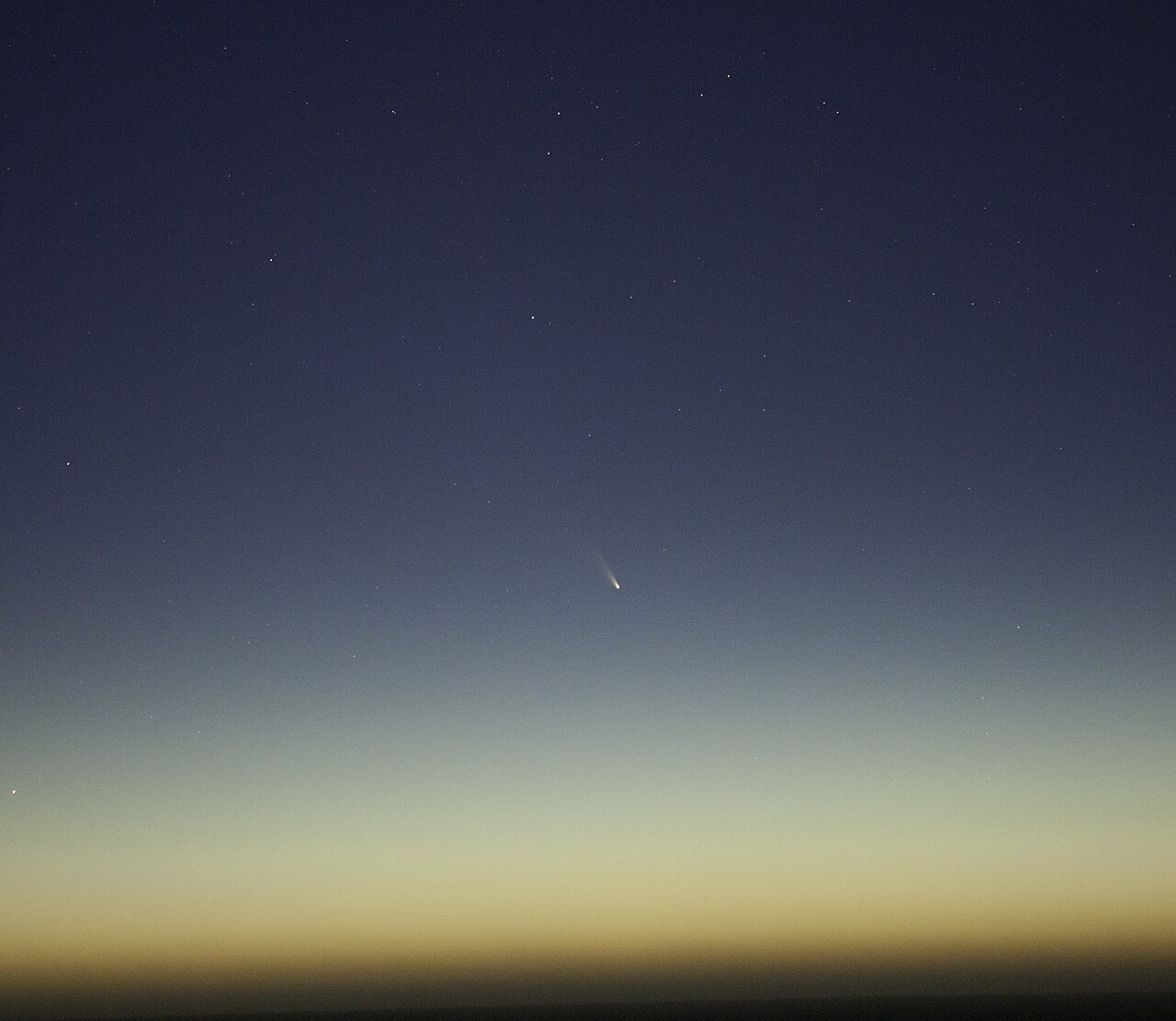
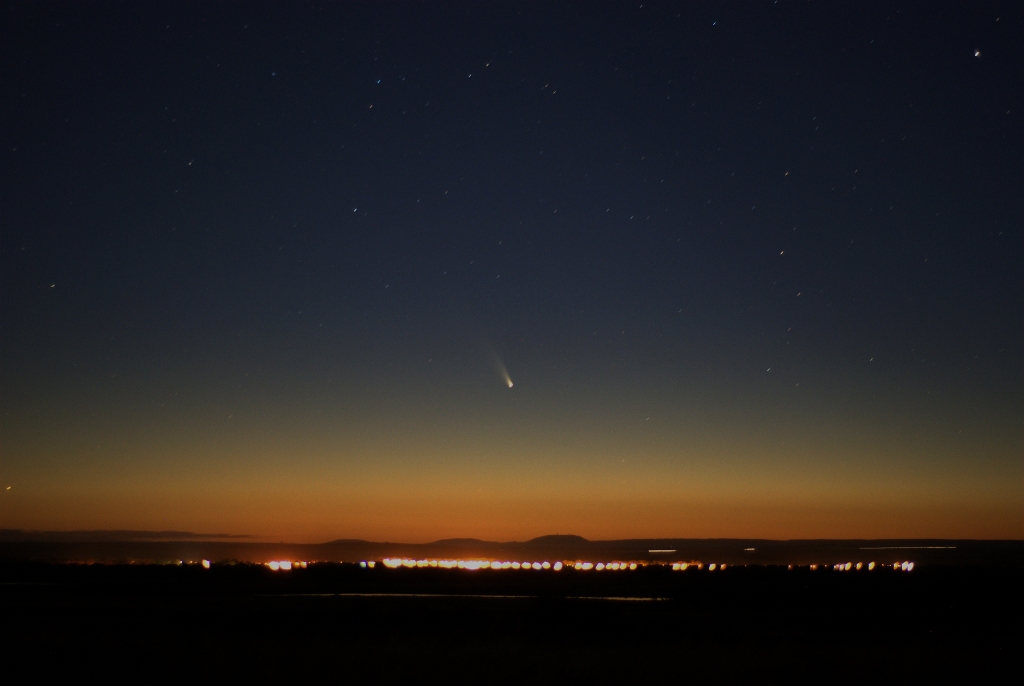
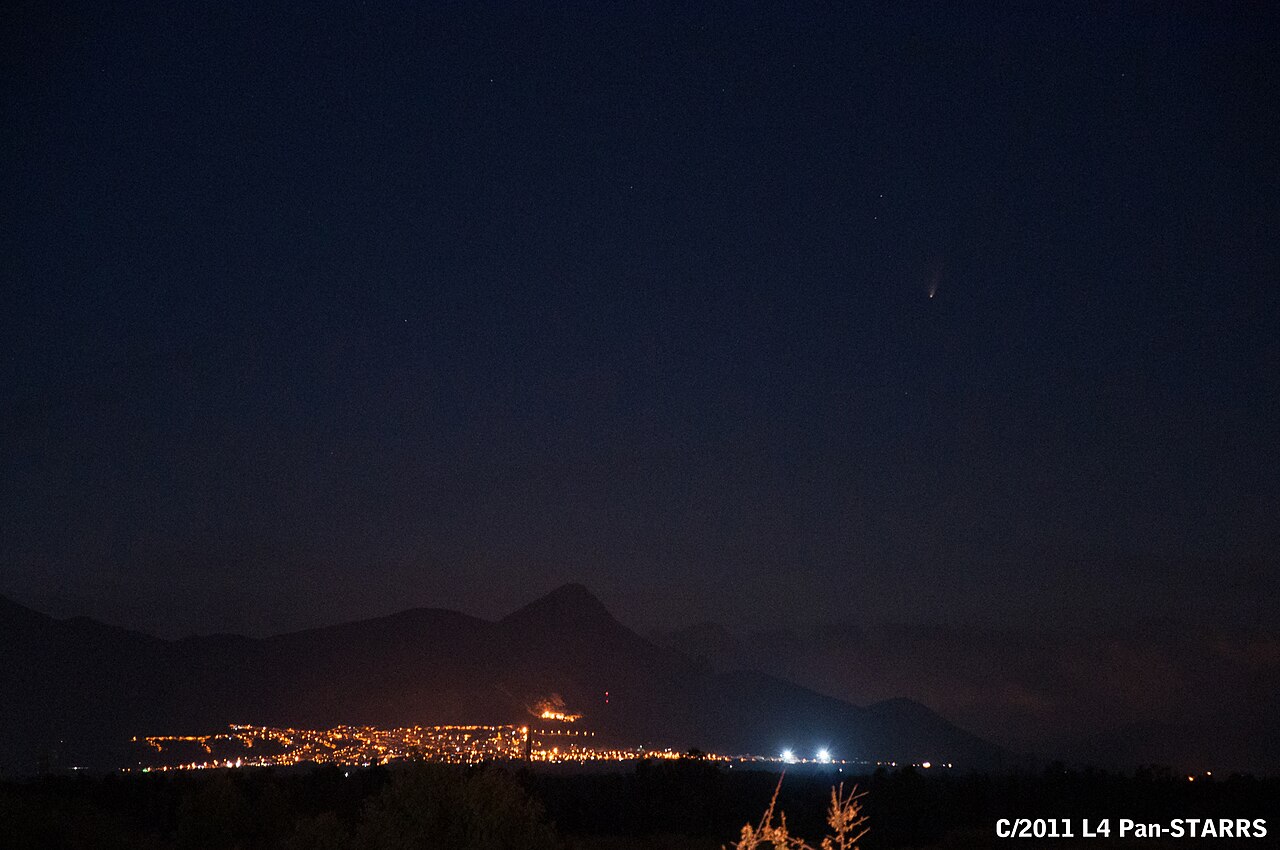
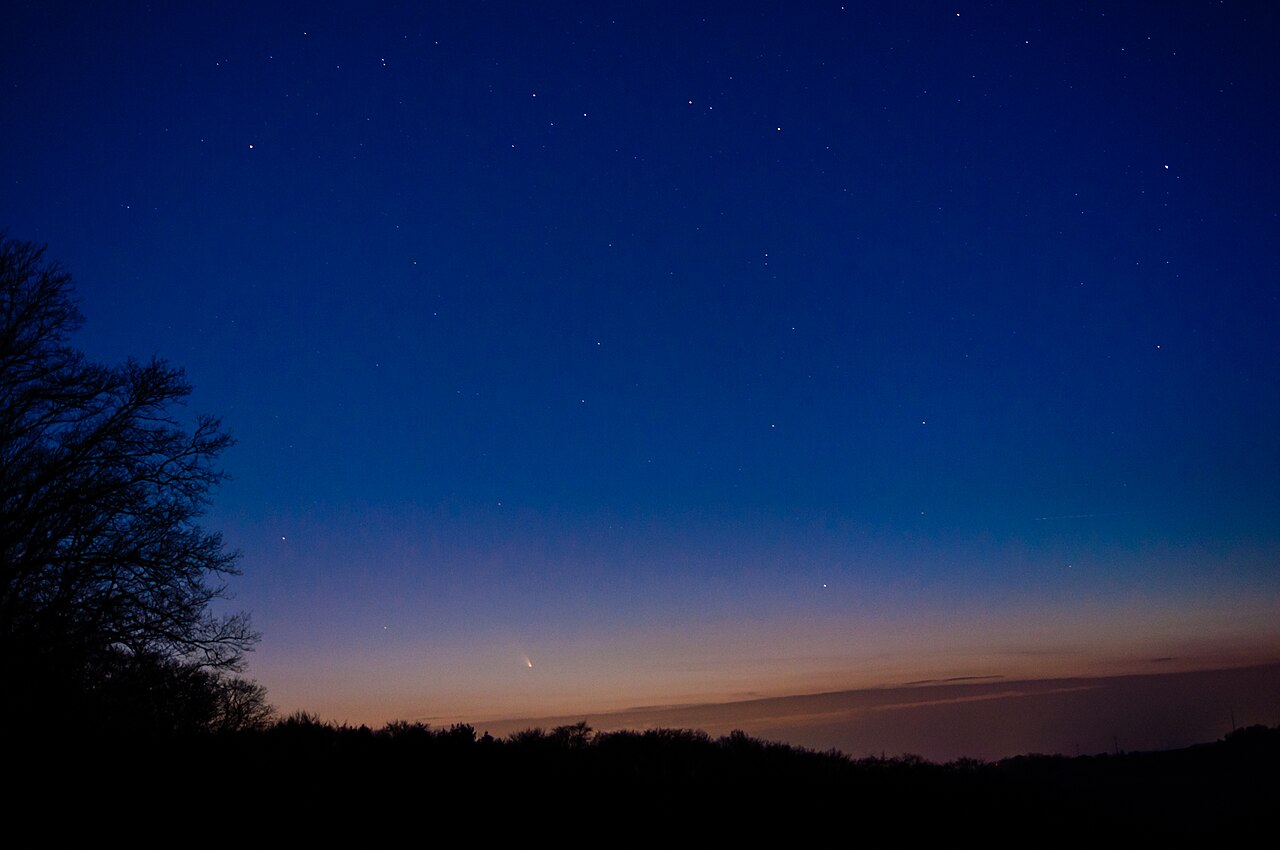
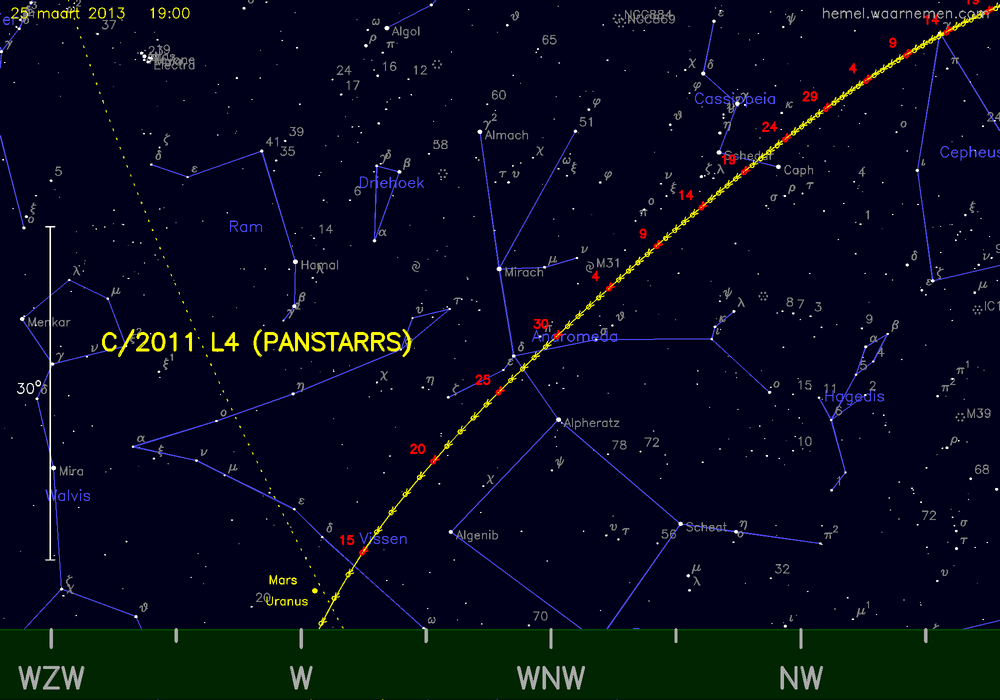
When perihelion arrived in March 2013, the actual peak magnitude was around +1, as reported by observers worldwide. However, the comet's low altitude above the horizon made these estimates difficult and uncertain, due to a lack of suitable reference stars and the need for corrections for atmospheric extinction. By mid-March, it was best seen in binoculars about 40 minutes after sunset, because of twilight and its low elevation. On 17–18 March, it passed near the 2.8-magnitude star Algenib (Gamma Pegasi). On 22 April, it was near Beta Cassiopeiae, and on 12–14 May, near Gamma Cephei. The comet continued moving north until 28 May. It may have had a sodium tail, similar to Comet Hale–Bopp.
Quick Facts
- Discoverer
- Pan-STARRS
- Discovery Date
- 6 June 2011
- Orbit Ref
- jpldata
- Epoch
- 20 March 2012 (JD 2456006.5)
- Observation Arc
- 3.27 years
- Obs
- 5413
- Orbit
- Oort cloud
- Aphelion
- 68000 AU (inbound) / 4500 AU (outbound)
- Perihelion
- 0.30161 AU (q)
- Eccentricity
- 1.000087
- Period
- Millions of years (inbound) / ~107,000 yr / (outbound solution for epoch 2050)
- Inclination
- 84.199°
Facts from the source article.
Lore & Background
Comet C/2011 L4 was still 7.9 AU from the Sun with an apparent magnitude of 19 when it was discovered in June 2011. By early May 2012, it had brightened to magnitude 13.5, and could be seen visually when using a large amateur telescope from a dark site. In October 2012, the coma was estimated to be about 120,000 kilometers in diameter. C/2011 L4 was spotted without optical aid on 7 February 2013 at a magnitude of ~6. It was visible from both hemispheres in the first weeks of March, and passed closest to Earth on 5 March 2013 at a distance of 1.09 AU. It came to perihelion on 10 March 2013.
Original estimates predicted that C/2011 L4 would brighten to roughly apparent magnitude 0, and an estimate in October 2012 predicted it might brighten to magnitude −4. In January 2013 there was a noticeable brightening slowdown suggesting it may only brighten to magnitude +1. During February the brightness curve showed a further slowdown suggesting a perihelion magnitude of around +2. A study using the secular light curve indicated that C/2011 L4 had a 'slowdown event' when it was 3.6 AU from the Sun at magnitude 5.6, and the estimated magnitude at perihelion was predicted as +3.5. The same study concluded that C/2011 L4 is very young and belongs to the class of 'baby comets' (photometric age less than 4 comet years). When it reached perihelion, the actual peak magnitude turned out to be around +1, though low altitude over the horizon made estimates difficult and subject to significant uncertainties.
As of mid-March 2013, due to the brightness of twilight and low elevation, C/2011 L4 was best seen in binoculars about 40 minutes after sunset. On 17–18 March it was near the 2.8-magnitude star Algenib (Gamma Pegasi). On 22 April it was near Beta Cassiopeiae. On 12–14 May it was near Gamma Cephei. It continued moving North until 28 May. The comet may have had a sodium tail as Comet Hale–Bopp had. Light curve measurements taken while the comet was in a brief, lesser active state between July and August 2013 revealed that it is a fast rotator, spinning once every five hours. It likely took millions of years to come from the Oort cloud; after leaving the planetary region, the post-perihelion orbital period (epoch 2050) is estimated to be roughly 107,000 years.
Reader's Guide
C/2011 L4 (PanSTARRS) is notable as a non-periodic comet that became visible to the naked eye near its March 2013 perihelion, despite significant uncertainties in brightness predictions. Its discovery in June 2011 using the Pan-STARRS telescope on Haleakalā, Hawaii, marked the beginning of a long observational campaign. The comet's brightness evolution was complex, with multiple slowdown events that led to a peak magnitude around +1, lower than early optimistic estimates of magnitude −4. This behavior, along with its classification as a 'baby comet' (photometric age less than 4 comet years), provides insight into the physical properties of comets recently arrived from the Oort cloud. The comet's nucleus size estimates vary, ranging from roughly 1 km to over 2.4 km, reflecting different measurement methods. Its fast rotation period of five hours was measured during a less active state in mid-2013. The comet's post-perihelion orbital period of roughly 107,000 years indicates it will not return for a very long time. Its visibility from both hemispheres in early March 2013, and its passage near stars such as Algenib, Beta Cassiopeiae, and Gamma Cephei, allowed widespread observation. The possible presence of a sodium tail, similar to Comet Hale–Bopp, adds to its scientific interest.
Did You Know?
- C/2011 L4 was discovered in June 2011 when it was 7.9 AU from the Sun with an apparent magnitude of 19.
- A study classified C/2011 L4 as a 'baby comet' with a photometric age of less than 4 comet years.
The Gigapixel Eye: Engineering Behind Pan-STARRS
The two 1.8-metre Ritchey–Chrétien telescopes perched atop Haleakalā on Maui carry an optical design that prioritises breadth over pinpoint resolution. Each instrument sweeps a three-degree field of view—a remarkably wide angle for a telescope of that aperture—allowing the system to capture vast swaths of sky in a single exposure. The heart of the system is a focal plane holding sixty separately mounted close-packed CCDs arranged in an eight-by-eight grid, with the four corner positions left empty because the optics never illuminate them. Every CCD, termed an Orthogonal Transfer Array, packs 4,800 by 4,800 pixels divided into sixty-four smaller cells, and together they produce images approaching 1.4 billion pixels. That gigapixel camera first recorded the Andromeda Galaxy on 22 August 2007. Typical exposures run thirty to sixty seconds, deep enough to reach apparent magnitude twenty-two, and each frame consumes roughly two gigabytes of storage. Five broad-band filters—g, r, i, z, and y—cover wavelengths from the blue through the near-infrared, with the z and y bands carefully trimmed to sidestep atmospheric water absorption features.
Covering the Sky: Survey Cadence and Data Volumes
The sheer scale of Pan-STARRS's nightly work is hard to overstate. Thanks to the wide field of view and short exposures, the system images roughly six thousand square degrees of sky every night. From Hawaii, about thirty thousand square degrees of the full celestial sphere are visible, meaning a complete all-sky pass takes approximately forty hours—roughly ten hours per night spread across four evenings. Because bright lunar phases must be avoided, the team schedules the full-sky sweep to repeat about four times each month, a cadence that was entirely unprecedented in astronomical surveying. By the close of PS1's initial three-year science mission in April 2014, the telescope had captured twelve images of every patch of sky in each of its five colour filters. The data pipeline is equally demanding: each image demands about two gigabytes of storage, and the continuous imaging schedule generates around ten terabytes of raw data every single night. In January 2019, the second Pan-STARRS data release went public at an astonishing 1.6 petabytes, making it the largest volume of astronomical data ever made available to the research community at that time.
A Global Partnership: Funding and Institutional Collaboration
Building and operating Pan-STARRS has never been a single-institution effort. The project is a collaboration among the University of Hawaiʻi Institute for Astronomy, MIT Lincoln Laboratory, the Maui High Performance Computing Center, and Science Applications International Corporation. The U.S. Air Force provided the primary construction funding, with the Air Force Research Laboratory playing a central role, while the NASA Near Earth Object Observation Program later supplied the money needed to finish Pan-STARRS2 and continues to fund most day-to-day telescope operations. The PS1 Science Consortium, which ran the all-sky survey until April 2014, drew together a remarkably international group: the Max Planck Society in Germany, National Central University in Taiwan, the universities of Edinburgh, Durham, and Queen's Belfast in the United Kingdom, Johns Hopkins and Harvard in the United States, and the Las Cumbres Observatory Global Telescope Network. The University of Hawaiʻi also received an $8.4 million contract modification to develop the telescope's data management system. Plans for a full four-telescope array, sometimes called PS4, carried an estimated total cost of one hundred million dollars, though funding difficulties left no clear timeline for completing the remaining instruments beyond the second telescope.
From Discovery to Defence: The NEO Mission
While Pan-STARRS was designed to catalogue moving and variable objects across the sky, its primary mission has increasingly centred on a more urgent task: identifying Near-Earth Objects that could pose an impact threat to Earth. The system is expected to build a comprehensive database of every object visible from Hawaii—roughly three-quarters of the entire sky—down to apparent magnitude twenty-four. The dedicated NEO survey searches all sky north of declination minus 47.5 degrees, sweeping for asteroids, comets, and other bodies whose orbits bring them close to our planet. The telescope's discovery record at Haleakalā includes the potentially hazardous Apollo-class asteroid (515767) 2015 JA2, first spotted on 13 May 2015 and formally credited to Pan-STARRS 2 by the Minor Planet Center in March 2018. The broader survey has also yielded numerous new asteroids, comets, variable stars, and supernovae by comparing each night's images against a database of known steady objects, flagging anything that has shifted position or changed brightness. Principal investigator Nick Kaiser captured the operational spirit of the project, noting that after six months of producing science-quality data, the team was imaging dusk-to-dawn every night, a rhythm that defined the survey's relentless pace.
Gallery
More in Named Comets, Part 5 1-24
Spotted an error? Know more?
Reader corrections go straight into our review queue. Suggest an edit · How this site is sourced