
Bhanumati (Yadava princess)
Yadava princess who married Sahadeva after rescue from a demon.

@PIB_India Press Information Bureau. Nodal agency for communicating to media on · CC BY-SA 4.0
Bhanumati is a figure mentioned in the Harivamsha, a supplementary text to the Mahabharata. She is described as the daughter of Bhanu, a prominent leader of the Yadava dynasty, and is introduced as a relative of Krishna. Her story, which involves abduction by a demon and subsequent rescue, leads to her marriage to Sahadeva, one of the Pandava princes.
Quick Facts
- Noinfo
- yes
- Family
- Bhanu (father)
- Spouse
- Sahadeva
- Series
- Harivamsha
- Origin
- Dvaraka
Facts from the source article.
Lore & Background
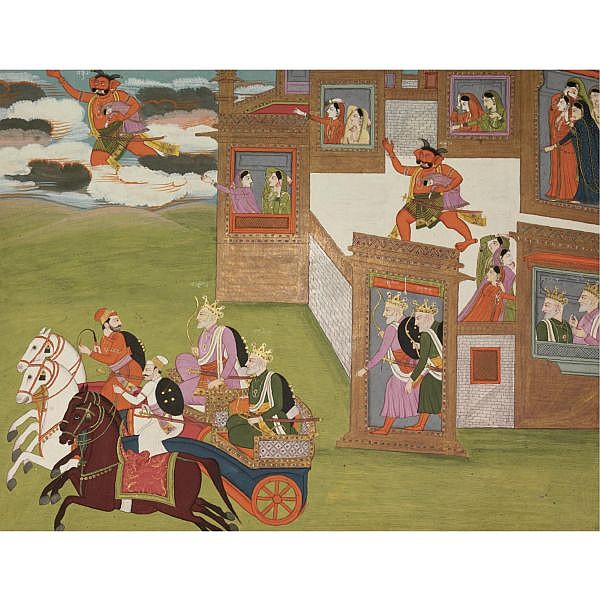
Following her abduction, Krishna, accompanied by Arjuna and Pradyumna, pursued Nikumbha. A fierce battle ensued, during which the three heroes sought to rescue Bhanumati without harming her. The demon used powerful illusions and formidable combat abilities, but was ultimately defeated when Krishna struck him with his mace (gada). After her rescue, Bhanumati was taken to Dvaraka. There, Narada reminded her father, Bhanu, of a prior arrangement or boon and advised him to give his daughter's hand in marriage to Sahadeva, the youngest of the Pandava brothers. Bhanu followed this counsel, and Bhanumati was married to Sahadeva in a ceremony attended by Krishna and other prominent figures.
Reader's Guide
Bhanumati's significance lies in her role within the Harivamsha, a text that expands on the life and lineage of Krishna. Her story, though absent from the Mahabharata, provides a narrative link between the Yadava dynasty and the Pandavas through her marriage to Sahadeva. The tale incorporates elements of divine intervention, curses, and heroic rescue, typical of Hindu epic literature. The Harivamsha itself is a substantial work, containing over 16,000 verses in its full form, though the Critical Edition contains only 5,965 verses. Bhanumati's narrative has also been adapted in later works, such as the 17th-century poem 'Bhanumati-parinayamu' by Reduri Rangaraju. Her story highlights the interconnectedness of the Yadava and Pandava families and the role of prophecy and curses in shaping events. As a figure who appears only in the Harivamsha, she represents the broader narrative scope of that text beyond the main Mahabharata story.
Did You Know?
- Bhanumati is mentioned only in the Harivamsha, not in the Mahabharata.
- She was abducted by the demon Nikumbha, typically due to his own desire or a boon, not a curse from Durvasas.
- Her rescue was led by Krishna, Arjuna, and Pradyumna.
- The 17th-century poet Reduri Rangaraju adapted her story in his poem 'Bhanumati-parinayamu'.
Textual Context and Literary Position
Bhanumati occupies a fascinating niche in Hindu literary tradition. Rather than appearing in the Mahabharata itself—where her future husband Sahadeva is paired only with Draupadi and Vijaya—she finds her narrative home in the Harivamsha, a substantial Sanskrit text that functions as both an appendix to the Mahabharata and, in many scholarly assessments, a standalone Purana. Composed to expand upon Krishna's life, ancestry, and divine exploits, the Harivamsha is organized into three major parvas and spans over sixteen thousand verses in its traditional form, though the Critical Edition condenses this to roughly five thousand nine hundred. Bhanumati's story is situated in Chapter 91 of the Vishnu Parva, where the text devotes particular attention to the Yadava dynasty. She is introduced as a relative of Krishna and the daughter of Bhanu, a prominent Yadava leader. Her very absence from the parent epic and presence in this supplementary work underscores how the Harivamsha serves as a space for dynastic elaboration and extended family narratives that the Mahabharata's tighter plot does not accommodate.
The Curse and Divine Intercession
At the heart of Bhanumati's story lies a curse that transforms her from a passive figure into the focal point of a dramatic narrative. According to the Harivamsha, she once offended the sage Durvasas while in the garden of Raivata. In response, the irate ascetic pronounced a curse that she would fall into the hands of an enemy. However, the tale does not end with this dark pronouncement. The sage Narada, along with other sages, intervened on Bhanumati's behalf, persuading Durvasas to soften the severity of his words. The tempered curse carried a crucial silver lining: although the abduction would still occur, Bhanumati would remain a virgin and physically unharmed throughout her captivity. Moreover, the sage assured that she would ultimately wed a virtuous and noble husband. This divine negotiation between the angry sage and the interceding deities sets the structural framework for everything that follows, ensuring that the abduction, however violent in its execution, remains a destined passage rather than a tragedy. The curse thus functions as both the inciting incident and the moral guarantee of Bhanumati's eventual union with Sahadeva.
Abduction and the Battle of Rescue
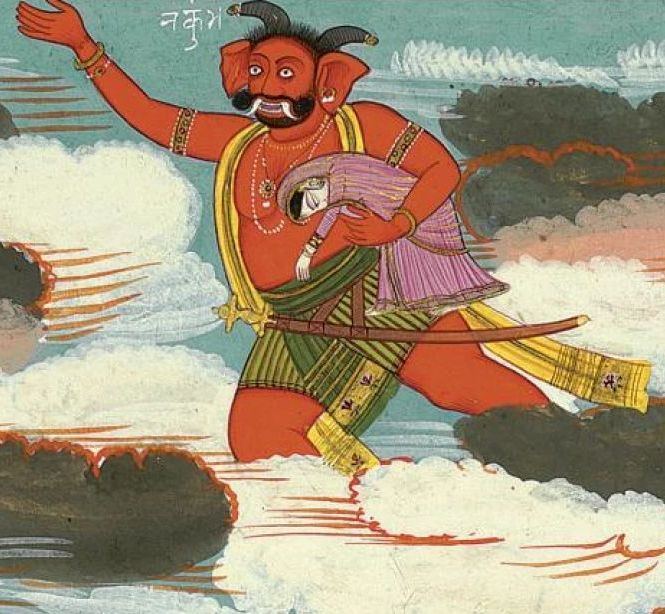
The abduction unfolds during a moment of collective vulnerability. The Yadavas were gathered at the palace of Pindaraka for a festive celebration, and it was in this atmosphere of revelry that the Danava Nikumbha struck. His motivation was deeply personal: Pradyumna, the son of Krishna, had previously slain Nikumbha's brother Vajranabha, and the demon sought retribution. Seizing upon the unguarded state of Bhanumati's garden, he carried her away. The response was swift and formidable. Krishna, accompanied by Arjuna and Pradyumna, pursued the demon into a fierce confrontation. The three heroes were determined to rescue Bhanumati without inflicting harm upon her, even as Nikumbha deployed powerful illusions and displayed formidable martial skill. The battle reached its climax when Krishna unleashed his Sudarshana Chakra, severing the demon's head and ending the threat. Bhanumati was then brought safely to Dvaraka, where the narrative pivots from action to the fulfillment of the sage's tempered prophecy.
Marriage, Lineage, and Later Adaptation
Following her safe return to Dvaraka, Bhanumati's story reaches its narrative resolution through marriage. Narada, ever the divine messenger, reminded her father Bhanu of the prophecy embedded in Durvasas's tempered curse and counseled him to bestow his daughter upon Sahadeva, the youngest of the Pandava brothers. Bhanu heeded this guidance, and the wedding ceremony was attended by Krishna and other prominent figures, lending the union a sense of dynastic and spiritual significance. Bhanumati's marriage thus bridges two of Hindu mythology's most celebrated lineages—the Yadavas and the Pandavas—reinforcing the interconnected family web that the Harivamsha so elaborately constructs around Krishna. Beyond the Sanskrit textual tradition, Bhanumati's story found new life in the seventeenth century through the Telugu poet Reduri Rangaraju, who composed Bhanumati-parinayamu, a poetic adaptation of her marriage narrative. This later retelling testifies to the enduring resonance of her tale across linguistic and temporal boundaries within the broader South Asian literary imagination.
Gallery


Frequently Asked Questions
Who is Bhanumati (Yadava princess)?
Bhanumati is a Yadava princess introduced in the Harivamsha's Vishnu Parva (Chapter 91) as the daughter of Bhanu, a leading figure of the Yadava clan. She is positioned as a kinswoman of Krishna and ultimately becomes the wife of Sahadeva, the youngest Pandava brother.
What is Bhanumati (Yadava princess)'s role in the mythological narrative?
Her role centers on being the object of a demon's abduction and the catalyst for a rescue episode that culminates in her marriage to Sahadeva. She does not wield independent powers in the text; her narrative function is to link the Yadava and Pandava lineages through this union.
Why is Bhanumati (Yadava princess) important to fans of mythological abduction tales?
She adds a lesser-known Yadava-side abduction episode to the broader Mahabharata-Harivamsha cycle, showing that such stories extend beyond the more famous princesses like Draupadi or Rukmini. Her rescue also reinforces the political bond between the Yadavas and the Pandavas.
Which demon abducted Bhanumati (Yadava princess)?
The Harivamsha identifies the abductor as Nikumbha, a rakshasa who seized her before she was rescued and married off to Sahadeva. No further details about Nikumbha's origin or fate are elaborated in the surviving passages.
More in Mythological kidnapped people 1-24
Spotted an error? Know more?
Reader corrections go straight into our review queue. Suggest an edit · How this site is sourced