Cupid (moon)
Small inner Uranian moon with an unstable orbit.
Last updated
Cupid is an inner satellite of Uranus, discovered in 2003 using the Hubble Space Telescope. It is one of the smallest known inner Uranian moons, with a diameter estimated at about 18 km, and its dark surface made it too dim for detection by the Voyager 2 cameras during the 1986 flyby. Cupid is named after a character in William Shakespeare's play Timon of Athens.
Last updated 2026-09-29 from the source article.
Background
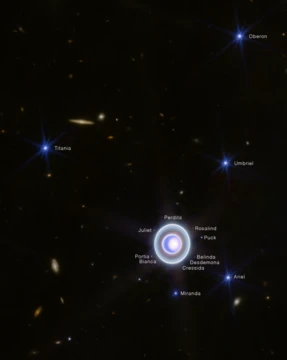
Cupid is a small inner moon of Uranus, roughly 18 kilometers across. It was spotted in 2003 by Mark R. Showalter and Jack J. Lissauer through the Hubble Space Telescope. The moon takes its name from a character in William Shakespeare's play Timon of Athens. Because of its tiny size and dark surface, Cupid was too faint for the Voyager 2 spacecraft to capture during its 1986 flyby of Uranus.
Its orbit lies just 863 kilometers from that of the larger moon Belinda. Unlike two other Uranian moons found in 2003, Mab and Perdita, Cupid does not seem to be disturbed by gravitational tugs. Even so, it has the most unstable orbit among Uranus's inner satellites. Over the next 100,000 to 10 million years, resonance effects are expected to push Cupid into a path that will likely end in a collision with Belinda.
Cupid is thought to be no older than 500 million years. It was first labeled S/2003 U 2 and later given the permanent designation Uranus XXVII.
More in Moons of Uranus
Related in Moons of Uranus and Neptune
Links follow this subject's own source article.
Elsewhere in Moons of Uranus and Neptune
Sources
Compiled from Wikipedia and the sources listed below. Text from Wikipedia is available under CC BY-SA 4.0; this entry is adapted from it.
- Wikipedia: Cupid (moon) (CC BY-SA 4.0).
Spotted an error? Know more?
Reader corrections go straight into our review queue. Suggest an edit · How this site is sourced