Belinda (moon)
Inner Uranian moon discovered by Voyager 2 in 1986.
Last updated
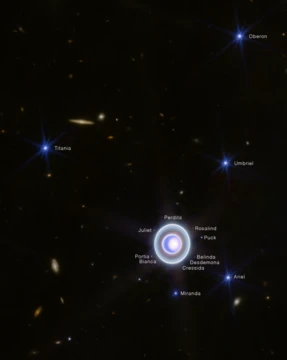
Belinda is one of Uranus’s inner moons. It was first spotted in images captured by Voyager 2 on January 13, 1986, and initially labeled S/1986 U 5. The moon takes its name from the heroine of Alexander Pope’s poem The Rape of the Lock, and it is also known as Uranus XIV.
Belinda is part of the Portia group, a cluster of satellites that includes Bianca, Cressida, Desdemona, Portia, Juliet, Cupid, Rosalind, and Perdita. All these moons share similar orbits and photometric characteristics. Within this group, Belinda orbits especially close to Cupid and Perdita.
Not much is known about Belinda beyond its orbit, its dimensions—128 km by 64 km (80 mi by 40 mi)—and its geometric albedo of 0.067. Voyager 2 images show it as an elongated body, with its long axis pointing toward Uranus. The moon is quite stretched: its short axis is only 0.5 ± 0.1 times the length of its long axis. Its surface appears grey.
Belinda is locked in a stable 44:43 mean-motion resonance with Perdita. From this resonance, its mass has been estimated to be about 26 or 27 times that of Perdita.
The Portia group is unstable over timescales of a few million years. A 2012 study suggested that Belinda and Cupid would likely be the first pair of moons to collide, within 100,000 to 10 million years, depending on the densities of the group’s satellites, due to resonant interactions with the much smaller Cupid.
However, a later analysis in 2022 indicated that Cupid’s orbit is protected by the 44:43 resonance between Belinda and Perdita, so Cupid might survive for at least 50 million years. Contradicting that, another 2022 study found that Belinda and Perdita were not in resonance, and that Cupid is unlikely to survive the next 50,000 years. A 2026 study then concluded that Belinda and Perdita are indeed in resonance.
Last updated 2026-09-29 from the source article.
Frequently Asked Questions
What is Belinda (moon)?
Belinda is a small inner satellite of Uranus, officially catalogued as Uranus XIV. It was first identified in Voyager 2 imagery in January 1986 and later given its permanent name.
What is the Portia group, and does Belinda belong to it?
The Portia group is a family of eight inner Uranian moons that share nearly identical orbital parameters and surface brightness. Belinda is a member of this cluster and orbits in close proximity to Cupid and Perdita.
More in Moons of Uranus
Related in Moons of Uranus and Neptune
Links follow this subject's own source article.
Elsewhere in Moons of Uranus and Neptune
Sources
Compiled from Wikipedia and the sources listed below. Text from Wikipedia is available under CC BY-SA 4.0; this entry is adapted from it.
- Wikipedia: Belinda (moon) (CC BY-SA 4.0).
Spotted an error? Know more?
Reader corrections go straight into our review queue. Suggest an edit · How this site is sourced