Puck (moon)
Largest inner moon of Uranus, discovered by Voyager 2.
Last updated
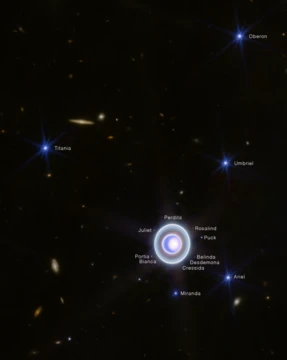
Among Uranus's moons, Puck ranks as the sixth-largest and is the biggest of the inner satellites.[1] Voyager 2's observations led to the detection of this moon in December 1985.[1] With a roughly spherical shape, Puck measures about 162 km across and its surface is dark and marked by many craters.[2]
Key facts and history
Puck is also designated Uranus XV.[3] With a radius of about 81 km, Puck is the largest inner moon of Uranus.[4] Puck's surface is grey in color and heavily cratered, with three named craters.[5] The largest crater on Puck is about 45 km in diameter.[5]
Puck's geometric albedo in visible light is approximately 10%.[5] Its leading hemisphere is about 10% brighter than its trailing hemisphere.[5] Images captured by Voyager 2 on 30 December 1985 allowed for the discovery of Puck.[1] In terms of size, Puck falls between Portia and Miranda.[6]
What the cited sources add
The dark material coating Puck's surface is probably made of rocks or radiation-processed organics.[7] Material spiralling inwards from Uranus's μ ring may coat Puck's leading hemisphere.[7] Puck is probably made of a mixture of water ice and rocks.[8] The absence of craters with bright rays implies Puck is not differentiated.[8]
A possible history for Puck includes being broken apart by a collision and then coming back together as a rubble pile.[8]
References
- Wikipedia, "Puck (moon)" (CC BY-SA 4.0), which cites: Smith Soderblom et al. 1986 (original not read by us) en.wikipedia.org
- Wikipedia, "Puck (moon)" (CC BY-SA 4.0), which cites: Karkoschka, Voyager 2001; Dumas Smith et al. 2003 (original not read by us) en.wikipedia.org
- Wikipedia, "Puck (moon)" (CC BY-SA 4.0), which cites: USGS: Planet and Satellite Names and Discoverers (original not read by us) en.wikipedia.org
- Wikipedia, "Puck (moon)" (CC BY-SA 4.0), which cites: Karkoschka, Voyager 2001 (original not read by us) en.wikipedia.org
- Wikipedia, "Puck (moon)" (CC BY-SA 4.0), which cites: Thomas Veverka et al. 1987; Karkoschka, Voyager 2001; Smith Soderblom et al. 1986; Karkoschka, Hubble 2001; Showalter Lissauer 2006; Karkoschka, Hubble 2001; Dumas Smith et al. 2003 (original not read by us) en.wikipedia.org
- Wikipedia, "Puck (moon)" (CC BY-SA 4.0), which cites: Karkoschka, Voyager 2001; Karkoschka, Voyager 2001 (original not read by us) en.wikipedia.org
- Wikipedia, "Puck (moon)" (CC BY-SA 4.0), which cites: Dumas Smith et al. 2003; Cartwright Beddingfield Nordheim 2021 (original not read by us) en.wikipedia.org
- Wikipedia, "Puck (moon)" (CC BY-SA 4.0), which cites: Cartwright Beddingfield Nordheim 2021; Belyakov, "JWST Spectrophotometry of the Small Satellites of Uranus and Neptune", The Planetary Science Journal, 2024-05-01, p. 119; Belyakov, "JWST Spectrophotometry of the Small Satellites of Uranus and Neptune", The Planetary Science Journal, 2024-05-01, p. 119; Smith Soderblom et al. 1986 (original not read by us) en.wikipedia.org
Each numbered sentence above was checked against the source it cites before publication. Sentences citing Wikipedia adapt text from the English Wikipedia article Puck (moon) (contributors), used under CC BY-SA 4.0; this entry is available under the same licence. Other sources were used for facts only; no text or images are copied from them.
More in Moons of Uranus
Elsewhere in Moons of Uranus and Neptune
Sources
Compiled from Wikipedia and the sources listed below. Text from Wikipedia is available under CC BY-SA 4.0; this entry is adapted from it.
- Wikipedia: Puck (moon) (CC BY-SA 4.0).
Spotted an error? Know more?
Reader corrections go straight into our review queue. Suggest an edit · How this site is sourced