Perdita (moon)
A small Uranian moon with a complicated discovery history.
Last updated
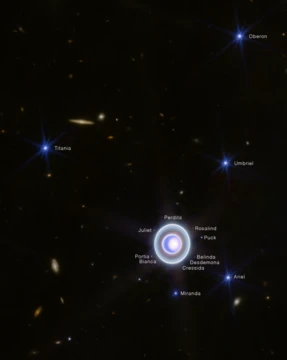
Perdita is a small inner satellite of Uranus. Its discovery was notably complicated: first photographed by the Voyager 2 spacecraft in 1986, it was not recognized from those images for more than a decade. It was noticed and reported by Erich Karkoschka in 1999, but because no further pictures could be taken to confirm its existence, it was officially demoted in 2001. In 2003, pictures from the Hubble Space Telescope finally confirmed its existence.
Last updated 2026-09-29 from the source article.
Background
Perdita's discovery was very complicated. The first photographs were taken by the Voyager 2 spacecraft in 1986, but the moon was not recognized from them for more than a decade.
In 1999, Erich Karkoschka noticed it and reported it, leading to the temporary designation S/1986 U 10. However, because no further pictures could be taken to confirm its existence, it was officially demoted in 2001. In 2003, the Hubble Space Telescope managed to pick up an object where Perdita was supposed to be, finally confirming its existence.
Perdita was named after the daughter of Leontes and Hermione in William Shakespeare's play The Winter's Tale; Perdita is Latin for 'lost'. The moon orbits between Belinda and Puck.
Hubble measurements showed that Perdita does not follow a direct Keplerian motion around Uranus; instead, it is caught in a 43:44 orbital resonance with Belinda, from which Belinda's mass was determined to be roughly 26 or 27 times that of Perdita. It is also close to an 8:7 resonance with Rosalind. A 2022 study found that Perdita and Belinda were not actually in resonance, but two other studies contradicted this, finding that the resonance does exist and is stable.
Perdita belongs to the Portia group of satellites, which also includes Bianca, Cressida, Desdemona, Portia, Juliet, Cupid, Rosalind, and Belinda. These satellites have similar orbits and photometric properties. Little is known about Perdita apart from its orbit and intrinsic brightness. By assuming its geometric albedo is similar to that of the other Portia group members, its radius can be estimated at 13.3 km.
Frequently Asked Questions
What is Perdita (moon)?
Perdita is a tiny inner satellite of Uranus with an estimated radius of about 13.3 km, carrying the official designation Uranus XXV. It belongs to the group of small moons that circle close to the planet.
How was Perdita discovered?
The moon was first captured in Voyager 2 images during the 1986 flyby but went unnoticed for over a decade. Erich Karkoschka finally identified it in those archived photographs in 1999, and it was initially given the temporary label S/1986 U 10.
Why was Perdita demoted in 2001 and later restored?
After the 1999 identification, no new imagery could be obtained to verify the object, so its confirmed status was revoked in 2001. Hubble Space Telescope pictures taken in 2003 provided the independent confirmation that brought Perdita back onto the official list.
More in Moons of Uranus
Elsewhere in Moons of Uranus and Neptune
Sources
Compiled from Wikipedia and the sources listed below. Text from Wikipedia is available under CC BY-SA 4.0; this entry is adapted from it.
- Wikipedia: Perdita (moon) (CC BY-SA 4.0).
Spotted an error? Know more?
Reader corrections go straight into our review queue. Suggest an edit · How this site is sourced