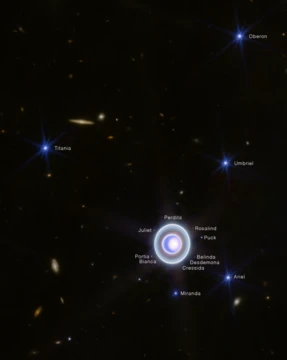
Francisco (moon)
Innermost irregular moon of Uranus, discovered in 2001.
Last updated
Francisco, also known as Uranus XXII and previously as S/2001 U 3, is the innermost known irregular moon of Uranus. It was discovered on 13 August 2001 by a team of astronomers at Cerro Tololo Inter-American Observatory in Chile and is named after a lord in William Shakespeare's play The Tempest. Francisco is notable for its retrograde orbit and for being one of the first Uranian irregular moons identified in the 2001 survey.
Last updated 2026-09-29 from the source article.
Background
Francisco was discovered on 13 August 2001 by astronomers JJ Kavelaars, Matthew J. Holman, Dan Milisavljevic, and Tommy Grav using the 4-meter Víctor M. Blanco Telescope at Cerro Tololo Inter-American Observatory in Chile. The team identified Francisco and three other Uranian irregular moons (Trinculo, Ferdinand, and Margaret) in telescope images processed with the shift-and-add technique. Follow-up observations to determine its orbit were conducted at Palomar Observatory and the Very Large Telescope at Paranal Observatory, lasting until 5 September 2002. The Minor Planet Center announced the discovery on 6 October 2003.
Francisco orbits Uranus at an average distance of 4.3 million km (2.7 million mi) and takes about 267 Earth days to complete one orbit. Its orbit is retrograde, moving opposite to Uranus's orbit around the Sun, with an average eccentricity of 0.14 and an average inclination of 147° relative to the ecliptic. Over a 10,000-year span, perturbations cause its semi-major axis to vary by ±700 km and its orbital period by ±1 day. Francisco is not known to be part of any collisional family; its orbit appears unique among known Uranian irregular moons.
Physically, Francisco is estimated to have a diameter of 22 km (14 mi), based on an assumed low albedo of 0.04 typical of other Uranian irregular moons. Its surface is expected to be dark, composed of water ice, hydrated silicates, and organic compounds. The moon has not been studied up close by any spacecraft, though Voyager 2 passed within 2.4 million km of it during its 1986 Uranus flyby.
Frequently Asked Questions
What is Francisco (moon)'s orbit like?
Francisco circles Uranus in a retrograde path at a mean distance of roughly 4.3 million kilometers, taking about 267 Earth days to complete one revolution. That backward orbital direction is characteristic of irregular moons thought to have been gravitationally captured from the outer solar system.
Why is Francisco (moon) called Francisco?
The name honors a lord character from Shakespeare's comedy The Tempest, in line with the tradition of naming Uranian moons after figures from his works. It replaced the earlier provisional designation S/2001 U 3 once the discovery was confirmed and published.
More in Moons of Uranus
Elsewhere in Moons of Uranus and Neptune
Sources
Compiled from Wikipedia and the sources listed below. Text from Wikipedia is available under CC BY-SA 4.0; this entry is adapted from it.
- Wikipedia: Francisco (moon) (CC BY-SA 4.0).
Spotted an error? Know more?
Reader corrections go straight into our review queue. Suggest an edit · How this site is sourced