Mab (moon)
Source of Uranus's blue μ ring, a tiny icy moon.
Last updated
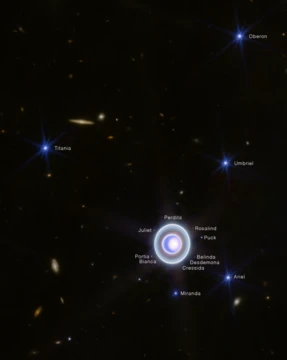
Mab, also designated Uranus XXVI, is an inner satellite of Uranus discovered in 2003 using the Hubble Space Telescope. It is notable as the source of the μ ring, a dusty ring around Uranus, and is the outermost of the planet's inner moons. Its physical size is among the smallest of the Uranian satellites, and it likely has an ice-rich surface comparable to that of Miranda.
Last updated 2026-09-29 from the source article.
Background
Mab was discovered by Mark R. Showalter and Jack J. Lissauer in 2003 using the Hubble Space Telescope. It was named after Queen Mab, a fairy queen from English folklore mentioned in William Shakespeare's play Romeo and Juliet.
Because the moon is very small, it was not seen in images taken by Voyager 2 during its Uranus flyby in 1986, though it is brighter than another moon, Perdita, which was discovered from Voyager's photos in 1997. This led scientists to re-examine the old photos, and the satellite was finally found in the images. Following its discovery, Mab was given the temporary designation S/2003 U 1.
Mab orbits between the moons Puck and Miranda and is the outermost inner moon of Uranus. It orbits at the same distance from Uranus as the μ ring, a dusty ring discovered around the same time. The μ ring is blue in colour, attributed to the small size of the particles rather than the material's intrinsic colour, and is the only blue ring in the Solar System known other than Saturn's E Ring. Mab is presumably the source of this ring, likely composed of small water ice particles lifted off Mab's surface by micrometeoroid impacts.
The moon is nearly the optimal size for dust production, as larger moons can recollect escaping dust and smaller moons have too small surface areas. No rings associated with Perdita and Cupid have been found, probably because Belinda limits the lifetimes of dust they generate. Mab's orbit was thought to be heavily perturbed, with its location shifting by 100 km in as little as six days, but later it was found that the apparent orbital variation was due to an instrumental error.
Mab's size is not precisely known and has not been measured; it is inferred by assuming the albedo to be similar to that of Puck or Miranda. If as dark as Puck (albedo 10%), it would be about 12 km in radius; if as bright as Miranda (albedo 46%), it would have a radius of 6 km. A 2006 study using the Keck telescope failed to detect Mab in the near-infrared (2.2 μm), hypothesizing it was covered in ice, making its radius 6–8 km. Another group in 2019 again failed to find Mab at ~1.6 μm, proposing that non-detection could be explained by water ice absorption bands.
Infrared observations in 2023 finally detected Mab in the near-infrared with the Keck telescope, using the shift-and-stack method, favouring a 6 km radius body with a brighter, Miranda-like surface rich in water ice, though it could not fully exclude a 12 km radius body with a dark, Puck-like surface. Mab appears spectrally blue, like Miranda, indicative of water ice, and its spectral slope is the only one among the inner moons of Uranus similar to Miranda's.
Frequently Asked Questions
Who discovered Mab (moon) and how?
Mark R. Showalter and Jack J. Lissauer identified the moon in 2003 using images captured by the Hubble Space Telescope. It was first logged under the temporary label S/2003 U 1 before being given its permanent name.
Where does Mab (moon) sit in Uranus's moon system?
Mab orbits in a narrow band between Miranda and Puck, placing it at the outer edge of Uranus's inner satellite family. This position is what gives it the role of anchoring the μ ring.
More in Moons of Uranus
Elsewhere in Moons of Uranus and Neptune
Sources
Compiled from Wikipedia and the sources listed below. Text from Wikipedia is available under CC BY-SA 4.0; this entry is adapted from it.
- Wikipedia: Mab (moon) (CC BY-SA 4.0).
Spotted an error? Know more?
Reader corrections go straight into our review queue. Suggest an edit · How this site is sourced