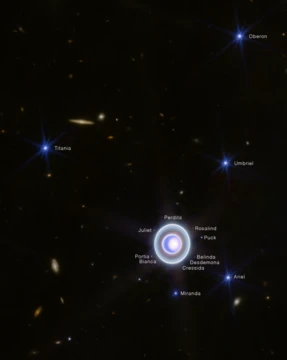
Miranda (moon)
Uranus's innermost round moon with extreme topography.
Last updated
Among Uranus's five round satellites, Miranda is both the one with the smallest size and the one that orbits closest to the planet.[1] Gerard Kuiper discovered Miranda on 16 February 1948 using the 82-inch Otto Struve Telescope at McDonald Observatory in Texas.[1][2] Verona Rupes, a scarp roughly 20 km high that could be the tallest cliff in the Solar System, is part of Miranda's extreme and highly varied topography.[3]
Key facts and history
Miranda's rotation period and its 34-hour orbital period are synchronous, so the same hemisphere always faces Uranus.[4] For a satellite so near its planet, Miranda's orbital inclination of 4.34° is remarkably large.[4] Miranda's equatorial diameter exceeds its polar diameter by 3%, making it the least spherical of Uranus's satellites.[5] The Voyager 2 flyby on 24 January 1986 provided nearly all existing knowledge about Miranda's geology and geography.[6]
What the cited sources add
The space.com account describes Miranda as resembling Frankenstein's monster, a bizarre jumble of parts that didn't quite merge properly.[7] Researchers suggest that constant squeezing and stretching from Uranus caused the moon's insides to heat up and churn.[7] Three-dimensional computer simulations revealed tidal forces would generate about 5 gigawatts of heat, 2.5 times the peak power output of the Hoover Dam.[7] This heat would cause Miranda's icy mantle to churn with convection much like Earth's mantle of hot rock does.[7]
The Planetary Society notes that Voyager 2 flew past Uranus in January 1986.[8] NASA's 2013-2022 decadal survey favored Uranus over Neptune due to more convenient planetary alignments affecting travel times.[8] The same source states that Uranus has five large moons: Miranda, Ariel, Umbriel, Titania, and Oberon.[8]
References
- Wikipedia, "Miranda (moon)" (CC BY-SA 4.0), which cites: Kuiper 1949 (original not read by us) en.wikipedia.org
- Wikipedia, "Miranda (moon)" (CC BY-SA 4.0), which cites: Kuiper 1949; Otto 2014; Kuiper 1949 (original not read by us) en.wikipedia.org
- Wikipedia, "Miranda (moon)" (CC BY-SA 4.0), which cites: Chaikin, "Birth of Uranus' provocative moon still puzzles scientists", space.com, 2001-10-16, p. 2; "APOD: 2016 November 27 - Verona Rupes: Tallest Known Cliff in the Solar System", apod.nasa.gov (we also read that source) en.wikipedia.org
- Wikipedia, "Miranda (moon)" (CC BY-SA 4.0), which cites: Williams, "Uranian Satellite Fact Sheet", NASA (National Space Science Data Center), 2007-11-23; Moons Henrard 1994; Tittemore Wisdom 1989; Malhotra Dermott 1990 (original not read by us) en.wikipedia.org
- Wikipedia, "Miranda (moon)" (CC BY-SA 4.0), which cites: Smith 1986; E. Burgess, "Uranus and Neptune: The Distant Giants", Columbia University Press, 1988; S.K. Croft, "Uranus", University of Arizona Press, 1991, p. 309–319; Lindy Elkins-Tanton, "Uranus, Neptune, Pluto and the Outer Solar System", Facts On File, 2006 (we also read that source) en.wikipedia.org
- Wikipedia, "Miranda (moon)" (CC BY-SA 4.0), which cites: Scobel 2005; E. Burgess, "Uranus and Neptune: The Distant Giants", Columbia University Press, 1988; Stone, "The Voyager 2 Encounter with Uranus", Journal of Geophysical Research, December 30, 1987, p. 14,873–14,876; R. H. Brown, "Uranus", University of Arizona Press, 1990, p. 513–528; Miner, 1990, pp. 309-319; Vision and Voyages for Planetary Science in the Decade 2013–2022; Revisiting the ice giants: NASA study considers Uranus and Neptune missions. Jason Davis. The Planetary Society. 21 June 2017. (we also read that source) en.wikipedia.org
- Chaikin, "Birth of Uranus' provocative moon still puzzles scientists", space.com, 2001-10-16, p. 2. facts only, no text reused. space.com
- Revisiting the ice giants: NASA study considers Uranus and Neptune missions. Jason Davis. The Planetary Society. 21 June 2017.. facts only, no text reused. planetary.org
Each numbered sentence above was checked against the source it cites before publication. Sentences citing Wikipedia adapt text from the English Wikipedia article Miranda (moon) (contributors), used under CC BY-SA 4.0; this entry is available under the same licence. Other sources were used for facts only; no text or images are copied from them.
More in Moons of Uranus
Elsewhere in Moons of Uranus and Neptune
Sources
Compiled from Wikipedia and the sources listed below. Text from Wikipedia is available under CC BY-SA 4.0; this entry is adapted from it.
- Wikipedia: Miranda (moon) (CC BY-SA 4.0).
Spotted an error? Know more?
Reader corrections go straight into our review queue. Suggest an edit · How this site is sourced